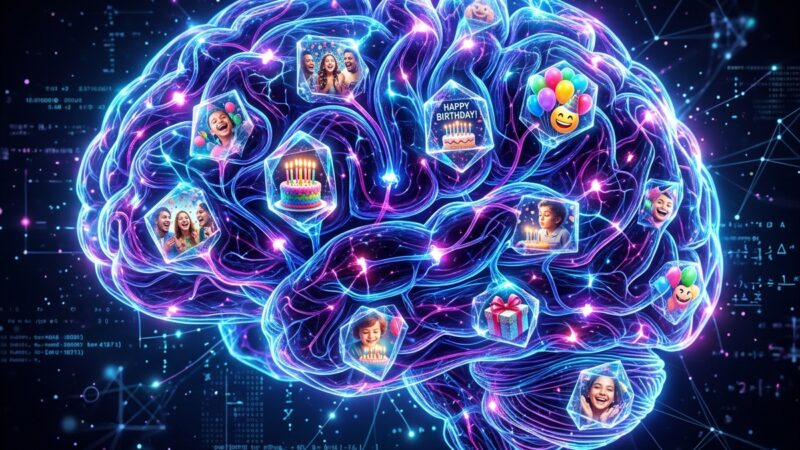
You were four years old. Someone placed a cake in front of you. The candles flickered. Everyone sang. And somehow — decades later — you can still feel the warmth of that moment.
But here’s what’s strange: you can’t remember what you ate for lunch last Tuesday.
The science behind birthday memories is genuinely fascinating because it reveals how selective your brain really is. It doesn’t store everything. It picks favorites. And birthday memories? They’re almost always on that VIP list.
So why do we remember birthdays so vividly? What makes your brain decide that your 7th birthday party deserves permanent storage, while thousands of ordinary days just vanish? The answer sits at the intersection of neuroscience, emotion, and something psychologists call “self-referential processing.”
Let’s break it all down — no jargon, no textbook language. Just the real stuff your brain is doing behind the scenes every time you blow out those candles.
How Your Brain Creates Memories (A Quick Primer)
Before we talk about birthday memories specifically, you need to understand how your brain forms any memory at all.
Your brain doesn’t record life like a camera. It’s more like a painter working from impressions. Every experience goes through a filtering process, and only certain moments get “painted” into long-term storage.
Here’s the simplified version of how it works:
- Encoding: Your senses pick up information — sights, sounds, smells, textures.
- Consolidation: Your hippocampus (a small, seahorse-shaped region deep in your brain) processes this information and decides what’s worth keeping.
- Storage: If something passes the test, it gets distributed across different areas of your cortex for long-term keeping.
- Retrieval: When you “remember,” your brain reconstructs the memory from these scattered pieces.
The key word here is decides. Your hippocampus doesn’t keep everything. It prioritizes based on specific criteria — and birthday experiences hit almost every single one of those criteria.
Quick Fact: According to research published in the journal Cognition and Emotion, emotionally charged events are remembered with roughly 50% more accuracy than neutral ones. Birthdays are basically emotion factories.
Why Birthday Memories Are So Powerful: The Emotional Factor
The single biggest reason birthday memory psychology is so interesting? Emotion.
Your brain has a built-in rule: if it made you feel something strong, it’s worth remembering.
This isn’t random. It’s evolution. Our ancestors needed to remember emotionally significant events — danger, joy, social bonding — to survive. The amygdala, your brain’s emotional processing center, works directly with the hippocampus during memory formation.
When you experience strong emotions, your amygdala essentially tells your hippocampus: “Hey, pay attention. This matters. Store this one carefully.”
And birthdays? They’re loaded with emotions:
- Joy from gifts, attention, and celebration
- Anticipation building up for days or weeks
- Love from family and friends gathering around you
- Sometimes sadness — a birthday that went wrong, or someone who was missing
Even negative birthday memories stick precisely because the emotional charge is high. That’s why some people feel emotional on their birthday in ways they can’t fully explain — their brain is processing layers of stored emotional data.
The Role of Dopamine
There’s a neurochemical angle too. When you’re happy and excited — like a child opening presents — your brain releases dopamine. This neurotransmitter doesn’t just make you feel good. It also strengthens the neural pathways involved in memory consolidation.
Think of dopamine as a highlighter pen for your brain. It marks certain moments as “important — keep this.”
Birthday celebrations are basically dopamine delivery systems: surprises, gifts, special food, laughter, attention. Every single one of those triggers a dopamine response.
The “Self-Reference Effect” — Why YOUR Birthday Feels Extra Special
Here’s something really interesting from cognitive psychology.
Your brain remembers information better when it’s about you. Psychologists call this the self-reference effect, and it was first documented by researchers Rogers, Kuiper, and Kirker back in 1977.
The concept is simple: if something is personally relevant to you, your brain processes it more deeply. And what’s more personally relevant than the one day of the year that’s literally designated as yours?
On your birthday:
- People say your name repeatedly
- The celebration is centered around you
- Gifts are chosen specifically for you
- Songs are sung to you
This intense self-focus activates areas of the medial prefrontal cortex — the brain region associated with self-reflection and identity. And when this region is active during an experience, memory encoding gets significantly stronger.
That’s a big part of why people love their birthdays so much. It’s not just vanity. Your brain is literally wired to pay extra attention when something is about you.
Pro Tip: This is also why personalized birthday experiences create stronger memories than generic ones. A personalized birthday gift doesn’t just feel nice — it actually embeds deeper into the recipient’s memory.
Sensory Memory: Why You Can Still Smell That Birthday Cake
Close your eyes and think about a childhood birthday. What comes to mind first?
For most people, it’s not a fact or a date. It’s a sensation. The smell of cake. The taste of frosting. The sound of everyone singing. The feeling of wrapping paper under your fingers.
This is sensory memory at work, and it’s one of the most powerful aspects of the science behind birthday memories.
The Proust Effect
You’ve probably experienced this: a random smell suddenly transports you back to a specific moment from years ago. Scientists call this the Proust Effect (named after French author Marcel Proust, who wrote about a cookie smell triggering a flood of childhood memories).
Here’s why it works: your olfactory bulb (the brain structure that processes smell) sits right next to the hippocampus and amygdala. Smell has the most direct neural pathway to your memory and emotion centers compared to any other sense.
Birthday celebrations are multi-sensory events:
- Smell: Cake, candles, specific foods
- Taste: Frosting, special birthday meals, candy
- Sound: “Happy Birthday” song, laughter, cheering
- Sight: Candles glowing, decorations, faces of loved ones
- Touch: Hugging people, unwrapping gifts, blowing out candles
Each sensory input creates a separate memory thread. When your brain stores a birthday memory, it weaves all these threads together into a rich, detailed tapestry. That’s why birthday memories often feel more vivid and “real” than memories of ordinary days.
The history of birthday cakes and candles is actually deeply connected to this. These traditions have survived for centuries partly because they create such strong sensory anchors in our memory.
The “Flashbulb Memory” Connection
In 1977, psychologists Roger Brown and James Kulik introduced the concept of flashbulb memories — vivid, detailed snapshots of moments when you learned about surprising or emotionally significant events.
Originally, they studied this with major public events (like people remembering exactly where they were when JFK was shot). But the same mechanism applies to personal milestones.
A birthday that included a genuine surprise? Your brain treats it similarly to a major life event.
What Triggers a Flashbulb-Level Birthday Memory?
Not every birthday becomes a flashbulb memory. Research suggests certain conditions make it more likely:
- Surprise element — An unexpected guest, an unexpected gift, a surprise party
- High emotional intensity — Tears of joy, overwhelming happiness, or even disappointment
- Personal significance — A milestone birthday like turning 18, 21, 30, or 50
- Social sharing — Talking about the event afterward with others reinforces the memory
- Novelty — Something that happened for the first time
Did You Know? Research from Emory University (2016) found that memories discussed socially within 48 hours of an event are retained significantly longer. This is why sharing birthday posts on social media might actually strengthen your birthday memories — you’re rehearsing the experience through retelling.
Why Childhood Birthday Memories Feel Stronger
Ask anyone about their most vivid birthday memory, and there’s a good chance they’ll describe something from childhood. There’s a real neurological reason for this.
The “Reminiscence Bump”
Cognitive psychologists have identified something called the reminiscence bump — a phenomenon where adults recall a disproportionate number of memories from ages 10 to 30. Memories from this period tend to be stronger, more detailed, and more emotionally charged.
Why? Several reasons overlap:
- Brain development: During childhood and adolescence, your brain’s memory systems are developing rapidly. The hippocampus is highly plastic, forming connections easily.
- Novelty factor: As a child, everything is new. Your first bicycle, your first surprise party, your first double-digit birthday — these are all “firsts,” and your brain gives special priority to novel experiences.
- Identity formation: Birthdays during ages 10-25 coincide with the period when you’re forming your identity. Events connected to your developing sense of self get stored with extra care.
- Higher emotional intensity: Let’s be honest — kids get way more excited for birthdays than adults. That excitement translates directly into stronger memory encoding.
Why Adult Birthday Memories Feel Blurry
As you age, birthdays start blending together. Your 34th and 35th birthdays might feel almost identical in memory. There’s a scientific term for this too: routine compression.
When your brain encounters repetitive, similar experiences, it doesn’t waste resources storing each one individually. It creates a “generic template” instead. So unless something truly unusual happened on your 34th birthday, it just gets filed under “generic adult birthday” in your brain’s archives.
This is also connected to why birthdays feel faster as you age. Fewer novel experiences mean less distinct memory formation, which makes time feel like it’s speeding up.
Social Connection and Birthday Memory Formation
Here’s something the science makes abundantly clear: memories formed in social contexts are stronger than memories formed alone.
A 2017 study published in Nature showed that shared experiences activate the brain’s reward circuitry more intensely than solo experiences. The presence of other people — especially people you care about — amplifies emotional processing during an event.
Birthday celebrations are inherently social:
- Family gathering around you
- Friends showing up specifically for you
- Group activities — singing, eating, playing
- Shared laughter and stories
- Physical touch — hugs, pats on the back
Each of these social interactions triggers oxytocin release (the “bonding hormone”), which further strengthens memory consolidation.
This also explains why some birthday memories are painful. If nobody showed up, if a friend forgot, or if a key person was absent — the social expectation of togetherness makes the disappointment cut deeper. And painful birthday memories stick just as hard as joyful ones.
Interestingly, different cultures celebrate birthdays in wildly different ways, but the social bonding element is almost universal. The rituals differ, but the brain science stays the same.
Memory Distortion: Your Birthday Memories Might Not Be Accurate
Here’s a twist that might make you uncomfortable: your birthday memories probably aren’t 100% accurate.
Memory researcher Elizabeth Loftus (University of California, Irvine) has spent decades demonstrating that human memories are reconstructive, not reproductive. Every time you recall a memory, your brain doesn’t play back a recording. It rebuilds the memory from scratch — and each rebuild introduces small changes.
How Birthday Memories Get Distorted
- Photos and videos replace real memory: You might “remember” a childhood birthday party, but what you’re actually recalling is the photograph you’ve seen dozens of times. Studies show that viewing photos of past events can create false memories — you start “remembering” details that only existed in the photo, not in your actual experience.
- Family storytelling reshapes memories: When your mom tells the story of your 5th birthday every year, her version slowly overwrites your original memory. You adopt her perspective, her details, her emotions.
- Emotional state during recall: If you’re feeling nostalgic, you’ll remember birthdays as warmer and happier than they might have actually been. If you’re sad, you’ll recall the disappointing parts more vividly.
Quick Fact: A study in Psychological Science (2013) found that roughly 40% of people’s earliest memories are at least partially fabricated. So that “first birthday memory” you have? There’s a decent chance parts of it never happened exactly that way.
This doesn’t make your memories less valuable. It just means they’re more like living paintings than frozen photographs — they change a little every time you look at them.
Birthday photos matter to people partly for this reason — they serve as external anchors that help stabilize memories that would otherwise drift over time.
Why Some Birthdays Are Forgotten Entirely
If birthdays are so memorable, why can’t you remember all of yours?
The truth is, most people can only recall 10-15 specific birthdays out of their entire lifetime. The rest just disappear.
Here’s why certain birthdays get erased:
- Low emotional intensity: A quiet, uneventful birthday doesn’t trigger the amygdala enough to get prioritized.
- No novelty: If it felt like every other birthday, your brain filed it under the generic template.
- Stress or distraction: If you were going through a tough period, your brain’s resources were allocated to dealing with stress, not forming celebratory memories.
- No social reinforcement: Nobody talked about it afterward. No photos were shared. No stories were retold.
- Age-related factors: Memories from very early childhood (before age 3-4) are almost always lost due to childhood amnesia — a phenomenon caused by the immature state of the hippocampus in early life.
Understanding why people remember some birthdays and forget others is actually a practical application of these memory science principles. It’s not random. Your brain follows rules — even when it feels like it doesn’t.
Common Myths About Birthday Memories
Let’s clear up a few misconceptions that float around:
Myth 1: “I have a perfect memory of my 2nd birthday”
Almost certainly not. Childhood amnesia affects memories before age 3-4 in most people. What you’re likely recalling is a reconstruction based on photos and family stories, not an actual episodic memory.
Myth 2: “Bad birthday memories prove I had a bad childhood”
Not necessarily. Negative memories are stored more efficiently than positive ones (a principle called negativity bias). Your brain prioritizes threats and disappointments for survival reasons. One bad birthday memory doesn’t define your childhood — it just means your brain did its job.
Myth 3: “If I don’t remember a birthday, it wasn’t important”
That’s not how memory works. Your brain’s storage decisions are based on neurochemical conditions at the time — not on the actual importance of the event. You might have had the best birthday of your life at age 12 but forgot it because you didn’t sleep well that night (sleep is critical for memory consolidation).
Myth 4: “Taking lots of photos helps me remember better”
Partially true, but there’s a catch. Research from Fairfield University (2014) found something called the “photo-taking impairment effect” — when you focus on photographing a moment, you actually encode less of it into memory. You outsource the remembering to your camera. So snapping 200 photos at your birthday party might actually make you remember less of the experience itself.
How to Create Stronger Birthday Memories (Backed by Science)
Now that you understand birthday memory psychology, you can actually use this knowledge to build richer, more lasting birthday memories — for yourself and for the people you love.
1. Prioritize Novelty
Do something you’ve never done before. Your brain pays more attention to new experiences. Skip the same restaurant you go to every year. Try something unexpected.
2. Engage All Five Senses
The more sensory channels you activate, the richer the memory. Cook a special meal together instead of ordering takeout. Light real candles. Play specific music that you’ll associate with that day.
3. Put the Phone Down (At Least Sometimes)
Take a few photos, sure. But spend most of the celebration actually present. Look at people’s faces. Listen to the laughter. Your brain encodes live experiences more deeply than photographed ones.
4. Tell the Story Afterward
Talk about the birthday within a day or two. Retelling an experience activates the same neural pathways that created the original memory, strengthening it through reconsolidation.
5. Create a Birthday Ritual Unique to Your Family
Family birthday traditions serve as memory anchors. When a ritual repeats each year with slight variations, your brain stores both the pattern (comfort) and the differences (novelty). It’s the perfect combination for long-lasting memories.
6. Include a Genuine Element of Surprise
Even small surprises trigger dopamine and activate the amygdala. You don’t need to rent a helicopter. A heartfelt letter, an unexpected guest on a video call, or a cake in a flavor they didn’t expect — these small surprises create disproportionately strong memories.
Birthday Memories and Mental Health: A Brief Note
It’s worth mentioning that birthday memories aren’t always positive, and the pressure to “create perfect memories” can backfire.
People who experience birthday blues — feelings of sadness, anxiety, or dread around their birthday — often have strong negative birthday memories from the past. The same brain mechanisms that make good birthday memories powerful also make painful ones persistent.
If birthdays bring up difficult emotions for you, that’s completely normal. Why some people hate celebrating birthdays often traces back to specific stored memories that the brain resurfaces automatically during birthday season.
A therapist trained in memory processing techniques (like EMDR) can help reshape the emotional charge of painful birthday memories without erasing them.
FAQ Section
Why do we remember birthdays more than regular days?
Your brain prioritizes memories based on emotional intensity, personal relevance, sensory richness, and social context. Birthday celebrations score high on all four criteria. The combination of dopamine release, amygdala activation, and the self-reference effect makes birthday memories significantly stickier than memories from ordinary days.
Can birthday memories be completely false?
Yes, partially or even completely false birthday memories are documented in memory research. Elizabeth Loftus’s work shows that family stories, photographs, and repeated retellings can create memories of events that never happened — or significantly alter real memories. This is especially common with early childhood birthday memories before age 4.
Why do some birthdays feel more memorable than others?
Milestone birthdays (like turning 18 or 21) carry extra weight because they represent identity transitions. Birthdays with surprise elements, high novelty, or strong social presence also encode more deeply. Routine, predictable celebrations tend to blur together in memory because the brain compresses repetitive experiences.
Do birthday celebrations have long-term psychological benefits?
Research suggests yes. Positive birthday memories contribute to a stronger sense of identity, belonging, and self-worth. Developmental psychologists note that childhood birthday celebrations help children understand their place in family and community. The psychology behind birthday happiness shows measurable benefits to emotional wellbeing.
Why can’t I remember birthdays from when I was very young?
This is due to childhood amnesia (also called infantile amnesia). Before ages 3-4, your hippocampus and prefrontal cortex aren’t mature enough to form stable, retrievable episodic memories. You might have emotional impressions from very early birthdays, but structured narrative memories from before age 3 are extremely rare and often unreliable.
Your Birthday Memories Are More Than Nostalgia
Every birthday memory sitting in your brain right now is the result of an extraordinary neurological process — one that involved your hippocampus, amygdala, prefrontal cortex, sensory systems, and a cocktail of neurochemicals all working together to decide: this moment matters, keep it.
And the beautiful part? You’re not just a passive receiver. Now that you understand the science behind birthday memories, you can actively shape the memories you create — for yourself and for the people who matter to you.
Next birthday that comes around, try one thing differently. Engage one more sense. Put the camera down for ten minutes. Tell someone a story about it the next day. Your future self will thank you for the memory.
Because at the end of it all, birthdays matter in psychology not because of the cake or the candles. They matter because they’re the moments your brain chooses to keep — and that choice says everything about what makes us human.
Related Articles

Twins’ Birthday Wishes: Double the Fun & Greetings
Celebrating two people at once is a special kind of joy. Whether you’re writing in a...

Thank You Messages: 100+ Replies for Birthday Wishes
Someone took a moment out of their day to think of you, type out a message,...

Best Friend Birthday Wishes: Top Heartfelt Messages
A good friend’s birthday deserves more than a rushed text or a recycled message you’ve sent...