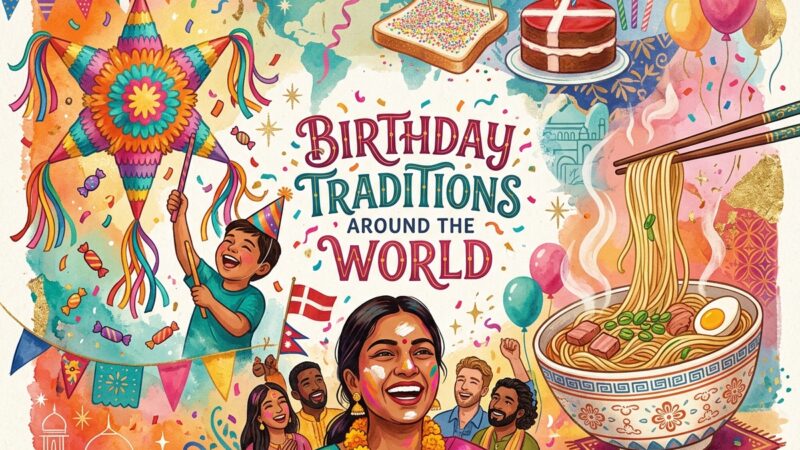
A kid in Mexico is blindfolded, swinging a bat at a piñata stuffed with candy. Meanwhile, a child in Denmark wakes up to find their national flag waving outside their bedroom window. And somewhere in Jamaica? That kid is getting pelted with flour by friends and family — and loving every second of it.
Birthday traditions around the world are wildly different, beautifully strange, and deeply meaningful. You might think blowing out candles on a cake is a universal thing, but it’s not. Some cultures don’t even celebrate individual birthdays at all.
So what do global birthday customs look like once you step outside your own neighborhood? That’s exactly what this article covers. You’ll discover how different countries celebrate birthdays — from ear-pulling in Hungary to nose-greasing in Canada. Some will make you laugh. Some will make you think. And a few might inspire you to borrow a tradition or two for your own next birthday.
If you’ve ever been curious about how different cultures celebrate birthdays, you’re in the right place. Let’s go country by country.
Why Birthday Traditions Differ So Much Across Cultures
Before we jump into specific countries, it helps to understand why these customs vary so much.
Birthday celebrations are shaped by three big forces:
- Religion — Some faiths historically discouraged individual birthday celebrations, while others built entire rituals around them. Curious? Here’s a deeper look at how different religions view birthdays.
- History and colonization — European birthday customs spread through colonialism, mixing with local traditions to create something entirely new.
- Cultural values — Collectivist cultures often emphasize community milestones (like naming ceremonies), while individualistic cultures focus more on the person.
Did you know? The ancient Egyptians were likely the first civilization to recognize a “birthday” — but only for pharaohs. Ordinary people? Their birthdays weren’t tracked at all. The Greeks later added the tradition of round cakes with candles to honor Artemis, the moon goddess. You can read the full story behind the origin of birthday cakes and candles — it’s more fascinating than you’d expect.
The point is, your birthday celebration isn’t random. It’s the result of centuries of cultural evolution.
Birthday Traditions in North America
United States
The American birthday formula is pretty familiar to most people: cake, candles, the “Happy Birthday” song, gifts, and maybe a party. But there are a few details worth noting.
- Cake smash photos for a baby’s first birthday have become almost mandatory in the Instagram era.
- Sweet 16 is a huge milestone, especially for girls, often involving an elaborate party.
- 21st birthdays revolve heavily around the legal drinking age. There’s a whole cultural weight behind why 18th and 21st birthdays are special.
Pro Tip: If you’re throwing a birthday party in the U.S. and want to stand out, borrow a tradition from another country on this list. Your guests will remember it.
Mexico
Mexican birthdays are loud, warm, and full of energy. The most iconic tradition? The piñata — a colorful, often animal-shaped container filled with candy and small toys. Kids take turns being blindfolded and swinging a stick at it until it breaks open.
But the real standout is the quinceañera — a girl’s 15th birthday celebration. It’s not just a party. It’s a full-blown event with:
- A religious ceremony (usually a Catholic mass)
- A formal dance (the waltz)
- A special dress, often pink or pastel
- The “last doll” — symbolizing the transition from childhood
The quinceañera costs families thousands of dollars on average. Some are as elaborate as weddings.
And yes, the birthday song in Mexico is “Las Mañanitas,” not “Happy Birthday to You.” It’s traditionally sung at dawn, before the birthday person even wakes up.
Canada
Canadian birthday customs are mostly similar to American ones, but with one quirky addition: nose greasing.
In parts of Atlantic Canada (especially Newfoundland), the birthday person gets their nose greased with butter or margarine. The idea? A greased nose makes you too slippery for bad luck to catch you.
It sounds odd, but kids absolutely love it. Adults… tolerate it with a laugh.
Birthday Traditions in Europe
Europe is where many modern birthday customs originated. But even within this continent, the differences are striking.
Germany
Germans take birthdays seriously — but with some strict unwritten rules.
- Never wish someone happy birthday early. This is considered extremely bad luck. Not a mild superstition — Germans genuinely get uncomfortable if you do this. For more on birthday superstitions, check out weird birthday superstitions people actually believe.
- Kinderfeste (children’s parties) often involve organized games, a “Geburtstagskuchen” (birthday cake), and candles on a wooden wreath called a Geburtstagskreuz.
- If a man is still unmarried at 30, his friends make him sweep the steps of the town hall or a church while onlookers throw garbage — until a woman kisses him. Yes, really.
Quick Fact: The concept of “Kindergeburtstag” (children’s birthday party) as we know it today was largely shaped in 18th-century Germany.
Denmark
Danish birthdays feel like a national event.
- The Danish flag (Dannebrog) is displayed outside the birthday person’s window. This isn’t just occasional — it’s expected.
- At children’s birthdays, a special “kagemand” (cake man) or “kagekone” (cake woman) is served — a large pastry shaped like a person. When the birthday child cuts the “throat” of the cake person, everyone screams. It’s wild and kids find it hilarious.
- Gifts are placed around the child’s bed so they wake up surrounded by presents.
Russia
Russian birthday celebrations vary, but one tradition stands out: the birthday person is responsible for organizing and paying for their own party. That includes dinner at a restaurant, snacks at school, or treats for coworkers.
The idea isn’t selfish — it’s generous in reverse. The birthday person hosts and treats everyone as a way of sharing their happiness.
Another Russian custom: pulling the birthday person’s earlobes once for each year of their age. It’s meant to bring good luck, though it probably doesn’t feel lucky by year 35.
Netherlands
The Dutch have a birthday tradition that visitors find truly baffling.
When you visit someone on their birthday in the Netherlands, you congratulate everyone present — not just the birthday person. “Gefeliciteerd!” (congratulations!) gets said to the parents, siblings, partner, friends… basically anyone connected to the birthday person.
Also, certain ages get special names:
- Turning 50 is called “Abraham” (for men) or “Sarah” (for women), referencing the biblical figures. The birthday person often gets a large inflatable Abraham or Sarah doll placed in their yard.
Ireland
In Ireland, children get the birthday bumps — they’re lifted upside down and gently “bumped” on the floor once for each year of their age, plus one extra bump for good luck.
For adults, Irish birthdays often involve a gathering at the local pub, traditional music, and plenty of good-natured teasing.
Italy
Italian birthday celebrations always center around food. Always.
- A special cake or pastry (often from a local bakery — homemade is less common)
- A big family meal, usually at someone’s home
- Pulling the birthday person’s ears — similar to the Russian custom
Fun detail: In Italy, the birthday person often brings treats to school or work, not the other way around. This “treat others on your day” pattern shows up in several European and South American cultures too.
Birthday Traditions in Asia
Asia is home to some of the most unique and varied global birthday customs you’ll find anywhere.
China
Chinese birthday traditions are deeply tied to food symbolism.
- Longevity noodles (长寿面) are served on birthdays. The catch? You’re not supposed to cut or break them — the longer the noodle, the longer your life.
- Red eggs are distributed to family and friends after a baby’s first month birthday (called “满月”). Red represents luck and prosperity.
- The 60th birthday is considered the most important in a person’s life. It marks the completion of one full cycle of the Chinese zodiac (12 animals × 5 elements = 60 years). This birthday gets a massive celebration.
Traditionally, many Chinese people didn’t celebrate individual birthdays at all — everyone “turned a year older” together during Chinese New Year.
South Korea
South Korea has some of the most fascinating birthday customs on this list.
- Doljanchi (돌잔치) is a lavish first birthday celebration. The baby is placed before a table of objects — a thread (long life), money (wealth), a pencil (academic success), a microphone (fame). Whatever the baby grabs “predicts” their future.
- Koreans traditionally eat seaweed soup (미역국) on their birthday. It’s the same soup given to mothers after childbirth, so eating it on your birthday honors your mother’s pain and sacrifice.
- Until recently, Korea used a different age-counting system where everyone was “1” at birth. So a Korean person might be 1-2 years “older” than their international age. In 2023, South Korea officially switched to the international age system.
Did you know? Korean seaweed soup is so strongly associated with birthdays that asking someone “Did you eat miyeokguk today?” is basically asking “Is it your birthday?”
Japan
Japanese birthdays weren’t traditionally celebrated the way Western cultures do. Individual birthday parties became popular only after World War II, influenced by American culture.
Today, Japan celebrates specific ages with special ceremonies:
- Shichi-Go-San (七五三) — Children aged 3, 5, and 7 visit Shinto shrines in November, wearing traditional kimono. It’s a celebration of healthy growth.
- 20th birthday (成人の日) — Coming of Age Day is a national holiday celebrated on the second Monday of January. Young adults wear formal attire and attend ceremonies hosted by local governments.
Modern Japanese birthday parties often feature a decorated cake (often from high-end bakeries — Japan’s cake culture is serious) and a meal at a favorite restaurant.
India
India doesn’t have one single birthday tradition — it has dozens, depending on the region, religion, and family customs.
- Hindu families often start the day with a visit to a temple. The birthday person may touch the feet of elders to receive blessings.
- Rice payasam (kheer) or other sweets are prepared and shared with neighbors.
- In schools, children dress in new clothes and distribute chocolates to classmates.
- Many Indian families celebrate the first birthday with a special “Annaprashan” ceremony (the baby’s first solid food).
Quick Fact: Some traditional Indian families still calculate birthdays based on the lunar calendar, so the date changes every year by the Gregorian calendar.
Vietnam
In Vietnam, individual birthdays were not traditionally celebrated. Instead, everyone celebrated their birthday together on Tết (Vietnamese New Year). You “aged” one year on the first day of the new year, regardless of your actual birth date.
Modern urban Vietnamese families now celebrate individual birthdays too — with cakes, parties, and gifts — but the Tết tradition remains strong, especially in rural areas.
Philippines
Filipino birthdays are big. Like, really big.
- Spaghetti (a sweet, Filipino-style version with banana ketchup and hotdogs) is the star of every birthday party. Not cake — spaghetti.
- The debut — a girl’s 18th birthday — is celebrated with the intensity of a quinceañera. It features 18 roses (dances with 18 men), 18 candles (well-wishes from 18 women), and 18 treasures (gifts with advice).
- Families often go into significant debt to throw a memorable party. Birthdays are community events, and it’s common to invite the entire neighborhood.
Birthday Traditions in Africa
African birthday customs are incredibly diverse, with over 50 countries and thousands of ethnic groups each bringing their own practices.
Nigeria
Nigerian birthdays — especially for children — often involve:
- Jollof rice — the unofficial birthday food of West Africa. No Nigerian birthday is complete without it.
- Music, dancing, and large gatherings of extended family
- Spraying — guests “spray” (toss or place) cash on the birthday person while they dance
Wealthy Nigerian families sometimes throw birthday parties that rival weddings, with owambe-style celebrations featuring live bands and elaborate aso-ebi (matching outfits for guests).
Ghana
Ghanaian families celebrate a child’s naming ceremony on the 8th day after birth, which functions as a sort of first birthday celebration. The baby is given a name, blessed with water and wine, and introduced to the community.
Individual birthday parties are becoming more popular in urban Ghana, often mixing Western customs (cake, balloons) with traditional elements (local food, drumming).
Kenya
In many Kenyan communities, milestone birthdays receive more attention than annual ones. Coming-of-age ceremonies — different across ethnic groups like the Maasai, Kikuyu, and Luo — are major events involving community participation, traditional clothing, and sometimes rituals lasting several days.
Urban Kenyan birthdays, especially for children, now look similar to Western celebrations but with Kenyan food staples like nyama choma (grilled meat).
Birthday Traditions in South America
Brazil
Brazilian birthdays are colorful, warm, and always involve brigadeiros — small chocolate truffles rolled in sprinkles. No Brazilian birthday happens without them.
- The birthday person gets the first slice of cake but must give it to someone special (usually a parent or best friend).
- Pulling the earlobes is common here too — one tug for each year.
- Festa de 15 anos — the Brazilian quinceañera — is a major event for girls, similar to the Mexican version but with a distinct Brazilian flair.
If you’re curious about birthday foods from other places too, here’s a great read on birthday foods from different countries.
Argentina
Argentine birthdays share many customs with Brazilian ones, but the waltz tradition stands out. At a girl’s 15th birthday (quinceañera), the birthday girl dances a waltz with her father, often followed by 14 other partner dances — one for each year of her life.
Also, the birthday person’s friends pull their earlobes — hard — once per year of life. By age 30, this stops being charming.
Birthday Traditions in the Middle East and Central Asia
Egypt
Modern Egyptian birthdays in cities include cake, decorations, and music. But there’s an interesting twist: birthday celebrations are relatively recent in Egyptian culture. Traditional Egyptian society placed less emphasis on individual birthdays, and some conservative families still prefer quiet observances.
Wealthy Egyptian families may host extravagant children’s parties with entertainment, performers, and lavish venues — a trend that’s grown significantly since the 2000s.
Saudi Arabia
Birthday celebrations in Saudi Arabia have a complicated history. For decades, public birthday celebrations were discouraged by religious authorities who viewed them as a Western innovation (bid’ah). This has softened significantly in recent years, especially among younger generations.
Today, many Saudi families celebrate birthdays privately with cake, gifts, and family gatherings — though the level of celebration varies greatly by family and region.
Nepal
In Nepal, a traditional birthday custom involves a tika ceremony. The birthday person receives a tika (a mark on the forehead made of rice, yogurt, and red vermillion powder) from elder family members, along with blessings.
Rice pudding or other sweets are prepared, and the day often begins with a visit to a local temple.
Unusual Birthday Customs That Surprise Most People
Some global birthday customs are just so unique that they deserve their own section.
Jamaica — Flour Bombing
Jamaican friends and family ambush the birthday person with flour. They throw it, dump it, and rub it all over you. The messier, the better. It’s done with total love and a lot of laughter. Wearing your best outfit on your birthday in Jamaica? Not the wisest choice.
Hungary — Ear Pulling (Intensified)
Hungarians pull your earlobes while reciting a rhyme that roughly translates to: “God bless you, live so long that your ears reach your ankles.” It’s affectionate, but those earlobes take a beating.
Australia — Fairy Bread
Australian kids’ birthday parties always feature fairy bread — white bread, butter, and colorful sprinkles (called “hundreds and thousands”). It sounds simple. It tastes like childhood. Australians are fiercely protective of this tradition and genuinely confused when other countries don’t have it.
Canada (Maritimes) — Nose Greasing (Again, Yes)
Worth repeating because it’s that quirky. In Atlantic Canada, greasing the birthday person’s nose with butter is believed to make them “too slippery for bad luck to grab.” Kids get chased around the house for this one.
Switzerland — Birthday Person Chooses Everything
In Switzerland, the birthday child gets to choose the entire menu for the day — breakfast, lunch, and dinner. They also get to pick the family activity. Total birthday dictatorship, sanctioned by tradition.
How Birthday Parties Have Changed Over Time
Birthday celebrations weren’t always parties. For most of human history, birthdays were private, spiritual, or simply ignored.
- Ancient Rome was one of the first civilizations to celebrate ordinary citizens’ birthdays (though mostly for men).
- Medieval Europe largely avoided birthday celebrations — the Church associated them with pagan customs.
- The Industrial Revolution made manufactured goods (cards, candles, decorations) affordable, turning birthdays into consumer events.
- The 20th century commercialized birthdays through greeting cards (Hallmark, founded 1910), party supplies, and eventually social media.
Want the full timeline? Here’s a detailed look at how birthday parties changed over time.
In 2025, birthday celebrations are more personalized than ever. People create TikTok birthday content, throw themed experiences, and even celebrate “half birthdays.” The trend toward meaningful, smaller celebrations is growing — especially among millennials and Gen Z. You might enjoy reading about how birthday trends changed in Gen Z.
Common Myths About Birthday Traditions
Let’s clear up a few things people often get wrong.
Myth 1: “Everyone in the world sings ‘Happy Birthday to You.'”
Not true. Many countries have their own birthday songs. Mexico has “Las Mañanitas.” Korea has “생일 축하합니다” (a translated version, but sung differently). Some cultures don’t have a birthday song at all. Here’s the full story of the history of Happy Birthday songs.
Myth 2: “Birthday cakes with candles are an ancient tradition.”
The candle-on-cake tradition is only a few hundred years old, originating in 18th-century Germany. Ancient Greeks used candles on cakes for Artemis worship — a completely different context.
Myth 3: “All cultures celebrate individual birthdays.”
Many cultures traditionally celebrated collective age milestones (like New Year) rather than individual birthdays. Vietnam, Korea, and parts of China all followed this pattern until relatively recently.
Myth 4: “Birthday celebrations are purely happy events everywhere.”
Not quite. Some people experience deep sadness, anxiety, or existential dread around their birthdays. This is called the “birthday blues,” and it’s more common than you’d think. If that resonates, read about why people feel emotional on their birthday.
How Schools Celebrate Birthdays Worldwide
Kids spend a huge chunk of their birthdays at school, so school traditions matter.
- USA: Cupcakes or treats brought by parents, sometimes a special hat or crown.
- Germany: The birthday child stands on a chair while classmates sing, and a special candle wreath is lit.
- Netherlands: The birthday child brings treats for the entire class AND the teachers’ lounge. Yes, the kid has to supply everyone.
- India: New clothes, distributing chocolates, and sometimes a small classroom celebration.
- Japan: Schools generally don’t celebrate individual birthdays during class — it’s considered a private family matter.
For a deeper comparison, check out how schools celebrate birthdays worldwide.
FAQ Section
What country has the most unique birthday tradition?
That’s subjective, but South Korea’s Doljanchi (first birthday) often tops the list for uniqueness. The ceremony where a baby “predicts” their future by grabbing objects from a table is unlike anything found in other cultures. Jamaica’s flour-bombing tradition and Germany’s “sweeping the steps at 30” are close runners-up.
Do all countries celebrate birthdays with cake?
No. While cake has become common in many countries due to Western influence, plenty of cultures use different birthday foods. Koreans eat seaweed soup. Chinese families serve longevity noodles. Nigerians prioritize jollof rice. Brazilians focus on brigadeiros. Birthday foods from different countries vary far more than most people realize.
Are there cultures that don’t celebrate birthdays at all?
Yes. Some religious groups (like Jehovah’s Witnesses) avoid birthday celebrations entirely for theological reasons. Historically, many East Asian and African cultures didn’t emphasize individual birthdays, focusing instead on communal milestones, naming ceremonies, or lunar new year celebrations. Even today, some conservative communities in the Middle East and parts of South Asia treat birthdays as a Western import and choose not to observe them. Here’s more on how different religions view birthdays.
Why do so many cultures pull ears on birthdays?
Ear-pulling (or ear-tugging) appears in Hungarian, Brazilian, Argentine, Italian, and Russian birthday customs. The exact origin is debated, but the most common explanation is that it symbolizes stretching your life longer — literally pulling you toward more years. It’s likely one of those traditions that developed independently in multiple places because the logic is so simple and physical.
What’s the most common birthday tradition worldwide?
Singing a birthday song and sharing some form of sweet food (cake, pastry, or dessert) with a group of people are the two most widespread traditions globally. The Western “Happy Birthday” song has been translated into dozens of languages and is recognized almost everywhere, even in cultures with their own birthday songs.
Your Birthday, Your World
Here’s what sticks with me after looking at birthday traditions around the world: every culture found its own way to say “we’re glad you exist.” Whether that looks like a quiet prayer at a temple, flour thrown in your face, or a table piled high with jollof rice — the core message is the same.
Your own birthday traditions — whatever they are — carry the weight of your culture, your family, and your personal history. And there’s nothing stopping you from adopting a new one. Serve longevity noodles next year. Put a flag outside your window. Make fairy bread. Why not?
If this article sparked something in you, consider exploring why people love their birthdays so much or discovering the psychology behind birthday happiness. Because understanding why we celebrate might be just as interesting as understanding how.
Now go text a friend whose birthday is coming up — and maybe grease their nose when they’re not looking. 🎂
Related Articles
Twins’ Birthday Wishes: Double the Fun & Greetings
Celebrating two people at once is a special kind of joy. Whether you’re writing in a...

Thank You Messages: 100+ Replies for Birthday Wishes
Someone took a moment out of their day to think of you, type out a message,...
Best Friend Birthday Wishes: Top Heartfelt Messages
A good friend’s birthday deserves more than a rushed text or a recycled message you’ve sent...