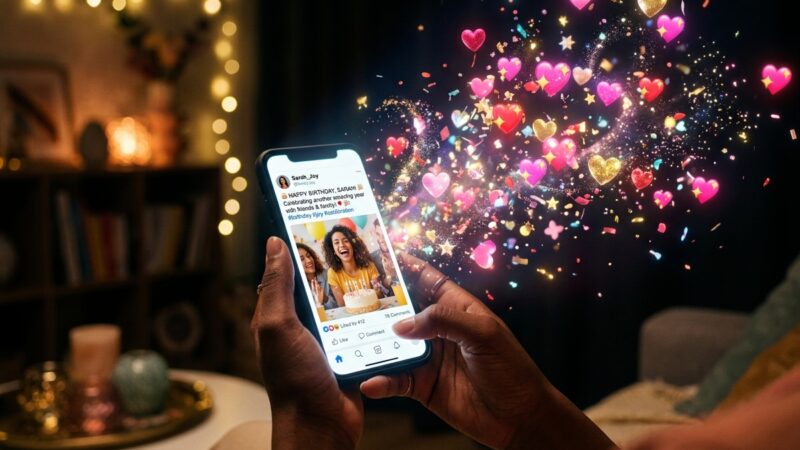
Last year, roughly 2 billion birthday posts went up on Facebook alone — in a single day. That’s not a typo. Two billion. And that’s just one platform.
Think about your own feed for a second. Every morning, you scroll past three or four birthday tributes. A childhood photo here, a heartfelt caption there, maybe a funny meme with “Old but gold” slapped on it. You’ve probably posted one yourself. Maybe even today.
But here’s the thing nobody really stops to ask — why do people share birthday posts on social media in the first place? Is it genuine love? Social pressure? A quick dopamine hit? Or something deeper running under the surface?
The answer, as it turns out, isn’t simple. It’s a messy, fascinating mix of psychology, social norms, digital culture, and real human emotion. And once you understand it, you’ll never look at a birthday post the same way again.
Let’s break it all down.
The Emotional Need Behind Birthday Posts
We’re Wired to Celebrate Each Other
Humans are social creatures. That’s not a cliché — it’s biology. Our brains literally release oxytocin (the bonding hormone) when we do something kind for someone we care about. Writing “Happy Birthday, you deserve the world 🎂” on your best friend’s timeline? That tiny act triggers a small chemical reward in your brain.
Birthday wishes online aren’t just words on a screen. They’re micro-expressions of connection. You’re telling someone, “Hey, I remember you. You matter to me.” And that feels good — for both the sender and the receiver.
There’s a reason why birthdays matter so much in psychology. They tap into our fundamental need to feel seen, valued, and remembered.
The Fear of Being the One Who Didn’t Post
Let’s be honest here. Not every birthday post comes from pure love. Sometimes, there’s a quiet pressure at play.
You see six of your friends have already posted a tribute for someone. You haven’t. Now there’s this nagging thought — “Will they notice I didn’t post? Will they think I don’t care?”
This is what psychologists call social obligation bias. You’re not always posting because you want to. You’re posting because NOT posting sends a message too. And in the world of social media, silence is loud.
Quick Fact: A 2023 survey by Pew Research found that nearly 40% of young adults (18-29) felt socially obligated to post birthday wishes for close friends and family members online.
Birthday Posts Social Media Psychology: What’s Really Going On?
The Psychology of Public Affection
Here’s where birthday posts social media psychology gets really interesting. Posting a private text saying “Happy Birthday” and posting a public tribute on Instagram are two completely different acts. Both express care. But the public one does something extra — it performs care.
That’s not necessarily fake. But it IS different.
When you share a birthday post publicly, you’re doing a few things at once:
- Expressing love for the birthday person
- Signaling to your audience that you’re a thoughtful, caring person
- Strengthening a social bond in a visible way
- Participating in a shared cultural ritual
Sociologists call this “performative intimacy.” You’re not just saying happy birthday. You’re showing the world you said it.
The Dopamine Factor
Every like, every heart react, every “Aww you two are so cute 😍” comment on your birthday post gives you a tiny hit of dopamine. Your brain’s reward system lights up. It feels good.
And the birthday person? They get an even bigger rush. Imagine opening your phone and seeing 50, 100, maybe 200 messages from people wishing you well. That flood of attention creates a genuine emotional high.
This is closely tied to the psychology behind birthday happiness. The attention, the validation, the feeling of being loved — it all stacks up into something powerful.
Identity Curation Through Birthday Posts
Your birthday post for someone else also says something about you. Think about it:
- A funny meme post says, “I’m the witty friend.”
- A long emotional caption says, “I’m the deep, sentimental one.”
- A throwback photo says, “We go way back — our bond is real.”
Every post is a small piece of your personal brand on social media. You’re curating how the world sees your relationships. And birthday posts are one of the easiest, most socially accepted ways to do that.
How Social Media Changed the Way We Give Birthday Wishes
From Phone Calls to Timeline Posts
Remember when wishing someone happy birthday meant calling them? Or at least sending a text? Now, for many people, a Facebook wall post or an Instagram story is the birthday wish.
This shift didn’t happen overnight. But it fundamentally changed birthday culture. The whole evolution of how social media changed birthday culture is fascinating when you really look at it.
Here’s a quick comparison:
| Before Social Media | After Social Media |
|---|---|
| Personal phone call | Public wall post |
| Handwritten card | Instagram story |
| Small gathering knew it was your birthday | Hundreds of people reminded |
| Wishes came from close circle | Wishes come from acquaintances too |
| Private, intimate | Public, performative |
Facebook’s Birthday Reminder: The Silent Game-Changer
Let’s give credit where it’s due. Facebook’s birthday notification feature is probably the single biggest reason why birthday posts exploded online.
Before that feature existed, only your closest people remembered your birthday. Now? Your college roommate from 12 years ago, your coworker you met once at a conference, your neighbor’s cousin — they all know. And many of them will post.
This created an interesting dynamic. Birthday wishes became quantity-driven. The number of posts on your wall became almost like a social scorecard. More posts = more loved. At least, that’s how it can feel.
Did You Know? Facebook reported that birthday posts are the most common type of interaction between users who don’t regularly communicate. That means your birthday might be the only day some people think about you all year.
The Different Types of Birthday Posters
Not everyone posts for the same reason. After years of watching social media patterns, you can spot some clear categories:
1. The Genuine Expressors
These are people who truly love the birthday person and use social media as one of many ways to express it. They probably also called, texted, and maybe showed up with a cake. The post is just an extra layer.
What their posts look like: Thoughtful captions, inside jokes, genuine memories shared.
2. The Obligation Posters
They saw the notification. They felt the pressure. They typed “Happy Birthday! 🎉” and moved on. No personal touch. No photo. Just the bare minimum to avoid looking like they don’t care.
What their posts look like: Generic one-liners. Copy-paste energy.
3. The Attention Seekers
This is where it gets tricky. Some people use someone else’s birthday as an opportunity to get attention for themselves. The post is less about the birthday person and more about showcasing the poster’s life, their photos, their memories.
What their posts look like: Multiple selfies where the poster looks great, a caption that’s more “look at us” than “happy birthday to you.”
4. The Brand Builders
Influencers, public figures, and people building a personal brand use birthday posts strategically. Posting for a famous friend? That’s social capital. Tagging someone with a big following? That’s visibility.
What their posts look like: Polished photos, tagged accounts, strategic hashtags.
5. The Nostalgic Ones
These posters genuinely miss the old times. A birthday gives them the perfect excuse to share a throwback photo and relive the memories. For them, why birthday photos matter to people goes beyond vanity — it’s about holding onto the past.
What their posts look like: Old photos, “Remember when…” captions, genuine warmth.
Why Birthday Wishes Online Feel Different Than Real-Life Wishes
The Visibility Factor
When your friend calls you and says “Happy Birthday,” that’s between you two. Beautiful. Private. Personal.
When they post about you on Instagram with a carousel of your best moments together — that’s a public declaration. And honestly? That hits different. There’s something about knowing that someone chose to tell the WORLD they love you. Not just you. Everyone.
That visibility is both the magic and the problem with birthday wishes online. It raises the stakes. And sometimes, it creates expectations that are hard to meet.
The Comparison Trap
Here’s the dark side nobody talks about. You posted a 500-word essay for your friend’s birthday. They posted a three-word story for yours. Now you’re hurt.
Or worse — you see everyone getting elaborate birthday posts from their friends, and nobody posted anything meaningful for you. Suddenly your birthday, which should feel special, feels lonely.
This connects deeply to why people feel emotional on their birthday. Social media amplifies both the joy and the pain of birthdays.
The Permanence of Digital Wishes
A spoken “Happy Birthday” fades. A card sits in a drawer. But a social media post? It lives on your timeline, potentially forever. You can scroll back five years and re-read what your friend wrote for you. That permanence gives digital birthday wishes a strange kind of power.
Pro Tip: If you genuinely want to make someone feel special, combine BOTH. Send a personal text AND post publicly. That combo covers all the emotional bases.
The Generational Divide in Birthday Posting
Gen Z and the Birthday Story Culture
For Gen Z (born roughly 1997-2012), posting an Instagram story for someone’s birthday is almost as standard as saying “bless you” after a sneeze. It’s expected. It’s automatic. And the format matters — a well-edited story with the right song, the right filter, and the right photos is a form of digital love language.
The way birthday trends changed in Gen Z tells us a lot about how digital culture is rewiring our emotional expressions. For this generation, if it didn’t happen on the story, did it even happen?
Millennials: The Facebook Wall Era
Millennials (born 1981-1996) grew up with Facebook birthday walls. Their birthday ritual was different — long wall posts, public comments, maybe an album of tagged photos. Many millennials still prefer this format, even as newer platforms take over.
Older Generations: Cautious But Present
Boomers and Gen X are on social media too. Their birthday posts tend to be more straightforward — a simple “Happy Birthday, dear!” with maybe a family photo. Less performative, more sincere. They didn’t grow up with the expectation of public celebration, so their posts feel different.
When NOT Posting Becomes a Statement
Here’s something interesting. Some people have started deliberately not posting birthday wishes online. And that’s its own kind of statement.
Why? A few reasons:
- Privacy concerns — not everyone wants their relationship broadcast
- Authenticity backlash — some feel public posts are performative and hollow
- Introversion — some people prefer showing love privately, and you can explore how introverts vs extroverts handle birthdays for more on this
- Social media detox — people stepping back from platforms entirely
- Reaction to pressure — refusing to participate in what feels forced
And you know what? That’s completely valid. Not posting doesn’t mean not caring. Sometimes the most meaningful birthday wish is the one nobody else sees.
The Cultural Angle: Birthday Posts Across the World
Birthday posting habits aren’t universal. They vary based on culture, religion, and regional traditions.
In some cultures, how different cultures celebrate birthdays shows that public celebration is central. In others, birthdays are quiet, family-only affairs. Social media is slowly blending these traditions, but cultural differences still shape how — and whether — people post.
For example:
- In the U.S., birthday posts are extremely common and expected among friends
- In Japan, birthday celebrations are more private, and public posts are less common
- In India, birthday posts have exploded, especially among younger users on Instagram and WhatsApp
- In some religious communities, how different religions view birthdays can influence whether public celebration is even appropriate
The Business Side: How Brands Jumped on Birthday Posts
It’s not just individuals posting. Brands realized that birthday-related content gets massive engagement. Think about it:
- Starbucks gives you a free drink on your birthday (and you bet people post about it)
- Sephora sends a birthday gift (cue the unboxing stories)
- Spotify creates personalized birthday playlists
- Netflix and other platforms send birthday emails hoping you’ll share
Brands understood the psychology. Your birthday is the one day you’re most receptive to feeling special. And if a brand can be part of that feeling? That’s loyalty built on emotion.
Common Myths About Birthday Posts on Social Media
Myth 1: “People who post are just showing off”
Reality: Some are. Many aren’t. For a lot of people, posting is a genuine expression of love that happens to be public. Don’t assume motive based on the platform.
Myth 2: “If they really cared, they’d call instead of posting”
Reality: Why not both? A social media post doesn’t replace a phone call, but it doesn’t cancel it out either. Different mediums serve different purposes.
Myth 3: “More birthday posts = more popular”
Reality: The number of posts you receive depends on many factors — how active you are on social media, whether your birthday is visible in settings, how large your friend list is. It’s not a popularity contest. Or at least, it shouldn’t be.
Myth 4: “Birthday posts are a new thing”
Reality: The format is new. The behavior isn’t. People have been publicly celebrating birthdays for centuries — through newspaper announcements, community gatherings, and the long history of birthday cards. Social media is just the latest version of a very old habit.
What This Means for You
So now you understand why people share birthday posts on social media. The question is — what do you do with that knowledge?
A few thoughts:
- Post authentically. If you’re going to share a birthday post, make it real. Skip the generic caption. Share a genuine memory or a specific reason you appreciate that person.
- Don’t judge silent friends. Not everyone expresses love publicly. That doesn’t mean they love you less.
- Set your own boundaries. If birthday posts stress you out — whether giving or receiving — it’s perfectly okay to opt out.
- Remember the human. Behind every birthday post is a real person who wants to feel seen and loved. That’s never a bad thing.
FAQ Section
Why do people feel obligated to post birthday wishes on social media?
Social media creates a visible record of who posted and who didn’t. When you see others posting for someone’s birthday, the pressure to do the same increases. This is rooted in social comparison theory and the fear of being perceived as uncaring. The obligation is strongest in close friend groups where posting is the established norm.
Do birthday posts on social media actually make people happy?
Yes, for most people. Research from the University of Wisconsin found that receiving personalized social media messages (not just generic “HBD” posts) on your birthday genuinely boosts mood and feelings of social connectedness. The key word is personalized. A thoughtful post with a real memory or specific message has far more emotional impact than a copy-paste greeting.
Is it rude not to post a birthday wish on social media?
It depends on your relationship and your social circle’s norms. Among Gen Z, not posting a story for a close friend’s birthday might feel like a snub. In other circles, nobody notices or cares. The safest approach? If you’re unsure, send a personal message AND post if you want to. But never let social media pressure override your genuine comfort level.
Why do some people get upset when they don’t receive birthday posts?
Birthdays are deeply tied to self-worth for many people. When someone doesn’t receive the expected number of posts, it can trigger feelings of loneliness or inadequacy. This reaction is especially strong among people who actively post for others’ birthdays, as they expect reciprocity. Understanding why people reflect on life during birthdays can help explain this emotional response.
Are birthday posts more common on Instagram or Facebook?
As of 2025, Instagram stories have become the dominant format for birthday wishes among users under 35. Facebook still leads for older demographics and for longer, text-heavy tributes. TikTok birthday content is growing too, with viral birthday trends on TikTok adding a whole new layer to the tradition.
Your Birthday, Your Rules
Here’s what it all comes down to. People share birthday posts for a hundred different reasons — love, habit, pressure, nostalgia, identity, connection. And all of those reasons are valid, because humans are complicated and social media is just a mirror reflecting that complexity.
The next time you see a birthday post in your feed, you’ll notice the layers now. The genuine ones will warm your heart. The performative ones will make you smile knowingly. And the absent ones won’t bother you as much, because you’ll understand that love doesn’t always need an audience.
Post or don’t post. Celebrate loudly or quietly. Just make sure that whatever you do on someone’s birthday — online or offline — comes from a place that feels right to you.
And hey, if someone’s birthday is coming up and you’re not sure how to make it special, check out personalized birthday gift ideas that actually feel special. Sometimes the best birthday gesture isn’t a post at all — it’s something only you could give.
Related Articles

Twins’ Birthday Wishes: Double the Fun & Greetings
Celebrating two people at once is a special kind of joy. Whether you’re writing in a...
Thank You Messages: 100+ Replies for Birthday Wishes
Someone took a moment out of their day to think of you, type out a message,...
Best Friend Birthday Wishes: Top Heartfelt Messages
A good friend’s birthday deserves more than a rushed text or a recycled message you’ve sent...