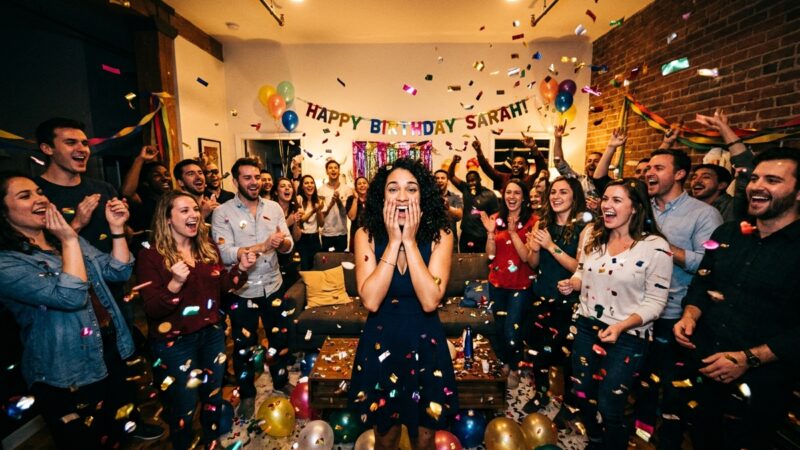
Picture this: you walk into a dark room, flip the light switch, and — BAM — twenty of your closest friends scream “SURPRISE!” Your heart races. Your jaw drops. Maybe you even tear up a little. That single moment, those three or four seconds of genuine shock, creates a memory that sticks with you for years.
That’s exactly why surprise parties are so popular. They pack more emotional punch into one evening than most celebrations deliver in a lifetime. According to a 2023 survey by the American Greeting Card Association, nearly 62% of adults said a surprise party was their most memorable birthday experience ever. Not a fancy dinner. Not an expensive gift. A surprise.
But here’s what most people don’t think about — there’s actual science behind this. The psychology of surprise parties explains why our brains light up like fireworks during unexpected moments, and why both the planners AND the guest of honor walk away feeling closer to each other.
So let’s break down what makes surprise parties so irresistible, why people keep planning them despite all the stress involved, and what’s really happening inside your brain when someone yells “SURPRISE!”
The Psychology of Surprise Parties: What’s Really Happening in Your Brain
You know that rush you feel during a surprise? That’s not just excitement — it’s a full-blown neurochemical event.
Your Brain on Surprise
When something unexpected happens, your brain releases a flood of dopamine — the same “feel-good” chemical linked to rewards, pleasure, and motivation. Dr. Tali Sharot, a neuroscientist at University College London, found that unexpected positive events trigger significantly more dopamine than expected ones.
Think about it this way: if someone hands you ₹500 you were expecting, you feel okay. But if someone randomly gives you ₹500 you weren’t expecting? You feel ecstatic. The actual amount is the same. The surprise is what multiplies the joy.
That’s the core psychology of surprise parties. The celebration itself might be ordinary — cake, balloons, music. But the unexpected delivery amplifies every emotion attached to it.
The Amygdala Hijack (In a Good Way)
Your amygdala — the brain’s emotional processing center — goes into overdrive during a surprise. It temporarily “hijacks” your rational brain, which is why people react so physically. They gasp, scream, cry, cover their mouth, or even freeze.
This intense emotional response is exactly what makes the memory so sticky. Research published in the Journal of Experimental Psychology shows that emotionally charged events are encoded more deeply into long-term memory than neutral ones.
So a surprise birthday party doesn’t just feel special in the moment. Your brain literally stores it differently than a regular party.
Quick Fact: The science behind birthday memories explains why we remember certain celebrations decades later while forgetting others completely. Surprise is one of the biggest factors.
Why People Love Planning Surprise Parties (Not Just Attending Them)
Here’s something interesting — the surprise birthday party appeal isn’t just about the person being surprised. The planners get a massive emotional payoff too.
The Joy of Giving Exceeds Receiving
A 2022 study from Harvard Business School confirmed what many of us instinctively feel: spending effort on others creates more lasting happiness than spending on yourself. Planning a surprise party is essentially a gift of time, energy, and thoughtfulness.
When you see someone’s face light up because of something you orchestrated? That feeling is addictive. It’s called the “helper’s high” — a real psychological phenomenon where acts of generosity trigger endorphin release.
The Secret Creates Bonding
There’s another layer here that most people overlook. The secrecy involved in planning a surprise party actually strengthens social bonds among the planners.
Think about it:
- You’re sharing a secret with a group
- You’re working toward a shared goal
- You’re coordinating and problem-solving together
- You’re experiencing collective anticipation
This creates what psychologists call “shared secret intimacy.” The group of planners feels like a mini-team on a covert mission. That shared experience brings people closer together even before the party happens.
It’s a Love Language in Action
For many people, planning a surprise party is their way of saying “I care about you enough to go through all this effort.” It’s an expression of love that goes beyond buying a gift.
And interestingly, why people love their birthdays so much often connects directly to feeling valued and remembered. A surprise party is the ultimate version of that feeling.
The Social and Cultural Reasons Behind Surprise Party Popularity
Surprise parties aren’t just a Western thing. They’ve become popular across cultures, ages, and social backgrounds. There are solid social reasons for this.
Social Media Changed Everything
Let’s be real — a huge reason why surprise parties are so popular in 2025 is because they make for incredible social media content.
That genuine, unscripted reaction? It’s gold for Instagram Reels and TikTok. You can’t fake the look of pure shock on someone’s face. And in an era where authenticity gets the most engagement, surprise party videos consistently go viral.
The most viral birthday trends on TikTok include surprise party reaction compilations that rack up millions of views. People love watching genuine human emotion — it’s the opposite of the curated, filtered content we usually see.
But here’s the flip side: how social media changed birthday culture isn’t always positive. Sometimes the pressure to create a “perfect” surprise can overshadow the actual celebration. More on that later.
Cultural Traditions Play a Role
Surprise elements in birthday celebrations exist across many cultures, though they look different everywhere.
- In Mexico, the quinceañera often includes surprise elements for the birthday girl
- In Germany, friends sometimes “ambush” you at midnight on your birthday
- In India, the midnight birthday surprise with cake-smashing has become hugely popular among young people
- In the Philippines, surprise debut parties for 18th birthdays are a cherished tradition
Birthday traditions around the world show that the concept of “unexpected joy” is almost universal. The format changes, but the desire to surprise someone you love? That crosses every border.
The “Experience Economy” Shift
People today — especially Millennials and Gen Z — value experiences over things. A 2024 Eventbrite report found that 78% of young adults would rather receive an experience than a material gift.
A surprise party is the ultimate experience gift. You’re not giving someone a product. You’re giving them a moment, a feeling, an unforgettable memory. That aligns perfectly with how birthday trends changed in Gen Z, where experiential celebrations dominate over traditional ones.
What Makes a Surprise Party Different From a Regular Party
Okay, but why can’t a regular party deliver the same emotional impact? What’s so special about the “surprise” element specifically?
The Element of Contrast
Your brain processes happiness partly through contrast. When you go from “normal Tuesday evening” to “room full of people who love you” in a split second, the emotional contrast is massive.
At a regular party, you know what’s coming. You’ve been anticipating it. Your brain has already “pre-processed” some of the joy. The actual event can sometimes feel anticlimactic compared to what you imagined.
With a surprise? There’s zero anticipation from the guest of honor’s side. So the full emotional impact hits all at once, unfiltered and unprocessed.
Vulnerability Creates Connection
Here’s something beautiful about surprise parties: they force vulnerability on the guest of honor. For a few seconds, you can’t control your reaction. You can’t put on a social mask. Your real emotions show up on your face.
And that vulnerability? It creates deeper connection with everyone in the room. People see the “real you” — not the composed, camera-ready version. That authentic moment bonds people in ways that polished celebrations simply can’t.
The Story Factor
Every great memory needs a great story. “We had a nice dinner for my birthday” is pleasant but forgettable. “My friends pretended we were going grocery shopping and then drove me to a rooftop where 30 people were waiting” — THAT’S a story you’ll tell for years.
Surprise parties naturally create narratives with tension, secrecy, near-misses (“She almost found out THREE times!”), and a dramatic climax. They’re basically built-in stories that people love retelling.
The Dark Side: When Surprise Parties Go Wrong
Not everyone loves surprises. And that’s a conversation worth having.
Anxiety and Surprise Don’t Mix Well
For people with social anxiety, PTSD, or sensory sensitivities, a surprise party can feel more like an ambush than a celebration. The sudden noise, unexpected crowd, and pressure to react “correctly” can be genuinely distressing.
Introverts vs extroverts on birthdays highlights how personality type significantly impacts whether someone enjoys surprise celebrations. What feels thrilling to an extrovert can feel overwhelming to an introvert.
The Pressure to React
There’s an unspoken expectation at surprise parties: you MUST look shocked and happy. If your face doesn’t show “enough” surprise, it can feel awkward for everyone — including you.
Some people process surprise quietly or internally. Others might feel annoyed that their evening plans got hijacked. And in the age of smartphone cameras, knowing your reaction is being recorded adds another layer of pressure.
Pro Tip: Before planning a surprise party, honestly assess whether the person would enjoy it. Ask their closest friend or family member. Some people would genuinely prefer birthday celebration ideas for introverts — like a small, intimate gathering where they can relax and be themselves.
When Planning Goes Too Far
Sometimes the planners get so absorbed in the logistics that they forget the point. The surprise becomes about their achievement (“We pulled it off!”) rather than the birthday person’s happiness.
Interestingly, why some people hate celebrating birthdays sometimes traces back to a bad surprise party experience. One poorly planned surprise can create birthday anxiety that lasts for years.
How Surprise Parties Have Evolved Over Time
Surprise parties aren’t new. But they’ve changed dramatically.
A Brief History
The concept of surprise celebrations dates back centuries, though the modern “surprise birthday party” became popular in the United States during the early 20th century. How birthday parties changed over time tracks this evolution from formal gatherings to the casual, fun-focused events we know today.
In the 1950s and 60s, surprise parties were mostly an adult affair — wives surprising husbands, friends surprising friends. By the 1980s, they became common for kids’ birthdays too. And by the 2000s, surprise parties had become a pop culture staple, featured in countless movies and TV shows.
The 2025 Surprise Party
Today’s surprise parties look very different from those of even 10 years ago:
- Virtual surprise parties became mainstream during the COVID-19 pandemic and haven’t fully disappeared
- Flash mob-style surprises in public places are increasingly popular
- Themed surprise parties inspired by TikTok trends dominate younger demographics
- Destination surprises — flying someone to an unexpected location — have become the ultimate flex
- Personalized video compilations from friends worldwide add an extra emotional layer
The production value has gone up, but the core appeal remains the same: creating an unexpected moment of pure joy.
Why Surprise Birthday Party Appeal Spans All Ages
You might think surprise parties are just for kids or young adults. But the data says otherwise.
Kids: Pure Magic
For children, a surprise party is almost magical. Their understanding of social planning is limited, so the surprise feels genuinely inexplicable — like their friends and family conjured a party out of thin air.
Why kids get more excited for birthdays than adults connects to their heightened emotional reactivity and the fact that they haven’t yet learned to “manage” their reactions. A surprised kid is the most honest emotional display you’ll ever see.
Adults: Feeling Valued
For adults, surprise parties carry a different kind of weight. As people get older, they often feel like birthdays become less important — just another day. Why some adults stop celebrating birthdays explores this gradual emotional retreat.
A surprise party directly combats that feeling. It says: “You matter enough for people to secretly coordinate, lie to your face for weeks, and put in real effort — all because they wanted to celebrate YOU.”
That message hits differently when you’re 45 than when you’re 15. And arguably, it hits harder.
Milestone Birthdays: Extra Special
Surprise parties are especially popular for milestone ages — 18th, 21st, 30th, 40th, 50th. Why 18th and 21st birthdays are special explains the cultural significance of these ages, and adding a surprise element makes them even more memorable.
Practical Tips: How to Plan a Surprise Party That Actually Works
Since you’re here, you might be planning one yourself. Here’s what actually works (beyond the obvious advice you’ll find everywhere).
Know Your Audience
This is rule number one, and people break it constantly. Ask yourself:
- Does this person genuinely enjoy surprises?
- Are they comfortable being the center of attention?
- Do they have any anxiety triggers related to sudden crowds or noise?
If the answer to any of these raises a red flag, consider a “semi-surprise” — where they know a party is happening but don’t know the details.
The Cover Story Must Be Believable
The most common reason surprise parties get ruined? A bad cover story. “Let’s go grab coffee at 8 PM on a Saturday” doesn’t fool anyone.
Build a cover story that:
- Makes logical sense for the day and time
- Involves an activity the birthday person would actually do
- Doesn’t require them to dress unusually (which raises suspicion)
- Has a natural reason to bring them to the party location
Manage the Guest List Carefully
Every additional person you invite increases the risk of the secret leaking. A 2024 informal Reddit poll found that surprise parties with more than 25 invitees had a 40% “leak rate” — meaning someone accidentally spilled the beans.
Keep the planning group small and trusted. Use a dedicated group chat that the birthday person can’t accidentally see.
Plan the Reaction Moment
The first 10 seconds after the surprise are the most important. Make sure:
- Someone reliable is recording video
- The lights work properly (test them!)
- People know when to yell “surprise” — one clear signal
- There’s a clear path for the birthday person to enter
- Nothing dangerous is near the entrance (tripping hazards, etc.)
Pro Tip: Have the birthday person’s favorite song start playing right after the surprise moment. It transitions the energy from “shock” to “celebration” beautifully.
Common Myths About Surprise Parties — Debunked
Myth 1: “Everyone Loves Surprise Parties”
Reality: Not true. Research suggests roughly 20-30% of people actively dislike being surprised. Personality type, past experiences, and cultural background all play a role. A surprise party thrown for the wrong person can damage relationships rather than strengthen them.
Myth 2: “Bigger Is Always Better”
Reality: Some of the most emotional surprise parties involve just 5-10 people. When someone who thought they’d be spending their birthday alone walks into a room with their 5 closest friends, the impact can be more powerful than a 100-person blowout.
Myth 3: “The Party Is Ruined If They Find Out”
Reality: Studies on gift-giving show that people often enjoy gifts MORE when they have some anticipation. If the birthday person finds out, the party can still be wonderful. The effort, the people, the love — those don’t disappear just because the surprise element does.
Myth 4: “Surprise Parties Are Expensive”
Reality: A surprise party at someone’s apartment with homemade food, some decorations, and the right people can be incredibly meaningful. Why personalized birthday gifts feel special reinforces this — it’s the thoughtfulness, not the price tag, that creates emotional impact.
FAQ Section
Are surprise parties good for someone with anxiety?
It depends on the person and the severity of their anxiety. For someone with mild social anxiety, a small surprise with close friends might be fine — even therapeutic. But for someone with diagnosed anxiety disorders, PTSD, or panic disorder, a surprise party can trigger genuine distress. Always prioritize the person’s mental health over the “wow factor.” If you’re unsure, talk to someone who knows them very well.
What age group enjoys surprise parties the most?
Research and party planning data suggest that young adults (18-35) tend to enjoy surprise parties the most, primarily because they’re socially active, enjoy group experiences, and are comfortable with spontaneous situations. Kids (5-12) also love them but might get overwhelmed by large crowds. Older adults (50+) often deeply appreciate the gesture but may prefer lower-key versions with family rather than a loud, crowded event.
How do I keep a surprise party secret?
The key is limiting information flow. Only tell people who absolutely need to know the full details. Use a group chat with a clear name (not “SURPRISE PARTY”) in case someone sees a notification on your phone. Give different people different tasks so no single person carries all the logistics. And most critically — don’t act weird around the birthday person. Overcompensating with “normal behavior” is the #1 way people give it away.
Why do surprise party reactions feel so genuine?
Because they ARE genuine. Unlike most social situations where we have time to prepare our facial expressions and responses, a surprise removes that buffer completely. Your brain’s emotional response (amygdala activation) happens faster than your rational brain (prefrontal cortex) can filter it. You’re seeing someone’s unedited, raw emotional reaction — and that authenticity is exactly what makes surprise party videos so captivating online.
Can a surprise party actually strengthen relationships?
Absolutely. The planning process bonds the organizers through shared secrecy and teamwork. The event itself shows the guest of honor that they’re valued and loved. And the shared memory becomes a reference point in the relationship — “Remember when we surprised you?” creates a permanent emotional anchor that people revisit for years.
Your Next Move
So why are surprise parties so popular? Because they tap into something deeply human — the desire to feel loved unexpectedly, the joy of giving someone a moment they didn’t see coming, and the power of genuine, unfiltered emotion.
Whether you’re planning one, hoping for one, or just curious about the psychology behind it all, the bottom line is simple: surprise parties work because they create real moments in a world that’s increasingly curated and predictable.
If reading this has inspired you to plan a surprise for someone you care about, start with the person — not the party. Understand what would make THEM feel celebrated. Maybe it’s 50 people screaming in a decorated hall. Maybe it’s 3 friends showing up unannounced with their favorite cake.
The size doesn’t matter. The surprise does. And more importantly, the love behind it does.
Now go make someone’s day — they won’t see it coming. 😊
Related Articles

Twins’ Birthday Wishes: Double the Fun & Greetings
Celebrating two people at once is a special kind of joy. Whether you’re writing in a...

Thank You Messages: 100+ Replies for Birthday Wishes
Someone took a moment out of their day to think of you, type out a message,...
Best Friend Birthday Wishes: Top Heartfelt Messages
A good friend’s birthday deserves more than a rushed text or a recycled message you’ve sent...