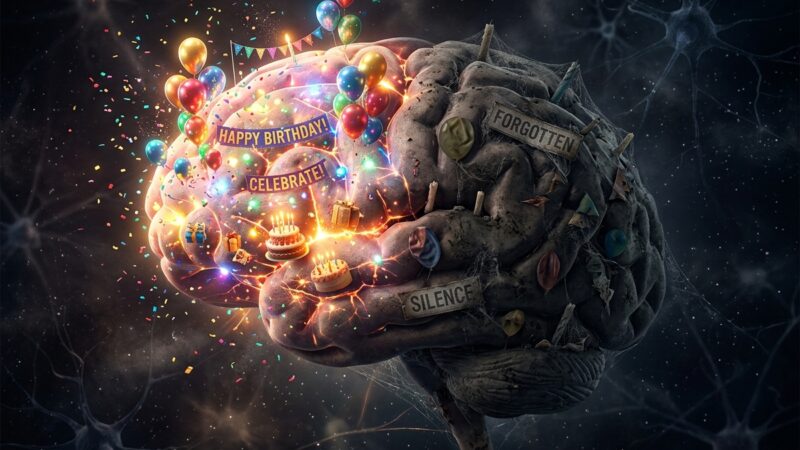
You remember your best friend’s birthday from school — the one you haven’t spoken to in eight years. But your cousin’s birthday? The one who calls you every Eid? Blank. Total blank.
Sounds familiar, right?
This isn’t just you being careless. There’s real birthday memory psychology at work here. Your brain has its own weird system for deciding which dates stay locked in and which ones slip through the cracks. And honestly, once you understand why people remember some birthdays and forget others, you’ll stop beating yourself up every time you miss one.
Let’s break it down — the science, the emotions, the habits, and the sneaky tricks your brain plays on you.
How Your Brain Actually Stores Birthday Dates
Before we talk about forgetting, let’s understand how your brain handles dates in the first place.
Your brain doesn’t treat every piece of information equally. It runs a filtering system — kind of like an email inbox. Some stuff goes to the priority folder, some hits spam, and some just… disappears.
Birthday dates fall under what psychologists call declarative memory — facts and information you consciously learn. But here’s the catch: just because you learn a date doesn’t mean your brain decides to keep it.
The Role of Repetition
Think about the birthdays you never forget. Your mom’s. Your partner’s. Your own kid’s. You’ve seen those dates repeated hundreds of times — on cakes, invitations, WhatsApp messages, calendar alerts.
Repetition strengthens neural pathways. The more you encounter a date, the deeper it gets etched into your memory. It’s the same reason you still remember your childhood phone number but can’t recall your current WiFi password.
Emotional Weight Matters
Your brain gives VIP treatment to memories attached to strong emotions. A birthday party where you laughed till your stomach hurt? That date sticks. A random colleague’s birthday where you just signed an office card? Gone by next week.
Neuroscience research shows that the amygdala — the brain’s emotional center — works closely with the hippocampus (the memory center). When emotions run high during a birthday event, these two regions tag-team to create a stronger, longer-lasting memory.
This is exactly why the science behind birthday memories is so closely tied to how those moments made you feel.
The Top Reasons People Forget Birthdays
Alright, so now you know your brain plays favorites. But what specifically causes you to forget certain birthdays? Let’s get into the real forgetting birthdays reasons that most people don’t talk about.
1. No Emotional Connection to the Person
This one’s straightforward. If someone doesn’t hold a strong emotional place in your life, their birthday simply doesn’t get priority storage.
You’re not a bad person for this. Your brain is a survival machine, not a social calendar. It remembers what it thinks matters for your emotional well-being. A distant relative you see once a year at family gatherings? Your brain quietly decides: “Not important enough to store.”
2. Information Overload
Here’s a number that might surprise you: the average person knows between 150-600 people personally. That’s a LOT of birthdays to track.
Your brain’s working memory can handle roughly 4-7 items at any given time. Expecting it to store hundreds of dates without any external system? That’s like asking a phone with 1GB storage to hold your entire photo library.
The people who seem to remember everyone’s birthday? Nine times out of ten, they’re using a calendar app, a notebook, or Facebook reminders. It’s not superhuman memory — it’s a system.
3. The Birthday Wasn’t “Eventful”
Did you know that your brain remembers events much better than dates?
If someone’s birthday involved a big party, a surprise, a funny disaster, or a meaningful gift exchange, you’ll remember the date because it’s anchored to a vivid memory. But if their birthday passed quietly — maybe just a text message — there’s nothing for your brain to grab onto.
Psychologists call this the “event-dependent memory” effect. The richer the event, the stickier the date becomes.
This also explains why surprise parties are so popular — they create exactly the kind of intense, unexpected emotional moment that locks into memory.
4. You Learned the Date Passively
There’s a huge difference between someone telling you their birthday and you experiencing their birthday.
If your friend casually mentioned “Oh, my birthday is March 14th” during a random conversation, your brain treated it as background noise. But if you attended their March 14th party, bought them a gift, and ate cake — now you’ve got multiple sensory anchors for that date.
Active engagement beats passive learning every single time.
5. Digital Dependence Killed Natural Memory
Let’s be real: social media ruined our ability to remember birthdays on our own.
Before Facebook and Instagram, you had to remember birthdays yourself. You wrote them in diaries. You memorized them because there was no backup system. Now? You rely on notifications. And the moment those notifications stop (like when you deactivate an account), suddenly you don’t know anyone’s birthday.
Research from the University of California found that “cognitive offloading” — relying on devices to store information — actually weakens your brain’s natural memory capacity over time.
So yeah, the very tool that helps you wish people on birthdays is making you worse at remembering them. Ironic, right?
The shift in how social media changed birthday culture runs deeper than most people realize.
Which Birthdays Do People Almost Always Remember?
Now let’s flip it. Some birthdays are practically impossible to forget. What makes them so sticky?
Milestone Birthdays
18th, 21st, 30th, 40th, 50th — these aren’t just numbers. They’re cultural markers. They carry social weight.
Your brain treats milestone birthdays differently because society tells you they matter. There’s usually a bigger celebration, more planning, and more social reinforcement around these dates. That extra attention creates stronger memory traces.
There’s a reason why 18th and 21st birthdays are considered special across so many cultures — they represent transition, identity, and social recognition.
Birthdays Close to Holidays or Significant Dates
Know someone born on December 25th? January 1st? Valentine’s Day? You probably never forget their birthday — because it’s tied to a date your brain already has filed away.
This is called “associative memory.” Your brain links the new information (birthday) to existing strong memory (holiday), and they become a package deal.
Your Own Birthday (Obviously)
Your own birthday is the one date your brain will never let go of. It’s tied to your identity, your legal documents, every form you’ve ever filled out, and a lifetime of celebrations.
Quick Fact: Studies show that people can recall their own birthday-related memories with far more detail and accuracy than almost any other autobiographical memory. Psychologists call this the “birthday effect” in memory research.
And the emotions tied to your own birthday? They run deep — which is why some people feel emotional on their birthday even when nothing particularly good or bad happens.
Birthday Memory Psychology: What Research Actually Says
Let’s get a bit nerdy here — because the psychology behind this is genuinely fascinating.
The Spacing Effect
German psychologist Hermann Ebbinghaus discovered something back in the 1880s that still holds true: we remember information better when we encounter it at spaced intervals rather than all at once.
This is why you remember the birthdays of people you interact with regularly. Every year, you see their birthday pop up. You wish them. Maybe you attend a party. That annual repetition — spaced perfectly — keeps the memory alive.
But if you lose touch with someone? Those spaced repetitions stop. And the memory fades within 2-3 years for most people.
The Serial Position Effect
Psychologists have found that people remember the first and last items in a list better than the ones in the middle. Apply this to birthdays: you likely remember the birthday of the first close friend you ever made and the most recent friend you’ve gotten close to. But the friends in between? Harder to recall.
Emotional Memory Enhancement
A 2019 study published in Nature Human Behaviour confirmed that emotionally charged events are remembered with significantly more clarity and persistence than neutral events. This directly explains why some birthday parties stay in your mind for decades while others vanish within months.
The birthday where your dad surprised you with your first bicycle? You’ll carry that memory forever — along with the exact date. The birthday where you just had dinner at home and went to bed? Probably can’t even tell someone which birthday that was.
Common Myths About Forgetting Birthdays
Let’s bust some myths that make people feel unnecessarily guilty.
Myth 1: “If You Forget Someone’s Birthday, You Don’t Care About Them”
Not true. Memory and affection aren’t the same thing. You can deeply love someone and still forget their birthday. Your brain’s storage system doesn’t rank information by how much you care — it ranks by how often you’ve been reminded and how emotionally intense the associated memories are.
Myth 2: “People With Good Memory Remember All Birthdays”
Even people with exceptional memory don’t automatically remember every birthday. Having a “good memory” usually means someone is better at encoding and retrieving certain types of information. But dates? Dates are abstract numbers. They’re some of the hardest things for the human brain to retain without context or repetition.
Myth 3: “Older People Forget More Birthdays Because of Age”
Age-related memory decline is real, but it’s not the main reason older adults forget birthdays. The bigger factor? Social circle changes. As people age, their active social circles often shrink. Fewer regular interactions mean fewer reminders, which means more forgotten dates.
Interestingly, why birthdays feel faster as you age is connected to this same psychological pattern — time perception and memory formation both change as we grow older.
Myth 4: “Men Are Worse at Remembering Birthdays Than Women”
Research does show a slight edge for women in remembering dates and social obligations, but the difference is small. What actually differs is the social expectation. Women are often socially conditioned to be the “rememberers” in families — the ones who buy cards, plan parties, and set reminders. When men don’t do this, it looks like they forget more. In reality, they just have fewer systems in place.
Practical Tips to Remember Birthdays You Keep Forgetting
Okay, enough psychology. Let’s get practical. Here are strategies that actually work:
Set Up a Dedicated Birthday Calendar
Don’t rely on social media. Create a separate Google Calendar or Apple Calendar just for birthdays. Set reminders for 3 days before each birthday so you have time to plan a wish, gift, or message.
Pro Tip: Spend 30 minutes one weekend adding every important birthday you know. This one-time effort pays off for years.
Create Emotional Anchors
For birthdays you keep forgetting, try linking them to something you’ll remember. Your uncle’s birthday is two days after Independence Day? Now you’ve got an anchor. Your friend was born the same month as your anniversary? There’s your connection.
Your brain loves patterns and associations. Give it some to work with.
Use the “Birthday Cluster” Method
Group birthdays by month. Instead of remembering 30+ individual dates, remember: “March is the month with three birthdays — Ali, Sara, and Dad.” Then check your calendar at the start of each month.
This reduces cognitive load and makes the task feel less overwhelming.
Write Physical Birthday Cards
This might sound old-school, but the act of writing engages your motor memory, visual memory, and cognitive memory simultaneously. Studies show you’re far more likely to remember something you’ve physically written down versus something you’ve typed.
There’s a reason the history of birthday cards goes back centuries — the physical act of creating or writing a card creates a deeper memory connection than any digital notification ever could.
Actually Attend Birthday Celebrations
Remember the event-dependent memory effect we talked about? Use it. When you actually show up to someone’s birthday celebration, you create a multi-sensory memory. The food, the laughter, the photos — all of it works together to cement that date in your brain.
Why birthday photos matter to people isn’t just about nostalgia — photos actually serve as memory anchors that help you recall dates and events years later.
Why This Matters More Than You Think
Forgetting someone’s birthday isn’t just a minor oops. For some people, it genuinely hurts. Birthday memory psychology tells us that people often interpret a forgotten birthday as a measure of their importance in your life.
A 2021 survey by Hallmark found that 68% of people said they’d feel “hurt or disappointed” if a close friend or family member forgot their birthday. Not angry — hurt. There’s a difference, and it matters.
You don’t have to throw a party for everyone you know. But a simple “Happy Birthday” text — sent on the right day — tells someone: “You matter to me. I remember you.”
That’s powerful. And it costs you nothing except a little bit of organization.
Some people even reflect deeply on life during birthdays, making your remembered wish arrive during one of their most emotionally open moments.
FAQ Section
Why do I remember my childhood friend’s birthday but forget my coworker’s?
Your childhood friend’s birthday is tied to strong emotional memories — parties, sleepovers, shared experiences during your formative years. Your brain encoded that date alongside powerful feelings. Your coworker’s birthday, on the other hand, was probably just a line on an office email. Without emotional weight or repeated personal experience, the date doesn’t stick.
Does social media actually help or hurt our ability to remember birthdays?
It’s a double-edged sword. Social media reminds you about birthdays, which is helpful. But it also creates cognitive offloading — your brain stops trying to remember because it knows Facebook will do the job. If you ever delete your account or the platform changes its notification system, you’ll suddenly realize you don’t actually know most people’s birthdays. The smartest move? Use social media as a backup, but keep your own calendar too.
Is forgetting birthdays a sign of a bad memory?
Not necessarily. Birthday dates are arbitrary numbers — they don’t have logical patterns or meaningful context on their own. Forgetting them is more about lack of repetition and emotional anchoring than about having a poor memory overall. You might forget your neighbor’s birthday but remember every lyric to a song you heard in 2009. That’s just how brains work — they prioritize differently.
Can you train your brain to remember more birthdays?
Yes. The most effective method is spaced repetition combined with emotional anchoring. Add birthdays to a calendar, review them monthly, and create personal associations for each date. Over time, your brain starts treating these dates as important information worth retaining. It takes about 3-4 annual cycles before a birthday truly feels automatic in your memory.
One Last Thought
The reason why people remember some birthdays and forget others isn’t about love, loyalty, or being a good person. It’s about how your brain files information — through emotion, repetition, and experience.
You remember your mom’s birthday because decades of cakes and celebrations burned that date into your neural wiring. You forget your colleague’s birthday because your brain simply never had a reason to prioritize it.
The fix isn’t to feel guilty. The fix is to build a simple system — a calendar, a habit, a monthly check-in — that does the remembering for you. Let your brain handle the emotions. Let the system handle the dates.
And next time you do remember someone’s birthday without a notification popping up? Watch their face. That moment of genuine surprise and happiness — “You actually remembered!” — is worth every bit of effort.
Now might be a good time to open your calendar and add a few dates you’ve been meaning to save. Your future self — and your relationships — will thank you for it.
Related Articles

Twins’ Birthday Wishes: Double the Fun & Greetings
Celebrating two people at once is a special kind of joy. Whether you’re writing in a...

Thank You Messages: 100+ Replies for Birthday Wishes
Someone took a moment out of their day to think of you, type out a message,...

Best Friend Birthday Wishes: Top Heartfelt Messages
A good friend’s birthday deserves more than a rushed text or a recycled message you’ve sent...