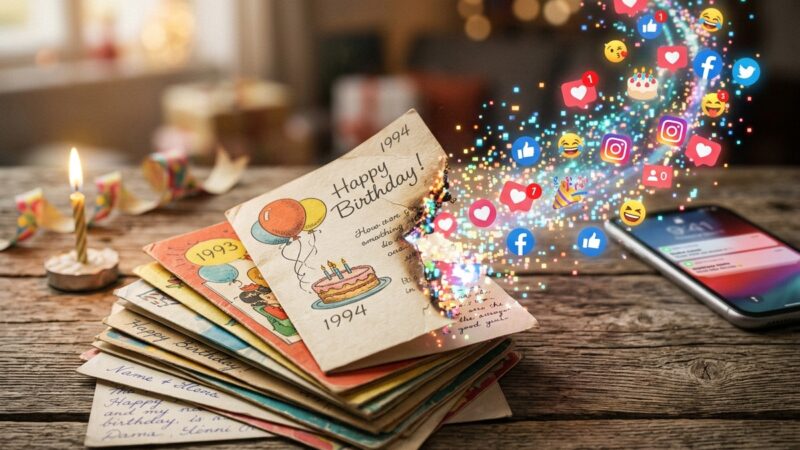
Ten years ago, forgetting someone’s birthday was just… forgetting. Nobody really noticed. Maybe your mom would remind you, or you’d see a date circled on a wall calendar. That was it.
Now? Facebook sends you a notification. Instagram stories flood your feed with birthday selfies. TikTok serves you a viral birthday trend before you’ve even had your morning coffee. And if you don’t post for someone’s birthday? Well, that silence speaks louder than any birthday card ever could.
How social media changed birthday culture isn’t just about technology — it’s about how we feel, connect, and even stress about a day that’s supposed to be fun. The entire emotional landscape of birthdays has shifted. What was once a private, intimate celebration has become a public, performative, and sometimes exhausting experience.
Let’s talk about what actually happened, why it matters, and what we lost (and gained) along the way.
The Birthday Before Social Media: A Quick Flashback
Before we talk about digital birthday culture, let’s rewind for a second.
Think about birthdays in the 90s or early 2000s. Your celebration was limited to people who actually remembered your birthday. Your mom called. Your best friend showed up with a gift. Maybe your office threw a small party with a store-bought cake.
The guest list was real, the wishes were personal, and nobody felt pressured to document every moment. You blew out candles without worrying about the camera angle.
Did you know? Birthday cards were a massive industry — Hallmark alone sold millions each year. People actually walked into stores, picked a card, wrote something by hand, and mailed it. That act itself carried emotional weight.
Birthday parties, too, had a very different feel. If you’re curious about how birthday parties changed over time, you’ll notice the shift started small — and then social media blew the doors wide open.
The point is: birthdays used to be personal. They belonged to you and your closest people. That version of birthday culture didn’t disappear overnight. It eroded slowly, one Facebook wall post at a time.
How Social Media Changed Birthday Culture: The Big Shifts
1. Facebook Made “Remembering” Birthdays Effortless (and Meaningless?)
Facebook deserves credit — or blame — for the single biggest change in birthday culture over the last two decades.
Before Facebook, remembering someone’s birthday required effort. You had to know the date. You had to care enough to remember it. That effort was the gift.
Then Facebook introduced birthday reminders. Suddenly, hundreds of people you barely knew were writing “HBD!” on your wall. Your third-grade classmate. Your neighbor’s cousin. That person you met once at a conference in 2012.
Here’s what changed:
- The number of birthday wishes exploded — but their emotional value dropped
- “Happy Birthday” became a two-word obligation, not a genuine gesture
- People started measuring their social worth by how many wall posts they received
- Some people even started deleting their birthday from Facebook to avoid the shallow flood
A 2023 Pew Research survey found that nearly 45% of adults under 35 consider social media birthday wishes “mostly performative.” That’s almost half of young adults saying these wishes don’t feel real.
And yet — removing your birthday from Facebook feels risky too. What if nobody notices? What if the silence confirms a fear you didn’t want to face? This tension between wanting authentic connection and fearing digital invisibility is something the psychology behind birthday happiness explains really well.
2. Instagram Turned Birthdays Into a Visual Performance
If Facebook changed who wishes you, Instagram changed how you celebrate.
Instagram made birthdays visual. Aesthetic. Curated. Your birthday isn’t just about having fun anymore — it’s about looking like you’re having fun. The cake needs to be photogenic. The outfit needs to be Instagram-worthy. The location needs a good backdrop.
Social media birthday trends on Instagram include:
- Birthday photo dumps (a carousel of your “best moments”)
- The birthday appreciation post (a public love letter to your friend)
- Matching outfits or themed birthday shoots
- Countdown stories leading up to the big day
- Balloon walls, neon signs, and elaborate party decor designed primarily for photos
Here’s the uncomfortable truth: a lot of modern birthday spending is driven by how the celebration will look online, not how it actually feels in person.
A 2024 study by Eventbrite found that 62% of millennials and Gen Z respondents said they consider “Instagrammability” when planning birthday events. That means the audience for your birthday isn’t just your guests — it’s your followers.
Pro Tip: If you find yourself stressing more about the photos than actually enjoying your birthday, that’s a sign to pause. The best birthday moments are the ones you feel, not the ones you filter. People who struggle with birthday pressure might relate to why some people hate celebrating birthdays — and there’s no shame in that.
3. TikTok Created Birthday “Content” and Viral Trends
TikTok took things even further. Birthdays aren’t just celebrations anymore — they’re content opportunities.
You’ve probably seen these viral birthday trends on TikTok:
- The “Get Ready With Me” birthday edition — filming your entire birthday prep routine
- Surprise reaction videos — friends recording your shock for views
- Birthday hauls — showing off every gift you received
- “What I got for my birthday” videos — which sometimes feel more like flexing than sharing
- Birthday transformation reels — “morning me vs. birthday glam me”
TikTok turned birthdays into a spectator sport. Your birthday doesn’t just belong to you and your circle anymore. It belongs to the internet.
And the pressure? It’s real. Younger users, especially teens, report feeling anxious if their birthday content doesn’t get enough likes or views. Imagine feeling like your birthday failed because a video didn’t go viral.
This is especially intense for Gen Z, who grew up with social media as their default social environment. The line between “celebrating” and “performing” barely exists for some of them. If you want a deeper look at these patterns, check out how birthday trends changed in Gen Z.
4. The Public Birthday Wish Became a Relationship Barometer
This one’s sneaky, but powerful.
Social media turned the birthday post into a public statement about your relationship. Not posting for someone’s birthday? That’s suspicious. Posting with the wrong photo? That’s shade. Writing a short caption instead of a long one? People notice.
Think about it:
- Couples now face silent pressure to post elaborate birthday tributes for each other. If you don’t? Followers assume something’s wrong.
- Friends judge their friendship status by whether they got a story mention, a feed post, or just a DM.
- Family members compare whose birthday message was more heartfelt — publicly.
This has created a weird new social anxiety. The birthday post isn’t about the birthday person anymore. It’s about proving your relationship to an audience.
And if you’re wondering why people share birthday posts on social media in the first place — the reasons go deeper than you’d think. It’s tied to validation, belonging, and social signaling.
Quick Fact: According to a 2023 YouGov survey, 33% of people admitted they’ve felt hurt when someone close to them didn’t post a birthday wish on social media — even if that person wished them privately.
The Emotional Cost of Digital Birthday Culture
Birthday Anxiety Is a Real Thing Now
Here’s something most articles about social media birthday trends won’t tell you: birthdays have become a source of genuine anxiety for many people.
The reasons stack up fast:
- Comparison pressure — Seeing other people’s extravagant birthday celebrations on your feed makes your own feel “less than”
- Expectation overload — You expect a flood of wishes, and if it’s a trickle, it stings
- Content pressure — Feeling like you need to post something, even when you don’t want to
- Financial pressure — Spending more than you can afford because the party needs to “look good” online
- Emotional vulnerability — Birthdays already stir deep feelings, and social media amplifies them
People who are naturally introverted feel this pressure differently. The expectation to perform publicly on your birthday clashes hard with wanting a quiet, low-key day. For anyone who relates, here’s a helpful read on birthday celebration ideas for introverts.
Why people feel emotional on their birthday is already complex enough — social media just adds layers of complication to those feelings.
The “Birthday Highlight Reel” Problem
You see someone’s birthday on Instagram. There are gorgeous photos, tons of friends, an amazing restaurant, flowers everywhere. You think, “Wow, their life is perfect.”
What you don’t see: the fight they had with their partner that morning. The friend who cancelled last minute. The cake that was ordered wrong. The quiet moment in the bathroom where they felt lonely despite the crowd.
Social media shows the highlight reel. Always has. But on birthdays, this effect hits harder because birthdays are already emotionally loaded days. You’re comparing your real, messy, complicated birthday with everyone else’s curated, filtered, carefully-angled version.
That comparison can leave you feeling genuinely sad — on a day that’s supposed to be yours.
What We Actually Gained From Digital Birthday Culture
Okay, it’s not all bad. Let’s be fair.
Social media has given us some genuinely good things when it comes to birthdays:
Long-Distance Connection
Before social media, staying connected with distant friends and family on birthdays was expensive (international calls) or slow (postal mail). Now, someone in Tokyo can send you a video message at midnight. A childhood friend you haven’t seen in years can drop a heartfelt comment that makes your entire day.
For people separated by geography, digital birthday culture is a lifeline. It keeps relationships warm even when physical distance makes in-person celebration impossible.
Creative Expression
Social media gave everyone a creative outlet for birthday celebrations. You don’t need a party planner or a big budget. You can make a heartfelt Instagram reel, a funny TikTok, or a beautiful story collage — all from your phone.
Some of the most touching birthday tributes live on social media. Written with genuine love, shared with beautiful photos, and preserved forever. These digital gestures have their own kind of permanence that handwritten cards couldn’t always offer.
Preserving Memories
Why birthday photos matter to people has taken on new meaning in the social media age. Platforms have become accidental scrapbooks. Your Facebook memories remind you of a birthday from 7 years ago. Instagram archives hold photos from celebrations you might have forgotten.
For many families, social media posts have become the primary way birthday memories are stored and revisited. That’s genuinely valuable.
Reconnection
Sometimes, a simple birthday wish from someone unexpected can reopen a door. Former colleagues, old school friends, distant relatives — social media birthday reminders have led to real reconnections. Conversations that start with “Happy Birthday!” sometimes lead to coffee dates, rekindled friendships, and meaningful catch-ups.
Social Media Birthday Trends That Define 2025
Digital birthday culture keeps evolving. Here’s what’s trending right now:
The “Anti-Birthday” Movement
More and more people — especially millennials and older Gen Z — are intentionally opting out of public birthday celebrations on social media. They’re removing birth dates from profiles, skipping the annual birthday post, and choosing private celebrations instead.
This isn’t about hating birthdays. It’s about reclaiming them. People want their birthday to feel personal again, not like a public event they need to manage.
Some people go a step further and stop celebrating birthdays altogether as adults. That’s a valid choice, and it’s becoming more common.
Micro-Celebrations Over Mega-Parties
The trend is shifting from one big Instagram-worthy event to smaller, meaningful moments. A quiet dinner with three close friends. A solo birthday trip. A FaceTime call with family instead of a party.
This shift suggests people are getting tired of performing. They want real connection, not content.
Digital Gift-Giving
E-gift cards, Venmo birthday funds, and online wishlists have replaced a lot of traditional gift-giving. This is especially true among younger demographics who prefer practical gifts over physical ones. Most popular birthday gifts by age shows how preferences have shifted dramatically alongside social media growth.
Birthday Fundraisers
Facebook’s birthday fundraiser feature changed how some people use their birthday. Instead of receiving gifts, they raise money for causes they care about. Since its launch, Facebook birthday fundraisers have raised over $7 billion for nonprofits. That’s a genuinely positive impact of digital birthday culture.
Nostalgia-Driven Celebrations
There’s a growing trend of recreating childhood birthday themes — but with an adult twist. Think: a 28-year-old throwing a “90s Nickelodeon” themed party and posting it on Instagram. It’s part nostalgia, part content creation, and part genuine fun.
Common Myths About Social Media and Birthdays
Myth 1: “Social media ruined birthdays.”
Not exactly. Social media changed birthdays. The core desire — to feel loved and celebrated — hasn’t changed at all. The methods and pressures have shifted, but the emotion underneath is the same one humans have felt for centuries. Why do people love their birthdays so much explores this deep human need that exists far beyond any app.
Myth 2: “Only young people care about social media birthdays.”
Wrong. People of all ages engage with digital birthday culture. Grandparents post birthday wishes on Facebook. Parents create birthday reels for their kids. The behavior patterns differ by age group, but the participation is cross-generational.
Myth 3: “A social media birthday wish is always shallow.”
Sometimes a two-word “Happy Birthday!” is shallow. But sometimes a friend writes a paragraph about what you mean to them, shares a photo from a meaningful moment, and puts thought into every word. The medium doesn’t automatically determine the sincerity. The person behind the post does.
Myth 4: “Birthday traditions haven’t really changed — it’s just online now.”
That’s an oversimplification. The nature of traditions has shifted. New rituals have formed — the birthday story, the appreciation post, the birthday dump, the TikTok reaction video. These are entirely new cultural traditions that didn’t exist 15 years ago. Compare them with birthday traditions around the world and you’ll see how dramatically things have evolved.
How to Protect Your Birthday Joy in the Social Media Era
If digital birthday culture stresses you out, here are some honest, practical strategies:
1. Set your own rules. You don’t owe anyone a public celebration. If you want a private birthday, take it. Hide your birth date. Post nothing. That’s completely fine.
2. Separate celebration from documentation. Put the phone down for at least part of your birthday. Experience the moment before you capture it. Your memory of how something felt is more valuable than how it looked.
3. Be intentional about your wishes. Instead of copy-pasting “HBD” on 30 walls, send five genuine, personal messages to people who actually matter. Quality beats quantity every time.
4. Stop counting. Don’t count wall posts. Don’t count likes on your birthday photo. Don’t compare your celebration to someone else’s highlight reel. Those numbers don’t measure love.
5. Create offline traditions. Build birthday rituals that have nothing to do with social media. A yearly handwritten letter to yourself. A specific meal you always cook. A walk in your favorite place. These personal traditions will mean more to you at 70 than any Instagram post.
FAQ Section
Has social media made birthdays more stressful?
For many people, yes. The pressure to post, perform, and compare has added new layers of anxiety to birthdays. A 2023 survey by the American Psychological Association noted that social media-related comparison is a growing factor in birthday-related stress, particularly among 18-34 year olds. That said, social media also creates joy for people who use it intentionally — connecting with distant loved ones, receiving unexpected wishes, and sharing happiness. The stress usually comes from external expectations, not the platforms themselves.
Why do people get upset when they don’t get birthday wishes on social media?
Because social media has turned birthday wishes into a visible, countable metric of social connection. When you see other people receiving hundreds of wishes and you receive few, it triggers feelings of being forgotten or unimportant. This taps into deep psychological needs for belonging and validation — the same needs explored in why birthdays matter in psychology. The key is remembering that a wish’s value comes from who sends it, not from how many you receive.
What are the biggest social media birthday trends right now?
In 2025, the biggest digital birthday culture trends include: the “anti-birthday” movement (opting out of public celebrations), birthday photo dumps on Instagram, TikTok birthday reaction videos, Facebook birthday fundraisers for charity, micro-celebrations with small groups instead of big parties, and nostalgia-themed birthday events. The overall direction is moving toward more authentic, personal celebrations — partly as a reaction against years of over-performing on social media.
Is it rude to not post a birthday wish on social media?
Not inherently, but context matters. Close relationships carry higher expectations. If you always post for other friends but skip one person, they’ll probably notice and feel hurt. The best approach? If someone is truly important to you, wish them personally — call, text, or visit. A private, heartfelt message will always outweigh a public, generic one.
Your Birthday, Your Rules
Social media didn’t destroy birthdays. It complicated them. It added new pressures, new expectations, and new ways to feel both connected and inadequate — sometimes on the same day.
But here’s what hasn’t changed: your birthday is still yours. No algorithm, no trend, no follower count gets to decide what it means to you. The people who truly love you will show up — whether that’s in your Instagram comments, your text messages, or your living room with a homemade cake.
The best birthday celebrations aren’t the ones that get the most likes. They’re the ones that make you feel genuinely seen.
So the next time your birthday comes around, ask yourself one simple question: “What would make me happy today?” — and then do exactly that. Phone optional.
Related Articles
Twins’ Birthday Wishes: Double the Fun & Greetings
Celebrating two people at once is a special kind of joy. Whether you’re writing in a...

Thank You Messages: 100+ Replies for Birthday Wishes
Someone took a moment out of their day to think of you, type out a message,...
Best Friend Birthday Wishes: Top Heartfelt Messages
A good friend’s birthday deserves more than a rushed text or a recycled message you’ve sent...