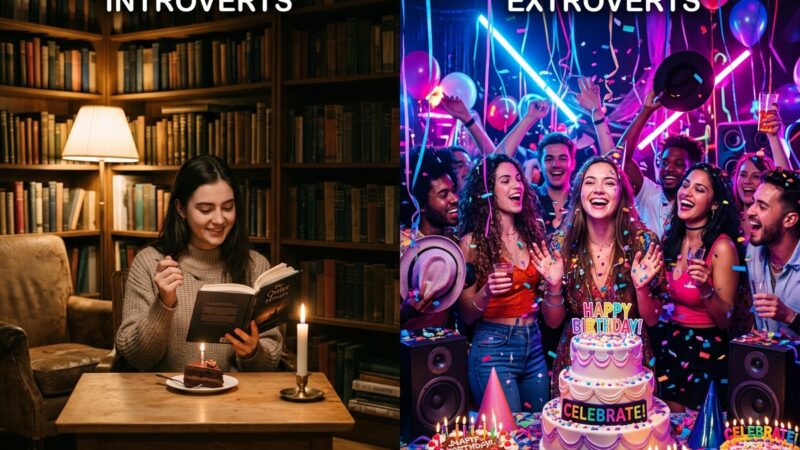
Picture this: your birthday is next week. Your extrovert friend is already making a guest list of 50 people, booking a venue, picking a DJ, and designing Instagram-worthy decorations. Meanwhile, you — the introvert — are quietly hoping everyone just… forgets.
Sound familiar?
The way introverts vs extroverts on birthdays behave is almost like watching two completely different movies. One’s a loud Bollywood masala film with 200 background dancers. The other is a calm, beautifully shot indie film with just two characters sharing coffee by the window. Neither is wrong. Both are perfect in their own way.
But here’s the problem — society has trained us to believe that birthdays MUST be loud, crowded, and full of social energy. If you don’t throw a big party, something’s “wrong” with you. And that belief makes a lot of introverts dread their own special day.
This article breaks down exactly how introverts and extroverts experience birthdays differently, gives you real introvert birthday ideas that feel authentic, and helps extroverts understand their quieter loved ones a little better. There’s also a good chance you’ll discover something surprising about yourself along the way.
Why Birthdays Feel So Different for Introverts and Extroverts
The core difference isn’t about liking or disliking birthdays. It’s about energy.
Psychologist Carl Jung introduced the introversion-extroversion spectrum back in the 1920s. His research showed that introverts recharge through solitude, while extroverts recharge through social interaction. This single difference changes EVERYTHING about how someone approaches their birthday.
An extrovert’s brain literally gets a dopamine hit from social stimulation. More people = more energy = more happiness. So a packed birthday party isn’t just fun for them — it’s actually energizing.
An introvert’s brain works differently. Too much social interaction drains their mental battery. A surprise party with 30 people doesn’t feel exciting — it feels exhausting. That doesn’t mean they hate people. It means their nervous system processes stimulation differently.
Quick Fact: According to research published in Frontiers in Human Neuroscience, introverts show higher sensitivity to external stimuli, which explains why big gatherings feel overwhelming rather than exciting.
If you’ve ever wondered why people feel emotional on their birthday, this energy dynamic plays a huge role. Introverts especially experience deep reflection and emotional processing around their birthday — something that gets interrupted when they’re forced into a party setting.
How Extroverts Celebrate Birthdays
Let’s talk about the extrovert birthday playbook. You probably already know someone who does ALL of these things:
The Planning Starts Early
Extroverts don’t wait for their birthday to happen — they build toward it. Some start planning weeks or even months in advance. The guest list, the theme, the outfit, the venue — everything gets curated carefully.
And it’s not vanity. For extroverts, the planning process itself is part of the fun. Texting friends, coordinating schedules, browsing decoration ideas on Pinterest — all of this gives them genuine joy.
The Bigger, The Better
A typical extrovert birthday might include:
- A house party or club night with a large group
- Group activities like bowling, karaoke, or escape rooms
- Social media countdowns and birthday-week celebrations
- Matching outfits or themed dress codes
- A birthday brunch AND a birthday dinner (because one event isn’t enough)
You know how birthday trends changed with Gen Z? A lot of those viral, over-the-top celebrations you see on TikTok lean heavily into extroverted energy.
Social Media Is Part of the Celebration
For many extroverts, the birthday isn’t complete until it’s documented and shared. Stories, reels, photo dumps, thank-you posts — it’s all part of the experience.
This isn’t shallow. For extroverts, sharing birthday posts on social media is a way of connecting with their wider circle. It extends the celebration beyond physical boundaries.
The Emotional Payoff
Extroverts feel most loved when surrounded by people. Hearing “Happy Birthday” from a room full of friends, getting surprise visits, receiving group gifts — these moments fill their emotional cup to the brim.
Their birthday energy is outward-facing. They give energy, receive energy, and the cycle keeps them buzzing for days.
How Introverts Celebrate Birthdays
Now let’s flip the script. How introverts celebrate birthdays looks NOTHING like the extrovert playbook — and that’s completely okay.
The Ideal Birthday Might Be “Nothing”
Ask an introvert what they want for their birthday, and the most honest answer you’ll get is: “Nothing big.” And they genuinely mean it.
“Nothing” doesn’t mean they don’t care about their birthday. It means their ideal celebration is low-key, intimate, and pressure-free. A quiet dinner with one or two close friends. A solo movie marathon. An entire day with zero obligations.
Some introverts actually look forward to their birthday precisely because it gives them “permission” to do exactly what they want — which is often something peaceful.
Small Gatherings Over Big Parties
If an introvert does celebrate with people, the group is usually small — maybe 3 to 5 close friends, max. The vibe is conversational, not performative. Think board games at home, a cozy dinner at a quiet restaurant, or cooking together.
Pro Tip: If you’re planning something for an introvert, never surprise them with a crowd. The “surprise” part triggers their fight-or-flight response, not joy. Seriously — surprise parties are popular for a reason, but that reason doesn’t apply to most introverts.
Deep Reflection Is Part of the Day
Introverts tend to use their birthday as a personal checkpoint. They reflect on the past year, think about growth, set quiet goals, and process emotions.
This is actually backed by psychology. Birthdays matter deeply in psychology because they act as temporal landmarks — moments that naturally trigger self-evaluation. Introverts lean into this process much more than extroverts do.
You might find an introvert journaling on their birthday, taking a long walk alone, or re-reading old messages. These activities aren’t sad. They’re meaningful.
The “Birthday Text” Is Enough
While extroverts want phone calls, video messages, and in-person wishes, introverts are perfectly happy with a thoughtful text. In fact, a heartfelt message from one close friend can mean more to an introvert than 200 Facebook “HBD” comments.
Quality over quantity — that’s the introvert birthday motto.
Introvert Birthday Ideas That Actually Feel Good
Alright, here’s the practical section. Whether you’re an introvert planning your own day or someone trying to make an introvert feel special, these introvert birthday ideas actually work:
Solo Celebration Ideas
- Bookstore + coffee shop day: Browse for hours, grab your favorite latte, buy yourself a book. Simple and perfect.
- Self-care marathon: Face masks, long bath, candles, your favorite playlist. No guilt, no interruptions.
- Solo travel day: Even a short drive to a nearby town or a nature trail can feel like the best birthday gift.
- Cook your favorite meal: The process of cooking alone, for yourself, is incredibly therapeutic for introverts.
- Art or creative project: Start that painting, write that poem, build that LEGO set you’ve been eyeing.
If you want more ideas specifically designed for quieter celebrations, check out these birthday celebration ideas for introverts.
Intimate Gathering Ideas
- Dinner for 2-4 people: A nice home-cooked meal or a quiet restaurant with your closest people.
- Movie night at home: Pick the birthday person’s favorite films, make popcorn, keep it cozy.
- Board game or card game evening: Low-pressure, fun, and genuinely bonding.
- Stargazing or bonfire night: If weather allows, this is magical and conversation-friendly.
Gift Ideas Introverts Actually Love
Forget the generic stuff. Introverts appreciate gifts that show you understand them:
- A handwritten letter (this hits different, trust me)
- A book from their wishlist
- Noise-canceling headphones
- A personalized birthday gift that shows thought, not price tag
- A journal or planner
- A subscription (streaming, audiobooks, or even a meal kit)
Did You Know? Research on gift-giving psychology shows that introverts value “experiential” and “personal” gifts over flashy material ones. The thought behind the gift matters 10x more than the packaging.
The Myths We Need to Stop Believing
There are some seriously persistent myths about introverts and birthdays. Let’s clear them up:
Myth 1: “Introverts Don’t Like Their Birthdays”
Wrong. Many introverts LOVE their birthdays. They just don’t love the performance that society attaches to birthdays. The day itself — the personal significance, the reflection, the quiet joy — is something they genuinely value.
Some people assume that those who hate celebrating birthdays are always introverts. That’s not accurate either. Plenty of extroverts avoid birthdays for their own reasons (aging anxiety, past trauma, loss). And plenty of introverts celebrate happily — just on their own terms.
Myth 2: “Extroverts Are Attention-Seekers”
Wanting a big birthday party doesn’t make someone an attention-seeker. Extroverts genuinely draw energy from social interaction. Their desire to celebrate publicly isn’t ego — it’s how they experience joy.
Judging an extrovert for wanting a big party is the same as judging an introvert for wanting a quiet night. Both are valid expressions of personality.
Myth 3: “You Can’t Be Both”
The introversion-extroversion spectrum isn’t black and white. Many people are ambiverts — somewhere in the middle. You might want a small dinner party one year and a solo spa day the next. Your birthday preference can change based on your mental state, life stage, and who’s around you.
Myth 4: “Introverts Need to Be ‘Fixed'”
This one makes introverts’ blood boil. Comments like “You should go out more!” or “Don’t be boring, it’s your birthday!” are deeply unhelpful.
An introvert choosing a quiet birthday isn’t a cry for help. It’s a confident, self-aware choice. Respect it.
What Happens When Introverts and Extroverts Are in the Same Friend Group
This is where things get tricky — and interesting.
The Birthday Planning Conflict
Imagine an extrovert planning their introvert friend’s birthday. Their instinct is to go big: surprise party, lots of people, loud music. Because that’s what THEY would want. But for the introvert, this is basically a nightmare scenario.
The reverse happens too. An introvert might plan a “nice quiet dinner” for their extrovert friend, who ends up feeling underwhelmed.
The key? Ask, don’t assume. A simple “How do you want to celebrate this year?” solves 90% of birthday conflicts.
The Couples Dynamic
Introvert-extrovert couples face this challenge every year. The extrovert wants to throw a joint party. The introvert wants to stay home. Neither is wrong, but compromise is essential.
Pro Tip for couples: Celebrate separately AND together. Let the extrovert have their big party. Let the introvert have their quiet morning. Then share a private moment — dinner for two, exchanging gifts, or just watching a movie together. Both partners feel honored.
The Workplace Birthday
Office birthdays are a special kind of torture for introverts. The forced gathering in the break room, the singing, everyone staring while you cut the cake — it’s a lot.
If you manage a team, consider asking each person privately how they’d like their birthday acknowledged. Some want the full celebration. Others would prefer a card and a quiet “happy birthday” in the hallway.
The Psychology Behind Birthday Preferences
Your birthday preference isn’t random. It’s deeply connected to your psychological wiring.
Dopamine sensitivity plays a major role. Extroverts have a more active dopamine reward system, meaning social activities trigger stronger pleasure responses. Introverts have a more active acetylcholine system, which rewards internal activities like thinking, reflecting, and quiet focus.
The psychology behind birthday happiness shows that happiness on birthdays isn’t one-size-fits-all. What makes one person euphoric can make another person anxious.
Attachment style also matters. People with secure attachment styles tend to celebrate more freely, regardless of introversion/extroversion. Those with avoidant attachment might resist celebrations as a way of maintaining emotional distance.
And then there’s the science behind birthday memories. Introverts often form stronger, more detailed memories of birthdays because they process experiences deeply. An extrovert might remember the party vibe. An introvert remembers the exact words their best friend said during a quiet midnight call.
How to Celebrate Someone Else’s Birthday the Right Way
Whether you’re planning for an introvert or an extrovert, here’s a quick cheat sheet:
For Your Introvert Friend:
- Don’t surprise them (or at least warn them vaguely)
- Keep the group tiny
- Give them an exit strategy — let them leave early without guilt
- Choose quiet venues over loud ones
- A thoughtful text or letter means more than a public shoutout
- Don’t pressure them to post about it on social media
For Your Extrovert Friend:
- Go big if you can — they’ll appreciate the effort
- Involve as many of their friends as possible
- Social media shoutouts are welcome and loved
- Group activities work great
- The more personal touches (photos, inside jokes, custom playlist), the better
- Energy and enthusiasm matter — match their vibe
FAQ Section
Do introverts actually enjoy their birthdays?
Yes, most introverts do enjoy their birthdays. They just prefer celebrating in ways that match their energy — think small gatherings, solo activities, or intimate dinners. The misconception that introverts “hate” birthdays comes from confusing introversion with being antisocial. They’re not the same thing. Introverts simply recharge differently, and a birthday spent in peace can feel just as special (if not more) than a wild party.
What’s the best birthday gift for an introvert?
The best gifts for introverts are thoughtful, personal, and useful. Handwritten letters, books, journals, noise-canceling headphones, or experience-based gifts like a spa voucher work wonderfully. Avoid gifts that require social performance, like group activity passes (unless they’ve specifically asked for them). The golden rule: show that you understand their personality, not just their wishlist.
Can someone be both an introvert and an extrovert on their birthday?
Absolutely. Many people are ambiverts, and birthday preferences can shift based on mood, age, and life circumstances. You might crave a party at 25 and prefer a quiet cabin trip at 30. Your personality isn’t locked in a box, and your birthday celebrations shouldn’t be either. Listen to what you actually want each year instead of following a script.
Why do introverts feel drained at birthday parties?
Introverts’ nervous systems are more sensitive to external stimulation. Large crowds, loud music, constant small talk, and being the center of attention all require significant mental energy. Their brains process social interactions more deeply, which means even a two-hour party can feel like a full workday. It’s not rudeness or disinterest — it’s neurology.
Your Birthday, Your Rules
Here’s what it really comes down to: introverts vs extroverts on birthdays isn’t a competition. Nobody “celebrates better.” The best birthday is the one that leaves YOU feeling genuinely happy — not performing happiness for someone else’s benefit.
If you want 100 people and a DJ? Do it. If you want a blanket, your cat, and a book? That’s equally perfect.
The only birthday rule worth following is this: celebrate in a way that fills YOUR cup. And if someone in your life celebrates differently than you do, don’t try to “fix” them. Try to understand them.
The fact that you’re reading this article means you already care enough to think about it. That alone makes you a pretty good friend, partner, or birthday planner.
Now go plan a birthday — yours or someone else’s — that actually feels right. 🎂
Related Articles

Twins’ Birthday Wishes: Double the Fun & Greetings
Celebrating two people at once is a special kind of joy. Whether you’re writing in a...

Thank You Messages: 100+ Replies for Birthday Wishes
Someone took a moment out of their day to think of you, type out a message,...

Best Friend Birthday Wishes: Top Heartfelt Messages
A good friend’s birthday deserves more than a rushed text or a recycled message you’ve sent...