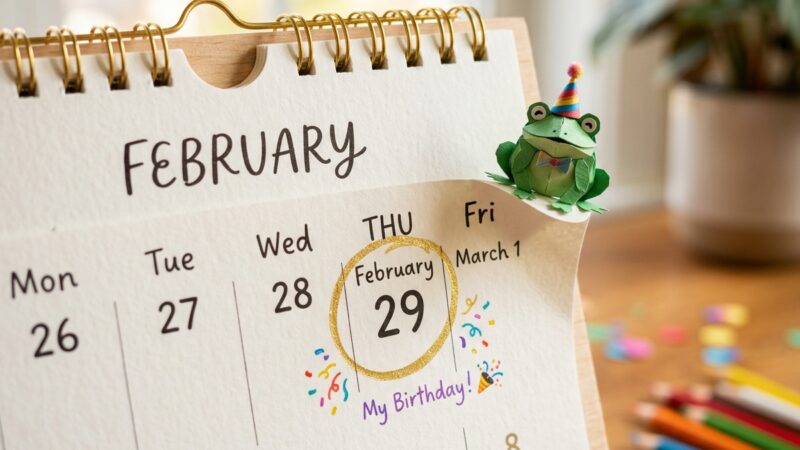
Only about 5 million people on the entire planet share a birthday that comes around once every four years. That’s roughly 1 in 1,461 odds — rarer than being left-handed, rarer than having green eyes.
If you or someone you know was born on February 29, you already know the drill. The jokes about “technically being 5 years old,” the confusion over which day to celebrate in non-leap years, and that constant need to explain your birthday to literally everyone.
But there’s a lot more to fun facts about leap year babies than just the calendar quirk. These “leaplings” — yes, that’s the real term — have a fascinating history, unique legal quirks, and some pretty surprising celebrity company. Whether you’re a leapling yourself, you know one, or you’re just curious about this rare birthday, you’re going to find some things here that genuinely surprise you.
Let’s get into it.
What Exactly Is a Leap Year Baby?
A leap year baby, also called a leapling or a leaper, is anyone born on February 29. This date only exists during leap years, which happen every four years (mostly — we’ll get to that exception in a second).
The whole reason February 29 exists is because Earth doesn’t orbit the Sun in a perfect 365 days. It actually takes about 365.2422 days. That extra quarter-day adds up, so every four years, we add an extra day to keep our calendar aligned with the seasons.
Quick Fact: Without leap years, our calendar would drift by about 24 days every century. Eventually, you’d be celebrating Christmas in the middle of summer.
So leaplings are born on a date that the calendar literally skips three out of every four years. And that creates some really interesting situations.
15 Fun Facts About Leap Year Babies You Need to Know
1. The Odds of Being Born on Feb 29 Are About 1 in 1,461
Do the math: one day out of every 1,461 days (that’s four years’ worth). Your chances of being a leapling are approximately 0.068%. To put that in perspective, you’re more likely to be born on any other single day of the year by a factor of four.
There are roughly 5 million leaplings worldwide as of recent estimates. That sounds like a lot, but spread across 8 billion people? It’s a tiny club.
2. There’s an Actual Debate About When to Celebrate
Here’s where it gets interesting. In non-leap years, leaplings face the annual question: February 28 or March 1?
Some go with February 28 because their birthday month is February. Others pick March 1 because that’s technically the day after February 28 — the “next day” after when they were born. And some celebrate both days, because why not?
Different countries have actually passed laws about this. In New Zealand, the legal birthday for leaplings in non-leap years is February 28. In the United Kingdom, it’s March 1. So your “real” non-leap-year birthday literally depends on where you live.
People who love celebrating their birthdays might find this frustrating. But most leaplings have learned to make the best of it — often turning it into a multi-day celebration.
3. Leaplings Have Their Own Club
It’s called the Honor Society of Leap Year Day Babies, founded in 1997. It has over 11,000 members from more than 50 countries. They connect online, share stories, and even organize meetups and birthday celebrations during leap years.
There’s also a Leap Year Festival held in Anthony, Texas — which has declared itself the “Leap Year Capital of the World.” The festival happens every four years and attracts leaplings from all over to celebrate together. The next big one is expected during the next leap year in 2028.
4. Some Famous People Share This Rare Birthday
The list of celebrities and historical figures born on February 29 is surprisingly fun:
- Ja Rule — rapper (born 1976)
- Tony Robbins — motivational speaker (born 1960)
- Mark Foster — British Olympic swimmer (born 1970)
- Superman — yes, DC Comics officially set his birthday as February 29
- Aileen Wuornos — the infamous serial killer (born 1956)
- Pope Paul III — born in 1468, one of the earliest recorded famous leaplings
It’s quite the mixed bag. You’ve got motivational speakers, athletes, fictional superheroes, and… well, some less cheerful names. But it does show that famous celebrities with unusual birth stories always capture public attention.
5. A Leapling’s “Age” Is a Constant Source of Jokes
If you’re born on February 29, 2000, by 2024 you’ve lived 24 years — but you’ve technically only had 6 actual birthdays on your real date. That means a 24-year-old leapling can joke about being “6 years old.”
Some leaplings absolutely love this. Others find it exhausting after hearing the same joke for decades. But it does make for a great icebreaker, and plenty of leaplings lean into it at parties.
Did You Know? A leapling doesn’t turn “21” (in leap year birthdays) until they’re actually 84 years old in regular years. So technically, no leapling has ever legally celebrated their 21st leap year birthday. The oldest verified leapling lived to be around 100.
6. Legal Age Can Get Complicated
This isn’t just a fun party fact — it has real legal implications. When can a leapling legally drive? Vote? Drink alcohol? Buy a house?
Most legal systems handle this by defaulting to March 1 in non-leap years as the date when a leapling “turns” a certain age. But this varies by jurisdiction. Some countries and states have specific statutes addressing this, while others leave it vague.
Imagine turning 18 and the DMV can’t figure out your exact legal birthday. It happens more often than you’d think.
There’s something worth exploring about why 18th and 21st birthdays are considered special, especially when your actual birthday doesn’t show up on the calendar that year.
7. The Gregorian Calendar Made Leap Years More Accurate
Here’s a fact most people get wrong. They think leap years happen every four years, no exceptions. That’s not quite right.
The rule is actually this:
- A year divisible by 4 is a leap year
- EXCEPT years divisible by 100 are NOT leap years
- EXCEPT years divisible by 400 ARE leap years
So 1900 was not a leap year (divisible by 100 but not 400). But 2000 was a leap year (divisible by 400). The next century year that won’t be a leap year is 2100.
This means if you were “supposed” to be born on February 29, 1900 — that date didn’t exist. Your birthday literally disappeared from the calendar, not just for three years, but permanently for that cycle.
Pope Gregory XIII introduced this system in 1582, replacing the Julian calendar. And it’s still the most accurate common calendar system we have.
8. Some Cultures Have Unique Superstitions About Leap Year Babies
In many cultures, being born on February 29 comes with weird birthday superstitions people still believe.
- In Scotland, there’s an old belief that being born on a leap day brings bad luck. Some Scottish farmers even believed leap year babies would have unpredictable, troubled lives.
- In Greece, getting married during a leap year was considered unlucky. About 1 in 5 Greek couples reportedly avoided leap year weddings in the past.
- In Taiwan, married daughters are expected to return home during leap years to bring good health to their parents — often bringing pig trotter noodles as a gift.
- In Ireland, there’s the tradition that women can propose to men on February 29 — a practice dating back to the 5th century and linked to a supposed deal between St. Bridget and St. Patrick.
Not all birthday traditions around the world treat leap day the same way. It really depends on where you are.
9. The Record for Most Generations Born on Leap Day
Here’s one of the most jaw-dropping leap year birthday facts: the Henriksen family of Norway holds the record for the most consecutive generations born on February 29.
Heidi Henriksen was born on February 29, 1960. Her daughter Olav was born on February 29, 1964. And Olav’s daughter Leif-Martin was born on February 29, 1968.
Three consecutive generations — all leaplings. The probability of this happening is astronomical. We’re talking roughly 1 in 3 billion odds.
The Keogh family from Ireland and the UK also had a father and son both born on February 29, in different years. These cases always make international headlines because the odds are so wild.
10. Leaplings Sometimes Face Issues with Technology
In the digital age, being born on February 29 can create some seriously annoying tech problems:
- Online forms sometimes don’t include February 29 as a valid date option
- Some software calculates age incorrectly for leaplings
- Auto-generated birthday reminders on social media can glitch or skip their birthday entirely
- Insurance and banking systems have occasionally flagged leap day birthdays as “errors”
Facebook, for example, used to have issues sending birthday notifications for leaplings on the right day. While most major platforms have fixed this by now, smaller websites and apps still struggle with it.
How social media changed birthday culture is a whole topic on its own, but for leaplings, the digital world adds an extra layer of complexity.
11. Some Parents Actually Try to Avoid a February 29 Birthday
Here’s something doctors have confirmed: some expecting parents who have due dates around late February specifically ask about scheduling inductions or C-sections to avoid having a leap day baby.
Their concerns usually include:
- The child will face birthday confusion their whole life
- Legal complications down the road
- The constant need to explain their birthday
On the flip side, some parents actively hope for a leap day baby, seeing it as unique and special. There’s no right or wrong here — it’s purely a matter of perspective.
12. Leap Day Has Its Own Unofficial Holiday
February 29 is sometimes called “Leap Day” as if it’s a holiday — and some people treat it that way. Businesses and brands occasionally run Leap Day promotions. Some restaurants offer free meals to leaplings. Certain retail chains have given discounts to anyone who can prove they were born on February 29.
The concept of celebrating an “extra” day has turned Leap Day into a quirky cultural moment. It’s not a national holiday anywhere, but it has the energy of one every four years.
13. Leaplings Tend to Develop a Unique Relationship with Birthdays
Because they can’t celebrate on their actual birth date three out of four years, many leaplings develop a different perspective on birthdays. Some become very protective of their “real” birthday in leap years and throw massive celebrations. Others become more relaxed about birthdays altogether.
There’s actually an interesting psychological angle here. Studies on the psychology behind birthday happiness suggest that anticipation plays a huge role in birthday joy. For leaplings, the four-year wait can make their real birthday feel exponentially more meaningful.
Some leaplings say they feel a deeper sense of reflection on life during their birthdays — especially the “real” ones — because they come around so rarely.
14. The “Pirate” Connection Most People Don’t Know About
Gilbert and Sullivan’s comic opera “The Pirates of Penzance” (1879) features one of the most famous leapling characters in fiction — Frederic. In the plot, Frederic was apprenticed to pirates until his 21st birthday. But because he was born on February 29, his 21st birthday wouldn’t arrive until he was 84 years old. The pirates use this technicality to keep him bound to their service.
It’s a comedic plot twist, but it actually highlights the real legal gray area leaplings face. And it’s been a cultural touchstone for leap year humor for over 140 years.
15. Leaplings Can Officially “Catch Up” on Milestone Birthdays
Think about this: a leapling born on February 29, 2020, will have their first “real” birthday in 2024, their second in 2028, and won’t hit their “5th birthday” until they’re 20 years old.
This creates a fun opportunity for unique birthday milestones that matter most — like celebrating your “sweet 16th birthday” when you’re actually 64. Or your “10th birthday” at age 40. Some leaplings throw themed parties based on their leap year age, complete with children’s decorations and cartoon cakes. It’s become a whole leapling tradition.
Common Myths About Leap Year Babies — Debunked
Myth 1: “Leaplings Are Unlucky”
There’s zero evidence for this. The Scottish superstition about leap day babies being unlucky has no basis in reality. Leaplings live perfectly normal lives, and the superstition has faded significantly in modern times.
Myth 2: “February 29 Doesn’t Count as a Real Birthday”
It absolutely does. It’s a real date on the calendar during leap years, and it’s legally recognized worldwide. The fact that it doesn’t appear every year doesn’t make it less valid.
Myth 3: “Leap Years Happen Every 4 Years, No Exceptions”
As we covered earlier, there ARE exceptions. Century years not divisible by 400 skip the leap year. So 2100, 2200, and 2300 won’t be leap years — but 2400 will.
Myth 4: “Hospitals Don’t Record February 29 as a Birth Date”
Hospitals absolutely do. Your birth certificate will say February 29 if that’s when you were born during a leap year. There’s no policy anywhere to “bump” babies to February 28 or March 1.
How Leaplings Celebrate Their Birthday (Real Stories)
The creativity of leaplings when it comes to birthday celebrations is next level. Here are some real patterns:
The “Quadrennial Blowout” — Many leaplings save up and throw a massive party every four years when their actual birthday rolls around. Think destination trips, big gatherings, and over-the-top themes.
The Two-Day Celebration — Some celebrate on both February 28 AND March 1 in non-leap years. Double the cake, double the fun.
The Age-Theme Party — Throwing a “5th birthday party” at age 20, complete with bounce houses and juice boxes. It’s become a beloved leapling tradition and makes for seriously fun birthday photos that people love to share.
The Low-Key Approach — Some leaplings deliberately skip celebrations in non-leap years and treat their actual birthday as the only “real” one. It makes the four-year wait feel more special.
FAQ Section
Do leap year babies age differently?
No, leaplings age exactly like everyone else — one year at a time. The joke about being “technically 5 years old at 20” is purely a calendar quirk. Biologically, legally, and in every practical way, a 20-year-old leapling is 20 years old.
When do leap year babies celebrate their birthday in non-leap years?
It depends on the person and their country. Some choose February 28, others pick March 1, and some celebrate on both days. Legally, New Zealand defaults to February 28, while the UK uses March 1. Most leaplings just pick whatever feels right to them.
How rare is it to be born on February 29?
You have roughly a 1 in 1,461 chance of being born on February 29 — that’s about 0.068%. There are approximately 5 million leaplings alive today worldwide. For context, that’s fewer people than the population of Singapore.
Can a leap year baby have a “normal” birthday every year?
Many leaplings simply pick February 28 or March 1 as their annual celebration date and live their lives normally. The “real” February 29 birthday becomes a special quadrennial event. So yes, they celebrate every year — just not always on the exact date printed on their birth certificate.
What happens if a leap year baby needs to renew a license or passport?
Government agencies handle this by using the birth date as recorded (February 29) and applying standard age calculations. Renewals, expirations, and legal milestones are all processed based on the actual number of years lived, not the number of times February 29 has appeared on the calendar.
Your Birthday, Your Rules
Whether you’re a leapling yourself or you just stumbled onto this page out of curiosity, one thing is clear — fun facts about leap year babies go way beyond the “you’re only technically 5!” joke. From legal quirks and world records to cultural superstitions and tech glitches, the leapling experience is genuinely unique.
Being born on a date that only exists 25% of the time sounds like an inconvenience. But most leaplings will tell you it’s actually a gift. It makes your birthday rarer, your celebrations more intentional, and your story more interesting than the average person’s.
If you know a leapling, maybe surprise them with one of these facts they haven’t heard before. Or better yet — make sure you actually remember their birthday when that magical February 29 comes around. They notice who remembers. Trust me.
And if you’re curious about what makes birthdays so meaningful to us as humans, check out why birthdays matter in psychology. It’ll give you a whole new appreciation for that one special day — whether it shows up on the calendar every year or not.
Related Articles

Twins’ Birthday Wishes: Double the Fun & Greetings
Celebrating two people at once is a special kind of joy. Whether you’re writing in a...

Thank You Messages: 100+ Replies for Birthday Wishes
Someone took a moment out of their day to think of you, type out a message,...

Best Friend Birthday Wishes: Top Heartfelt Messages
A good friend’s birthday deserves more than a rushed text or a recycled message you’ve sent...