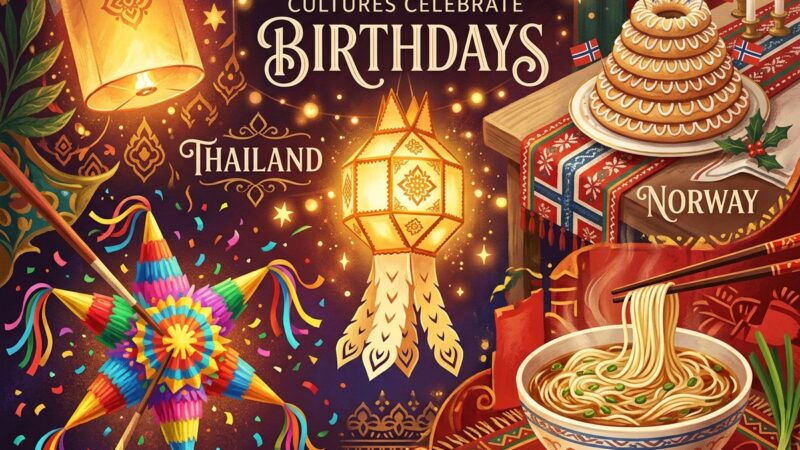
In Denmark, friends and family sneak up and throw cinnamon all over you if you’re unmarried on your 25th birthday. Sounds wild, right?
Here’s the thing — what feels like a “normal” birthday celebration to you might seem completely strange to someone from another country. And their traditions might blow your mind too.
The way how different cultures celebrate birthdays tells us so much about their values, history, and what they believe matters most in life. Some cultures throw massive feasts. Others believe birthdays are unlucky and skip them altogether. A few even have rituals involving ear-pulling, face-smashing into cake, or eating extremely long noodles.
This article walks you through cultural birthday traditions from across the globe — continent by continent, country by country. You’ll discover why certain foods are eaten, which ages are considered milestones, and how birthday celebrations worldwide have evolved into the colorful, diverse patchwork they are today.
Whether you’re curious, planning a multicultural party, or just love learning about the world, you’re going to enjoy this ride. There’s a reason people love their birthdays so much — and these traditions prove it.
Why Do Birthday Traditions Differ So Much Across Cultures?
Before we explore country-specific customs, let’s address the “why” behind these differences.
Birthday celebrations are shaped by three main forces:
- Religion and spiritual beliefs — Some religions encourage celebrating life. Others view birthdays as self-centered or linked to pagan practices.
- Historical customs — Ancient civilizations had their own rituals around aging and milestones, and many of those stuck.
- Social values — Collectivist cultures often celebrate differently than individualist ones. Family-centered societies might prioritize group meals, while others focus on the individual.
Quick Fact: The concept of birthday parties for common people didn’t even become widespread until the 18th century in Europe. Before that, only royalty and religious figures had their births celebrated.
You can trace how birthday parties changed over time to see how economics, religion, and pop culture all played a role in shaping what we do today.
North American Birthday Traditions
United States and Canada
American birthday parties are probably what most people picture when they think of birthdays: cake with candles, the “Happy Birthday” song, gifts, and a party. But even this “standard” celebration has some fascinating roots.
- Birthday cake and candles — This tradition has German origins (more on that later). Blowing out candles and making a wish is believed to date back to Ancient Greece, where lit candles represented moonlight offered to the goddess Artemis. If you’re curious, you can read about the origin of birthday cakes and candles in detail.
- “The Birthday Spanking” — Older generations might remember birthday spankings — one smack for each year plus “one to grow on.” This tradition has mostly faded, but it traces back to German folklore where physical birthday bumps were thought to ward off evil spirits.
- Sweet Sixteen — For American girls, turning 16 is a big deal. Sweet Sixteen parties can range from small gatherings to lavish events rivaling weddings.
- 21st birthday — The legal drinking age makes this a huge milestone. You’ll find why 18th and 21st birthdays are considered special across multiple Western cultures.
Did You Know? The “Happy Birthday to You” song was originally a classroom greeting called “Good Morning to All,” written by sisters Patty and Mildred Hill in 1893. Learn more about the history of Happy Birthday songs and how this tune became the world’s most recognized song.
Mexico — La Mordida and Quinceañera
Mexican birthday celebrations are loud, colorful, and absolutely full of love.
Two traditions stand out:
La Mordida — When the birthday person leans in to take the first bite of cake, someone pushes their face right into it. Everybody laughs, frosting goes everywhere, and it’s considered good luck. If you’ve seen viral videos of this, you know how entertaining it gets.
Quinceañera — This is the celebration of a girl’s 15th birthday. It marks her transition from childhood to young womanhood. A Quinceañera typically includes:
- A religious ceremony (usually a Catholic Mass)
- A formal ball or reception
- A special tiered cake
- The “last doll” — representing childhood left behind
- A waltz with the father
- Changing from flat shoes to heels — symbolizing growing up
Some families save for years to afford a Quinceañera. It’s that culturally significant.
Latin American Birthday Customs
Brazil
Brazilians don’t wait until the party to eat cake. The birthday person is the first to cut the cake and traditionally offers the first slice to their most important person — usually a parent or best friend.
Pulling ears is also common in Brazil. Friends and family tug on the birthday person’s earlobes — one pull for each year of life. It’s playful, not painful (usually).
Brazilian birthday parties also feature brigadeiros — chocolate truffle-like sweets rolled in sprinkles. No birthday is complete without them. Speaking of food traditions, birthday foods from different countries are surprisingly varied and tell their own cultural stories.
Argentina
Argentinians share a special tradition: when a child turns 1, objects are placed in front of them. Whatever the baby grabs is thought to predict their future. A pen means they’ll be a writer. Money means wealth. A ball means they’ll be an athlete.
For older kids and adults, the ear pull tradition shows up here too — just like Brazil.
European Birthday Traditions
Germany — Kindergeburtstag
Germany holds a special place in birthday history. Many historians credit Germans with popularizing children’s birthday parties — known as Kindergeburtstag — back in the 18th century.
Some unique German traditions:
- The Birthday Wreath (Geburtstagskranz) — A wooden wreath with candle holders, one for each year, plus a taller “life candle” in the center. It’s lit at breakfast and the birthday child blows it out.
- No early wishes — You should never wish a German person “Happy Birthday” before their actual birthday. It’s considered extremely bad luck. Germans take this so seriously that if someone tries, they’ll genuinely get uncomfortable. This connects to weird birthday superstitions people still believe around the world.
- Sweeping the stairs at 30 — If a man turns 30 and is still unmarried, his friends make him sweep the steps of a public building (usually the town hall). Women have to polish door handles. Friends throw things to make the job harder, and it only stops when the single person gets a kiss from someone.
Denmark
Danish birthdays are visually distinctive. If it’s a child’s birthday, a Danish flag (Dannebrog) is flown outside the window. You’ll also see flags placed around the table and even stuck into the birthday cake.
And that cinnamon tradition I mentioned? It’s real. If you hit 25 and you’re not married, your friends drench you in cinnamon. At 30? They upgrade to pepper. It’s messy, hilarious, and very Danish.
Ireland — Birthday Bumps
In Ireland, children are held upside down and “bumped” gently on the floor — once for each year of age, plus one for good luck. It’s called birthday bumps, and it’s done with lots of laughter.
The Irish also have a tradition called The Key of the House — when a child turns 21, they’re presented with a large symbolic key, representing freedom and maturity.
Russia
Russian birthdays focus heavily on the birthday person as the host. Instead of people bringing gifts and food for you, you are expected to bring treats to school or work for your friends and colleagues.
Children’s birthdays often include pie instead of cake, and the birthday song is different — it’s called “Пусть бегут неуклюже” (Let Them Run Clumsily), from a beloved Soviet-era cartoon.
Pro Tip: If you’re attending a Russian birthday, don’t give an even number of flowers. Even numbers are reserved for funerals. Always give odd — 1, 3, 5, 7 flowers.
Asian Birthday Traditions
Asia is home to some of the oldest and most meaningful cultural birthday traditions on the planet.
China
Chinese birthday customs are deeply tied to symbolism and food:
- Longevity noodles (长寿面) — The birthday person eats long noodles that must not be cut or broken. The length represents a long life. Slurping them up in one piece is the goal.
- Red eggs — For a baby’s first month birthday (called 满月 / mǎn yuè), families dye eggs red and distribute them to friends and family. Red symbolizes luck and happiness.
- 60th birthday — This is the biggest birthday milestone in Chinese culture. It marks the completion of one full cycle of the Chinese zodiac (5 cycles x 12 animals = 60 years). Families throw elaborate banquets with the elder seated at the center.
Younger generations in China have adopted Western-style cake and candles, but traditional customs still hold strong, especially in rural areas.
South Korea — Doljanchi and Age Counting
South Korean birthday culture is unique in multiple ways.
Doljanchi (돌잔치) — A baby’s first birthday is a massive event. Similar to Argentina, objects are placed before the child: thread (long life), money (wealth), a pencil (scholarship), rice (prosperity). The entire extended family gathers for this celebration.
Korean Age System — Until recently, Korea had a fascinating age-counting system where everyone is 1 year old at birth, and everyone ages up together on New Year’s Day. So a baby born in December would turn “2” just weeks later on January 1st. South Korea officially switched to the international age system in June 2023, but many people still reference Korean age informally.
Seaweed soup (미역국 / miyeokguk) is eaten on birthdays as a tribute to mothers. It’s the same soup given to women after childbirth because it’s rich in nutrients. Eating it on your birthday is a way of thanking your mother.
Japan
Japan has several age-specific celebrations:
- Shichi-Go-San (七五三) — On November 15, children aged 3, 5, and 7 are dressed in traditional kimono and taken to Shinto shrines. The ages 3, 5, and 7 are considered lucky in Japanese culture.
- 20th birthday (Coming of Age Day / 成人の日) — Young adults turning 20 celebrate together on the second Monday of January. They dress in formal kimono or suits and attend municipal ceremonies. In 2022, Japan lowered the age of majority to 18 for legal purposes, but the celebration still commonly happens at 20.
- 60th birthday (Kanreki / 還暦) — Like China, the 60th birthday is a major event. The birthday person wears a red vest (chanchanko) because red symbolizes rebirth — they’ve completed the full 60-year zodiac cycle and are symbolically “born again.”
Vietnam
Vietnamese traditionally celebrate birthdays on Tết (Lunar New Year) — everyone’s birthday is observed at the same time, regardless of their actual birth date. Individual birthday parties are a newer, Western-influenced trend that’s growing among younger Vietnamese.
On Tết, children receive red envelopes (lì xì) filled with money from elders. This is similar to Chinese New Year traditions.
India
India’s birthday traditions vary wildly depending on region, religion, and family background:
- Hindu tradition — Some families visit temples on birthdays. The birthday person touches the feet of elders to receive blessings.
- Cake feeding — A popular modern tradition is feeding the first piece of cake to the closest person (mom, dad, best friend, or spouse).
- New clothes — Wearing brand-new clothing on your birthday is considered auspicious in many Indian communities.
- First birthday (Annaprashan) — In Bengali and some other cultures, a baby’s first solid food ceremony is celebrated as a milestone, often near the first birthday.
Did You Know? Some Hindu families consult astrologers to determine the most auspicious time for birthday celebrations. The actual ritual might happen at a specific hour based on the person’s birth chart.
Also, how different religions view birthdays is a topic that explains why celebrations look so different even within the same country.
African Birthday Traditions
African birthday traditions are as diverse as the continent itself — with 54 countries, hundreds of ethnic groups, and vastly different economic realities, there’s no single “African birthday.”
Nigeria
In Nigeria, birthdays can be large community affairs. Families that can afford it host massive parties called “Owambe” — with loud music (often Afrobeats), matching outfits (called “aso ebi”), and mountains of jollof rice.
Children’s birthdays often include:
- Hiring a DJ or live band
- Elaborate cakes
- Spraying money on the birthday person (similar to wedding celebrations)
Ghana
Ghanaian tradition has a special ceremony called “Outdooring” on the 8th day after a baby’s birth. The baby is brought outside for the first time, officially introduced to the community, and named. This is considered more significant than annual birthday celebrations in many families.
Kenya and East Africa
In some Kenyan communities, a child’s birth is celebrated, but annual birthday parties are a relatively recent, urban phenomenon. In rural areas, acknowledging the day of birth happens but large celebrations aren’t typical. Maasai communities, for example, celebrate age-set transitions rather than individual birthdays — groups of people move through life stages together.
Egypt
Egyptian birthdays, particularly in urban areas like Cairo, look similar to Western celebrations — with cakes, candles, and parties. But there’s an emphasis on large gatherings, where extended family and neighbors are all invited. Children’s parties often feature savory foods alongside sweet ones.
Middle Eastern Birthday Traditions
Saudi Arabia and the Gulf States
Birthday celebrations in parts of the Middle East have a complicated history. Some conservative religious scholars viewed individual birthday celebrations as bid’ah (innovation in religion) and discouraged them. But this has shifted significantly over the past two decades.
Today, especially in cities like Riyadh, Dubai, and Doha, birthday parties are common and often extravagant. Theme parks, event halls, and designer cakes are popular choices for children’s celebrations. Some of the most expensive celebrity birthday parties have been thrown in the Gulf region.
Israel
Israeli children celebrate birthdays with parties that usually include:
- A crown of flowers or leaves (especially for younger kids)
- The birthday child sitting on a decorated chair that’s lifted up by adults — once for each year of age, plus one for good luck
- Singing “Yom Huledet Sameach” (Happy Birthday)
For Jewish communities globally, the Bar Mitzvah (boys, age 13) and Bat Mitzvah (girls, age 12 or 13) are perhaps the most significant birthday-adjacent celebrations, marking religious maturity.
Oceania: Australia and New Zealand
Australia — Fairy Bread
You can’t talk about Australian kids’ birthdays without mentioning fairy bread — white bread spread with butter and covered in sprinkles. That’s it. It sounds ridiculously simple, and it is. But Australians are fiercely loyal to it.
Australian birthday parties also tend to be outdoor affairs — BBQs in parks, beach parties, and pool parties are standard because of the warm climate.
New Zealand — Māori Birthday Traditions
New Zealand’s Māori culture celebrates birthdays within the broader context of whanau (family). While modern Kiwi birthdays look similar to Australian ones, some Māori families incorporate traditional songs (waiata) and blessings into celebrations.
Cultures That Don’t Celebrate Birthdays
Not every culture emphasizes individual birthdays — and that’s perfectly okay.
Jehovah’s Witnesses
Jehovah’s Witnesses don’t celebrate birthdays. They point to biblical references where birthday celebrations are associated with negative events and view them as having pagan origins.
Some Buddhist Traditions
In certain Buddhist cultures, individual birthdays aren’t traditionally celebrated because the focus is on community and selflessness rather than individual attention. In Bhutan, many people don’t know their exact birth date.
Older Generations in China and Vietnam
As mentioned, in traditional Chinese and Vietnamese culture, Lunar New Year served as everyone’s collective birthday. Individual birthday celebrations are a more recent development, adopted partly through Western influence.
If you’re someone who doesn’t love birthday celebrations, you’re definitely not alone. There are real reasons why some people hate celebrating birthdays, and cultural background plays a big part.
Common Birthday Traditions That Cross Borders
Despite all the differences, some birthday customs show up almost everywhere:
| Tradition | Where You’ll Find It |
|---|---|
| Birthday cake with candles | Most Western and many Asian countries |
| Special birthday foods | China, Korea, Brazil, India, Nigeria |
| Ear/body pulling or bumping | Brazil, Argentina, Ireland, Hungary |
| Age-based milestones | Japan, USA, Jewish culture, Latin America |
| Money as gifts | China, Vietnam, Middle East, Korea |
| New clothes on birthdays | India, parts of Africa, Philippines |
| Making a wish | Nearly universal |
Pro Tip: If you’re hosting a multicultural birthday party, incorporating small elements from different traditions — like longevity noodles, fairy bread, and red envelopes — can make guests feel seen and celebrated.
How Globalization Is Changing Birthday Celebrations
Social media and globalization have done something interesting to birthday culture. Traditions are blending. A kid in Tokyo might want an American-style party with a piñata (originally Mexican). A teenager in London might post TikTok-style birthday content inspired by South Korean idol celebrations.
How social media changed birthday culture is a real phenomenon — birthday aesthetics, themed photo shoots, and “birthday month” celebrations are now global trends. The most viral birthday trends on TikTok borrow freely from multiple cultures and create entirely new customs.
But here’s the flip side: as global trends spread, some traditional practices are fading. Younger generations in Japan, China, and India increasingly prefer Western-style cake-and-candle celebrations over traditional rituals. Whether that’s progress or loss depends on who you ask.
FAQ Section
Do all cultures celebrate birthdays?
No. Several cultures and religions don’t emphasize individual birthday celebrations. Jehovah’s Witnesses avoid them for religious reasons. In parts of Southeast Asia and Bhutan, many people historically didn’t track individual birth dates. Traditional Vietnamese and Chinese cultures treated Lunar New Year as a collective birthday instead.
What is the most unique birthday tradition in the world?
That’s subjective, but the Danish cinnamon-and-pepper tradition for unmarried people at 25 and 30 consistently surprises people. The German tradition of sweeping public stairs at 30 if you’re single is another crowd favorite. South Korea’s Doljanchi — where a baby’s future is “predicted” by what object they grab — is also incredibly unique.
Why do some birthday traditions involve pulling ears or bumping?
Physical birthday rituals like ear-pulling (Brazil, Argentina, Hungary) and birthday bumps (Ireland, UK) trace back to folk beliefs. In many cultures, a bump or tug for each year was thought to bring good luck or ward off evil spirits. It’s a way the community physically marks your growth — literally giving you a “nudge” into the next year of life.
Are birthday cakes universal?
Not quite. While birthday cakes have spread globally thanks to Western influence, many cultures have their own birthday foods. Koreans eat seaweed soup. Chinese families serve longevity noodles. Australians eat fairy bread. Russians might have pie instead of cake. The sweet, candle-topped cake is popular worldwide but far from the only option.
At what age do birthday celebrations matter most across cultures?
Milestone ages vary dramatically. In Jewish culture, 12/13 (Bar/Bat Mitzvah) is the big one. In Latin America, it’s 15 for girls (Quinceañera). In Japan, 7-5-3 ages and 20 are key. In China, 60 is the most significant birthday. In the US, 16, 18, and 21 are major markers. You can explore birthday milestones that matter most for a deeper look.
Final Thoughts
Every candle, noodle, red egg, ear-pull, and face-plant into cake carries centuries of meaning behind it. How different cultures celebrate birthdays isn’t just a fun trivia topic — it’s a window into what societies value, fear, hope for, and find funny.
The next time your birthday rolls around, think about this: someone halfway across the world, born on the same day as you, might be eating seaweed soup to honor their mother, sweeping stairs because they’re single, or getting doused in cinnamon by their best friends.
Same milestone. Completely different experience. And that’s what makes birthday celebrations worldwide so beautifully human.
If you want to start your own new birthday tradition — borrow one from this list. Try the Brazilian brigadeiros. Adopt the Danish flag idea. Serve longevity noodles. The best traditions are the ones that feel right for your people.
What tradition surprised you the most? Go explore birthday traditions around the world for even more customs that didn’t make this list — there are plenty more where these came from.
Related Articles
Twins’ Birthday Wishes: Double the Fun & Greetings
Celebrating two people at once is a special kind of joy. Whether you’re writing in a...

Thank You Messages: 100+ Replies for Birthday Wishes
Someone took a moment out of their day to think of you, type out a message,...
Best Friend Birthday Wishes: Top Heartfelt Messages
A good friend’s birthday deserves more than a rushed text or a recycled message you’ve sent...