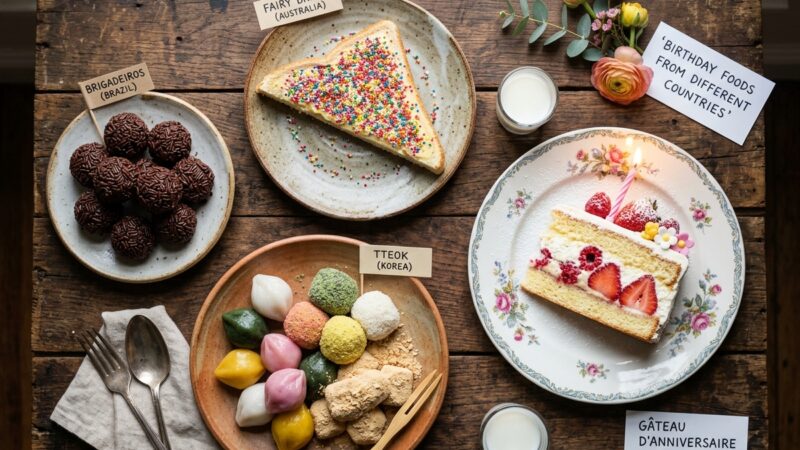
In Russia, kids get a birthday pie with a secret message baked inside it. In China, you don’t blow candles — you slurp long noodles for a longer life. And in Sweden? Your birthday morning starts with a flag-decorated cake served to you in bed.
Birthday foods from different countries aren’t just about eating something sweet and calling it a day. They carry stories, beliefs, and traditions passed down through generations. A birthday cake with candles might feel universal, but the truth is, most of the world celebrates with something wildly different.
If you’ve ever wondered what people eat on birthdays around the world, you’re in for a treat — literally. This isn’t your regular list of “cake from here, cake from there.” We’re going deep into kitchens across continents. You’ll discover traditional birthday food worldwide that’s surprising, meaningful, and honestly, mouth-watering.
And who knows — you might just steal an idea for your own next birthday bash. If you’re curious about how different cultures celebrate birthdays beyond just food, that’s a whole other rabbit hole worth exploring.
Let’s go country by country and see what’s cooking.
Why Birthday Food Matters More Than You Think
Before we travel the globe, let’s talk about why birthday food is such a big deal in every culture.
Food is emotional. Think about it — your favorite birthday memory probably has a taste attached to it. Maybe it’s your mom’s homemade chocolate cake, or that pizza party you had when you turned 10.
Across cultures, the food served on a birthday isn’t random. It’s symbolic. It represents wishes — for long life, good health, prosperity, or sweetness in the year ahead. The ingredients, shapes, even the way food is served often carry deep meaning.
Quick Fact: The tradition of birthday cakes actually traces back to ancient Greece, where round cakes were offered to Artemis, the moon goddess. Those cakes were shaped like the moon and topped with candles to make them glow. You can read more about the origin of birthday cakes and candles — it’s a fascinating story.
So traditional birthday food worldwide isn’t just about taste. It’s about meaning, connection, and culture baked (or steamed, or fried) into every bite.
Birthday Foods From Asia — Where Noodles Beat Cake
Asia is home to some of the most unique and symbolic birthday foods you’ll find anywhere. Cake isn’t always king here.
China: Longevity Noodles (Shòu Miàn)
In China, the star of any birthday table isn’t cake — it’s longevity noodles (shòu miàn). These are extra-long noodles that represent a long, healthy life. Here’s the important part: you’re not supposed to cut or break them. Slurping them whole is the tradition.
Many Chinese birthday celebrations also include shòu táo — peach-shaped buns filled with sweet lotus paste. Peaches symbolize immortality in Chinese mythology.
Pro Tip: If you’re ever invited to a Chinese birthday dinner, don’t cut your noodles. It’s considered bad luck — like cutting your lifespan short.
Modern Chinese birthday parties have adopted Western-style cakes too, but they’re usually lighter — think sponge cake with fresh fruit and whipped cream, not heavy buttercream.
Japan: Celebratory Sushi and Special Cakes
Japanese birthday celebrations often feature a spread of sushi or a family meal at a nice restaurant. Birthdays are seen as personal milestones, so the food is a bit elevated from everyday meals.
Japanese birthday cakes are famous for being incredibly light. They use Japanese sponge cake (castella-inspired) with whipped cream and strawberries. If you’ve ever seen photos of Japanese “Christmas cakes,” birthday cakes look similar — delicate, beautiful, and not overly sweet.
For a child’s first birthday (Issho Mochi), there’s a specific tradition. The baby is given a large, heavy rice cake (mochi) to carry on their back. It symbolizes a healthy life ahead. The mochi isn’t really eaten by the baby — it’s more of a ritual.
South Korea: Seaweed Soup (Miyeokguk)
This one surprises most people. In South Korea, the must-have birthday food isn’t cake or candy — it’s miyeokguk, a warm bowl of seaweed soup.
Why seaweed soup? Because it’s the same soup Korean mothers eat after childbirth to recover their strength and boost nutrition. Eating it on your birthday honors your mother and the day you were born.
Did You Know? Skipping miyeokguk on your birthday in Korea is like skipping cake in America. People will actually ask you, “Did you eat your miyeokguk today?” on your birthday.
Younger generations in Korea do eat Western-style cakes too, but the seaweed soup tradition remains strong across all age groups.
India: Kheer, Halwa, and Sweet Celebrations
India doesn’t have one single birthday food because the country is so culturally diverse. But sweets are the common thread.
Popular birthday treats include:
- Kheer (rice pudding) — especially in North India
- Gulab Jamun — deep-fried milk balls soaked in sugar syrup
- Payasam — a South Indian version of sweet pudding
- Halwa — made from semolina, carrots, or lentils
- Mithai boxes distributed to friends and family
In many Indian families, the birthday person touches the feet of elders and receives blessings before the party even starts. Food is then shared generously — because birthdays in India are about community, not just the individual.
Modern urban India has fully embraced birthday cakes too, often with elaborate fondant designs. But those traditional sweets? They’re still on the table, right beside the cake.
Birthday Foods From Europe — More Than Just Cake
Europe gives us some of the most charming birthday food traditions. And yes, there’s cake — but not always the kind you’d expect.
Germany: Geburtstagskuchen and the Birthday Wreath
Germany takes birthday cake seriously. A traditional Geburtstagskuchen (birthday cake) is often a layered cake, but the really unique tradition is the Geburtstagskranz — a birthday wreath-shaped cake for children.
This wreath has small holes for candles, plus one extra candle in the center called the “Lebenslicht” (light of life). Kids blow out the candles just like anywhere else, but the wreath shape and the life-candle concept are distinctly German.
Adults usually celebrate with a party where the birthday person is expected to bring cake to the office or school — not receive it. That’s right. In Germany, you bring the cake on YOUR birthday.
Russia: Birthday Pie With a Secret Message
Russian birthday celebrations often feature a birthday pie instead of a cake. But here’s the fun part — a secret message or wish is baked right into the pie. Think of it like a fortune cookie, but hidden in pastry.
Some families make savory pies, others go sweet. The filling depends on the region and family tradition. What matters is the hidden wish.
Russian birthdays also involve lots of toasting, and kids’ parties usually have a large spread of food including salads, meats, and of course, that special pie.
Sweden: Birthday Morning in Bed
Swedish kids wake up on their birthday to something special — the family sneaks into their room with a decorated cake, flags, and presents, and sings to them before they even get out of bed.
The cake itself is usually a traditional Swedish prinsesstårta (princess cake) — a domed cake covered in green marzipan, layered with sponge, jam, cream, and custard. It’s been a Swedish classic since the 1940s.
Fun Fact: Princess cake was named because Sweden’s three princesses loved it so much that the pastry school named it after them.
Netherlands: Crown Treatment and Beschuit met Muisjes
In the Netherlands, the birthday child wears a special crown and sits in a decorated chair at school. The food tradition? Traktaties — the birthday kid brings treats for the entire class.
For baby birthdays (and often adult ones too), the Dutch serve beschuit met muisjes — round rusks topped with butter and anise sprinkles. Pink muisjes for girls, blue for boys.
The whole family also gathers in a circle (the famous “Dutch birthday circle”), eats cake, and drinks coffee. If you’re interested in how birthday parties changed over time, you’ll notice these Dutch traditions have stayed remarkably consistent across generations.
United Kingdom: Classic Birthday Cake and Coins
The British stick to the classic birthday cake with candles tradition, but with a quirky twist from the past — coins were sometimes baked into the cake. Finding a coin in your slice meant good fortune.
Other traditional British birthday foods include:
- Fairy cakes (small cupcakes) for children’s parties
- Sausage rolls and finger sandwiches for birthday teas
- Trifle — a layered dessert with sponge, custard, fruit, and cream
- Jelly (what Americans call Jell-O)
The birthday tea party is a very British concept, and while kids today might prefer a bouncy castle and pizza, many families still keep the traditional spread alive.
Birthday Foods From the Americas — North, Central, and South
The Americas offer some of the most vibrant and community-centered birthday food traditions.
Mexico: Tres Leches Cake and Tamales
Mexican birthdays are legendary for their energy, music, and food. The tres leches cake (three-milk cake) is a birthday staple — a sponge cake soaked in three types of milk (evaporated, condensed, and heavy cream). It’s unbelievably moist and sweet.
But cake isn’t the only star. Many Mexican birthday parties also serve:
- Tamales — wrapped in corn husks, filled with meat, cheese, or chili
- Mole — a rich, complex sauce served over chicken
- Churros — fried dough sticks rolled in cinnamon sugar
- Pozole — a hearty hominy soup
And of course, there’s the piñata. While it’s not food itself, what’s inside definitely is — candy, fruit, and treats come raining down when kids break it open.
For a girl’s quinceañera (15th birthday), the celebration reaches another level entirely, with a massive feast that can rival a wedding reception. Speaking of milestone celebrations, birthday milestones that matter most vary wildly from culture to culture.
Brazil: Brigadeiros
You can’t have a Brazilian birthday without brigadeiros. These are small, round chocolate truffles made from condensed milk, cocoa powder, and butter, then rolled in chocolate sprinkles.
They’re so essential to Brazilian birthday culture that a party without brigadeiros would feel incomplete — like a birthday without singing.
Brazilian birthday parties also feature coxinhas (chicken croquettes), empadas (mini pot pies), and beijinhos (coconut truffles, the brigadeiro’s white cousin).
Did You Know? Brazilian birthday celebrations include a tradition where the birthday person takes the first bite of cake but doesn’t cut it for themselves — the closest person (usually their best friend or partner) feeds them the first piece.
United States and Canada: The Classic Birthday Cake
The U.S. and Canada are responsible for popularizing the birthday cake tradition as we know it globally. A layered cake with frosting, candles, the “Happy Birthday” song, make a wish, blow out the candles — this sequence is deeply American.
Popular birthday cake flavors include chocolate, vanilla, red velvet, and funfetti (that sprinkle-filled cake that screams “party”).
But regional differences exist:
- South: Red velvet cake or hummingbird cake
- Northeast: Cannoli cakes, Italian-influenced desserts
- West Coast: Health-conscious options, fruit-based cakes
- Texas: Sheet cake with chocolate frosting is king
American birthday parties also heavily feature pizza, burgers, and ice cream — because honestly, what’s a birthday without junk food?
If you’re curious about how the history of the happy birthday song fits into all of this, that story involves lawsuits, royalties, and a song originally written for kindergartners.
Argentina: Birthday Cake and Ear Pulling
Argentina follows the cake-and-candles tradition, but with a fun twist — the birthday person gets their earlobes pulled once for each year of age. Ouch, but it’s affectionate!
Argentine birthday tables typically feature:
- Dulce de leche cake — because Argentina runs on dulce de leche
- Medialunas — crescent-shaped pastries
- Empanadas — savory filled pastries
- Choripán — chorizo sandwiches for casual gatherings
Birthday Foods From Africa — Rich Flavors and Community Feasts
African birthday traditions are deeply rooted in community and togetherness. Birthday food here is often about sharing a feast rather than individual treats.
Nigeria: Jollof Rice and Celebration Feasts
In Nigeria, a birthday isn’t complete without jollof rice — the beloved one-pot tomato-based rice dish that’s the centerpiece of every celebration. Birthday or not, jollof rice means “this is a big deal.”
Nigerian birthday parties also feature:
- Fried rice alongside jollof (it’s a friendly rivalry)
- Puff puff — sweet fried dough balls (think Nigerian doughnuts)
- Suya — spicy grilled meat skewers
- Chin chin — crunchy fried snacks
- Cake — often multi-tiered and elaborately decorated
Nigerian birthday celebrations are known for being big. We’re talking loud music, matching outfits (aso ebi), and enough food to feed the entire neighborhood. The celebration is a community event.
South Africa: Braai and Birthdays
In South Africa, birthdays often center around a braai — a traditional barbecue that’s practically a national religion. Birthday braais feature:
- Boerewors — coiled sausage
- Sosaties — marinated meat skewers
- Pap — a maize porridge side dish
- Melktert — milk tart for dessert
The 21st birthday is especially significant in South Africa. There’s a tradition called the “key ceremony” where the birthday person receives a large symbolic key representing the key to adulthood. The feast for this milestone? Absolutely massive. You can read about why 18th and 21st birthdays are special across various cultures.
Ghana: Oto for First Birthdays
In Ghana, a child’s first birthday is celebrated with oto — a dish made from mashed yams mixed with palm oil and hard-boiled eggs. It’s a traditional Akan ceremony food that carries deep cultural significance.
The yam symbolizes growth and nourishment, and the occasion marks the child’s survival through their first year — something historically celebrated with great gratitude.
Birthday Foods From the Middle East and Central Asia
This region brings warmth, spice, and generosity to birthday tables.
Iran: A Celebratory Spread
Iranian birthdays feature an elaborate spread that might include:
- Sholeh zard — saffron rice pudding decorated with cinnamon
- Bastani — Persian ice cream with rose water and saffron
- Baghali polo — herbed rice with fava beans, served with lamb
- Fresh fruits, nuts, and pastries
Birthdays weren’t traditionally celebrated in Iran the way Western cultures observe them, but today — especially in urban areas — birthday cakes and parties are very common while traditional foods still hold their place.
Turkey: Feasting and Lokum
Turkish birthdays involve a lot of food, family, and warmth. While Western-style cakes are popular now, traditional celebrations might feature:
- Lokum (Turkish delight) — because no Turkish celebration is complete without it
- Baklava — layers of phyllo, nuts, and honey syrup
- Börek — flaky savory pastries
- Kebabs and grilled meats for larger gatherings
Birthday Foods From Australia and Oceania
Australia: Fairy Bread and Lamingtons
Australian kids’ birthday parties have a food icon that outsiders find baffling — fairy bread. It’s white bread, buttered, and covered in rainbow sprinkles. That’s it. And Australians absolutely love it.
Other Aussie birthday party classics include:
- Lamingtons — sponge cake cubes coated in chocolate and rolled in coconut
- Pavlova — a meringue-based dessert topped with fresh fruit and cream
- Sausage sizzle — because Australia
- Tim Tam slam with hot chocolate
Quick Fact: The fairy bread tradition likely started in the 1920s and became a kids’ party staple by the 1960s. No Australian childhood birthday party is complete without it.
New Zealand: Pavlova Rivalry
New Zealand claims pavlova as their own (Australians disagree — it’s an ongoing friendly battle). Kiwi birthday parties feature pavlova prominently, along with lolly cake — a no-bake slice made with malt biscuits, butter, condensed milk, and fruit-flavored candies.
Surprising Birthday Food Facts You Didn’t Know
Here are some lesser-known traditions that show just how creative the world gets with birthday food:
- Denmark: A flag-covered cake called kagemand (cake man) or kagekone (cake woman) shaped like a person. The head is “chopped off” dramatically while everyone screams.
- Vietnam: Everyone turns a year older on Tết (Lunar New Year), not on their actual birthday. The celebration food? Bánh chưng — sticky rice cakes wrapped in banana leaves.
- Jamaica: It’s common to have the birthday person floured — friends throw flour on them. Then they eat rum-soaked black cake.
- Ghana: Breakfast of oto is followed by a party with loud music and dancing.
- Switzerland: The birthday child gives treats to classmates, not the other way around — similar to Germany.
These traditions remind us that birthday celebrations are incredibly personal and cultural. There are even weird birthday superstitions people believe that connect directly to food — like why you should never cut your birthday cake before the actual day.
Common Myths About Birthday Food Traditions
Let’s clear up a few misconceptions:
Myth 1: Everyone eats birthday cake.
Not true. As we’ve seen, many cultures prioritize noodles, soup, savory pies, or rice dishes over cake.
Myth 2: Blowing out candles on cake is ancient.
The candle tradition only became widespread in the 18th century in Germany. It’s not as old as most people assume. Before that, cakes existed for celebrations, but candles weren’t standard.
Myth 3: Western birthday food traditions are the “default.”
This is a bias. Most of the world’s population celebrates with food traditions that have nothing to do with buttercream frosting and “Happy Birthday to You.” If you explore birthday traditions around the world, you’ll see that Western practices are just one small slice (pun intended) of the picture.
Myth 4: Birthday food traditions don’t change.
They absolutely do. Globalization, social media, and migration have blended traditions beautifully. A Korean family in Los Angeles might have miyeokguk in the morning and a red velvet cake at night. Traditions evolve, and that’s perfectly fine.
How to Bring Global Birthday Foods to Your Celebration
Want to try something different for your next birthday? Here’s how:
- Pick a country that resonates with you and research their specific birthday dish
- Start simple — brigadeiros from Brazil are incredibly easy to make at home
- Go for symbolism — longevity noodles are a beautiful wish for someone’s birthday
- Mix traditions — there’s no rule saying you can’t have fairy bread AND tres leches cake
- Make it a theme — host a “birthday foods around the world” party where each dish represents a different country
Your birthday, your rules. And honestly, borrowing food ideas from around the globe just makes the celebration richer.
FAQ
What is the most common birthday food worldwide?
While birthday cake (specifically a frosted cake with candles) is the most widely recognized birthday food globally due to Western influence, traditional birthday foods vary dramatically. In many Asian countries, noodles or soup take priority. In parts of Africa, communal feasts with rice dishes are the norm. The “most common” depends entirely on the region.
What do people eat on birthdays in Asia?
Asian birthday foods are heavily symbolic. Chinese families serve longevity noodles (shòu miàn) and peach-shaped buns. Koreans eat miyeokguk (seaweed soup) to honor their mothers. Japanese celebrations feature light sponge cakes and sushi. Indian birthdays are marked with traditional sweets like kheer, gulab jamun, and halwa. Cake has become popular across Asia too, but traditional dishes remain central.
Why do some countries eat savory food on birthdays instead of sweet?
Birthday food reflects cultural values and history. In many cultures, the birthday meal is about nourishing the body and soul — not just indulging a sweet tooth. Korean seaweed soup, Nigerian jollof rice, and Russian birthday pie are all savory because the emphasis is on health, community, and tradition rather than sugar and frosting. Sweet foods aren’t absent — they’re just not always the main event.
Can I mix birthday food traditions from different countries?
Absolutely. There’s no cultural rulebook that says you can’t enjoy brigadeiros alongside fairy bread. Many modern families — especially multicultural ones — blend traditions from different backgrounds. Just approach it with respect and genuine appreciation for the culture you’re borrowing from. It’s a celebration, after all.
Your Next Birthday Could Taste Completely Different
Here’s what I love about birthday foods from different countries — they remind us that celebration is universal, but how we celebrate is beautifully unique.
A bowl of seaweed soup in Seoul carries the same love as a tres leches cake in Mexico City. Fairy bread at an Aussie backyard party holds the same joy as longevity noodles at a family dinner in Beijing.
You don’t have to stick with what you’ve always done. Next year, pick one tradition from this list and bring it to your table. Cook those noodles. Roll those brigadeiros. Bake that wreath cake with the “light of life” candle in the center.
Because birthdays are about more than marking another year. They’re about connection — to your people, your roots, and if you’re feeling adventurous, to the rest of the world’s kitchen.
If food traditions got you thinking about the deeper emotional side of birthdays, you might enjoy reading about why people feel emotional on their birthday. It connects a lot of dots.
Now go plan that birthday menu. The world just gave you plenty of options. 🎂🍜🥟
Related Articles

Twins’ Birthday Wishes: Double the Fun & Greetings
Celebrating two people at once is a special kind of joy. Whether you’re writing in a...

Thank You Messages: 100+ Replies for Birthday Wishes
Someone took a moment out of their day to think of you, type out a message,...

Best Friend Birthday Wishes: Top Heartfelt Messages
A good friend’s birthday deserves more than a rushed text or a recycled message you’ve sent...