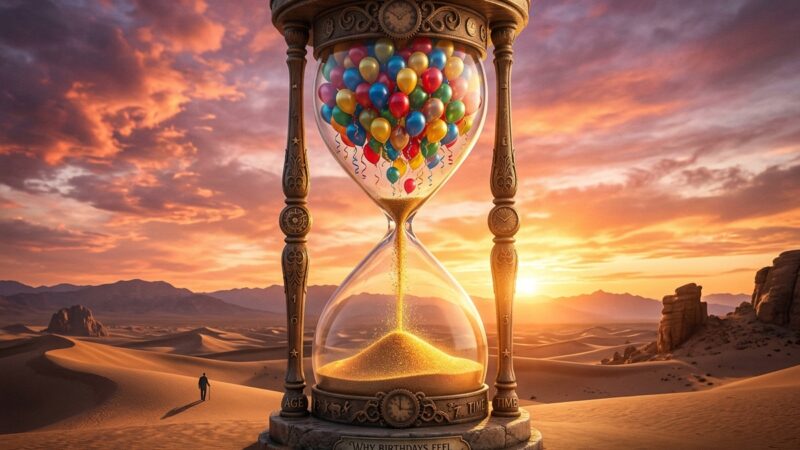
Remember when summer vacations felt like they’d never end? Three months felt like a lifetime. Your 10th birthday felt ages away from your 9th. But somewhere after 25 or 30, something shifted. Now, you blink in January and suddenly it’s October. Another birthday shows up, and you think — “Wait, didn’t I just celebrate one?”
You’re not imagining things. Why birthdays feel faster as you age isn’t just a random feeling — there’s real science behind it. Psychologists, neuroscientists, and philosophers have studied this phenomenon for over a century. And the answers are genuinely fascinating.
This article breaks down exactly what’s happening in your brain, why time perception birthdays play tricks on you, and — most importantly — what you can do to slow things down a bit. So grab your chai, settle in, and let’s figure this out together.
The Proportional Theory: Your Brain Does Birthday Math
Here’s the simplest explanation, and it hits hard once you hear it.
When you’re 5 years old, one year equals 20% of your entire life. That’s a massive chunk. No wonder your 6th birthday felt like it took forever to arrive.
But when you’re 50? One year is just 2% of your life. It’s a tiny fraction. Your brain perceives that fraction as smaller, so the year feels shorter.
This idea was first proposed by French philosopher Paul Janet back in 1877. His theory, often called Janet’s Law, suggests that we perceive time proportionally to the total time we’ve lived.
The Math Is Brutal
Think about it this way:
- At age 10, waiting one year feels like waiting 10% of your existence
- At age 20, that same year shrinks to 5%
- At age 40, it’s just 2.5%
- At age 60, it’s barely 1.67%
Each birthday arrives faster because each year takes up a smaller proportion of your total experience. Your brain isn’t lying to you — it’s doing cold, hard math.
Quick Fact: If Janet’s Law holds perfectly, the period between ages 5 and 10 should feel subjectively equal to the period between ages 40 and 80. Let that sink in for a moment.
This proportional shift is one key reason why years go faster when older. But it’s not the only factor. Your brain has several other tricks up its sleeve.
The Novelty Factor: New Experiences Slow Down Time
Remember your first day at school? Your first bike ride? Your first trip to a new city? Those memories feel vivid, detailed, and long. That’s because your brain was working overtime to process everything new.
When you’re a kid, almost everything is new. Every birthday party has new games, new friends, new gifts. Your brain creates rich, detailed memories for each novel experience. And when you look back, all those detailed memories make the time period feel longer.
Why Adults Live on Autopilot
Fast forward to adulthood. You wake up at the same time. Drive the same route. Do the same job. Eat at the same restaurants. Watch the same types of shows.
Your brain gets efficient. It stops recording every detail because it already knows the script. Fewer new memories get formed. And when you look back at the past year? It feels compressed — like nothing much happened.
This is called the “reminiscence bump” effect in psychology. Research published in journals like Memory & Cognition shows that people recall the most memories from ages 15 to 25 — the period with the most first-time experiences.
Pro Tip: Want to make a year feel longer in hindsight? Do more new things. Travel somewhere unfamiliar. Pick up a new hobby. Break your routines. Your brain will create richer memories, and the year won’t feel like it vanished.
There’s a strong emotional layer to this too. The psychology behind birthday happiness explains how emotional intensity creates stronger time markers in our memory.
The Attention and Mindfulness Connection
Here’s a truth nobody likes hearing: you’re not paying attention to your life.
Not because you’re careless. But because adult life demands constant multitasking. You’re thinking about tomorrow’s meeting while eating today’s dinner. You’re planning next month’s budget while sitting at a birthday party.
How Distraction Eats Your Time
Neuroscience research, including studies from Duke University and work by psychologist William James (who wrote about this back in 1890), shows that when you’re not mindfully present, your brain doesn’t encode time properly.
Kids are naturally present. A five-year-old at a birthday party isn’t thinking about mortgage payments. They’re fully absorbed in the cake, the balloons, the wrapping paper. Every moment registers.
Adults? We’re physically there but mentally somewhere else. And those “unregistered” moments don’t count in your brain’s time ledger.
Think about this: how many days from last month can you actually remember distinctly? Probably just a handful. The rest blur into a grey haze. That’s not aging — that’s inattention.
Did You Know? Studies on mindfulness meditation show that people who practice regular mindfulness perceive time as passing more slowly. Their brains process more details per unit of time, creating richer temporal experiences.
This connects to why people reflect on life during birthdays — birthdays become one of the few moments when adults actually pause and think about where time went.
The Emotional Intensity Theory
Not all years feel the same speed. Think about a year when you went through a breakup, lost a job, or moved to a new city. That year probably felt longer than a smooth, uneventful one.
Emotional intensity stretches time perception.
Why Kid-Birthdays Feel Like Emotional Epics
For children, emotions are dialed up to maximum. The excitement of a birthday isn’t just “Oh nice, it’s my birthday.” It’s the single most important day of their year. The anticipation builds for weeks. The countdown feels endless.
Dr. David Eagleman, a neuroscientist at Stanford University, explains this beautifully. His research shows that when we experience fear, excitement, or any strong emotion, our brain’s amygdala kicks into high gear. It records more data per second. This makes the experience feel longer when we recall it.
As adults, birthdays lose that emotional punch. By your 38th birthday, you might not even feel particularly excited. Some adults actually dread them. And without that emotional intensity, the birthday arrives and passes without stretching your time perception at all.
That shift in emotional response also explains why kids get more excited for birthdays than adults. The excitement gap is real, and it directly affects how long the wait between birthdays feels.
The Routine Trap: How Repetition Compresses Time
Your brain is an efficiency machine. It hates wasting energy on things it already knows. So when your days follow predictable patterns, your brain essentially fast-forwards through them.
How a Typical Year Gets “Compressed”
Picture two scenarios:
Scenario A (Age 8): You started a new grade, made three new friends, went on a family vacation to a place you’d never been, learned to swim, had a birthday party with a theme you’d never tried, and got a pet goldfish.
Scenario B (Age 38): You went to work, came home, watched Netflix, went to work, came home, watched Netflix. Weekends blurred together. You took one vacation to a place you’d been before.
When you look back at Scenario A, your brain has six distinct memory anchors. The year feels full. Rich. Long.
Scenario B? Maybe two anchors at best. The year feels like it lasted three months.
This isn’t just about birthdays — it’s about how your brain measures time using memory density. Fewer unique memories = shorter perceived time.
Pro Tip: Create what psychologists call “temporal landmarks.” These are distinctive events that break up the monotony. A surprise weekend trip. A cooking class you’ve never tried. Even rearranging your living room creates a new spatial memory that marks time differently.
Some families use birthday traditions to create these landmarks. The best birthday traditions for families can actually serve as time anchors that make years feel more distinct.
The Biological Clock Factor
Your body has a real internal clock, and it changes with age.
Your Internal Metronome Slows Down
Research from Duke University’s Adrian Bejan (published in 2019 in European Review) proposed a physics-based explanation. As you age, the neural pathways that process visual information degrade slightly. Your brain processes fewer “mental images” per second.
When you’re young, your brain processes information faster. More mental snapshots per unit of real time means time feels slower — you’re experiencing more within each moment.
As you age, fewer snapshots get processed. Real time ticks at the same rate, but your experience of it thins out. Days feel shorter. Weeks fly. Birthdays pile up.
The Body Temperature Connection
There’s another quirky factor: body temperature. Some studies suggest that metabolic rate (which correlates with body temperature) affects time perception. Higher metabolism = time feels slower. Lower metabolism = time feels faster.
Children naturally have higher metabolic rates than older adults. So there may be a literal biological reason why years go faster when older.
Quick Fact: Fever can actually make time feel slower. Some researchers found that people with elevated body temperatures estimated time intervals as being longer than they actually were. Your internal clock isn’t as reliable as your wristwatch.
This biological angle ties into the broader topic of the science of aging and birthdays, which explores how our bodies and minds change with each passing year.
What Science Says About Birthday Memories
Here’s where things get personal. It’s not just that time passes faster — we also remember birthdays differently as we age.
The Telescoping Effect
Psychologists use the term “telescoping” to describe how we misjudge when past events happened. Recent events feel further away than they are (forward telescoping), and distant events feel more recent (backward telescoping).
So your 35th birthday — which was three years ago — might feel like it happened just last year. Meanwhile, your incredible 21st birthday party might feel like it was a decade ago even if it was only six years back.
Your brain warps the timeline, and this warping gets worse with age because you have more events competing for space in your memory.
Why Some Birthdays Stick and Others Vanish
Not all birthdays are created equal in your memory. Research on why people remember some birthdays and forget others shows that emotionally charged, novel, or milestone birthdays (like 16th, 18th, 21st, 30th, 50th) get preserved better.
The ordinary ones — 27th, 33rd, 41st — they fade into the general blur. And as more birthdays fade, the gaps between them shrink in your memory. It feels like they’re accelerating.
Those birthday milestones that matter most act as speed bumps on the highway of time. Without them, time just zooms by uninterrupted.
Common Myths About Time Perception and Aging
Let’s clear up a few misconceptions that float around this topic.
Myth 1: “Time Actually Speeds Up Physically”
No. A minute is still 60 seconds whether you’re 5 or 75. Clock time doesn’t change. What changes is your subjective experience of it. Your perception shifts, not reality.
Myth 2: “It’s Just Because Adults Are Busier”
Partially true, but not the full picture. Busyness doesn’t automatically make time feel faster. In fact, if you’re busy doing varied, engaging tasks, time can feel slower. It’s monotonous busyness — doing the same things repeatedly — that compresses time.
Myth 3: “You Can’t Slow Down Time Perception”
Absolutely false. Multiple studies show that intentional lifestyle changes can significantly alter how you experience time. This isn’t just feel-good advice — there’s real neuroscience backing it.
Myth 4: “Only Old People Experience This”
People in their late 20s already report feeling that time moves faster. The shift begins earlier than most think. By 25, most people notice their birthdays arriving “too quickly.”
7 Practical Ways to Make Time Feel Slower
You can’t stop aging (not yet, anyway). But you can change how you experience the time you have. Here are strategies backed by psychology and neuroscience.
1. Pursue New Experiences Deliberately
Your brain records novelty in high definition. New experiences = richer memories = longer perceived time. You don’t need exotic vacations. Try a new recipe. Walk a different route. Read a genre you’ve never touched.
2. Practice Mindful Presence
Even five minutes of daily mindfulness changes your time perception. When you’re fully present, your brain processes more details. Those details create denser memories.
3. Break Your Routines Regularly
Switch things up every few weeks. Change your morning routine. Rearrange your workspace. Small disruptions force your brain out of autopilot mode.
4. Create Personal Rituals and Traditions
Birthday traditions, holiday customs, weekly special activities — these create reliable memory anchors. They give your brain reference points that make time feel more structured and less blurry.
5. Keep a Journal or Photo Diary
Recording your experiences forces you to notice them. When you review your journal at year’s end, you’ll realize you experienced more than you thought. This counters the “empty year” feeling.
6. Learn Something New Every Year
Pick up a new skill or subject annually. The learning process creates dense neural pathways and vivid memories. Guitar, photography, a new language — anything works.
7. Reduce Mindless Screen Time
This is the big one. Scrolling through social media puts your brain in a passive state where time evaporates without creating memories. Two hours of scrolling feels like 15 minutes and leaves zero memory trace.
Pro Tip: Track your screen time for one week. You’ll be shocked. Those “lost” hours are literally stolen from your experienced life.
The Emotional Side: Why Birthday Speed Triggers Anxiety
It’s not purely scientific. There’s a deep emotional component to feeling like birthdays arrive too quickly.
When birthdays speed up, they remind you of mortality. Each “fast” birthday feels like proof that life is slipping away. This triggers what psychologists call “birthday blues” or birthday anxiety.
Research shows that many adults feel emotional on their birthday for exactly this reason. The speed of arriving birthdays forces a confrontation with time that most people avoid during the rest of the year.
Some people respond by stopping birthday celebrations altogether. They figure — if I don’t acknowledge the birthday, maybe time won’t feel so fast.
But avoidance doesn’t work. The birthday still happens. The year still passes. The healthier approach? Acknowledge the feeling, understand the science behind it, and take active steps to enrich your days.
How Different Ages Experience Birthday Speed
Not everyone experiences this the same way. Here’s a rough breakdown:
Ages 5–12: Time crawls. Every birthday feels like an eternity away. Waiting for Christmas or your next birthday is genuine torture.
Ages 13–18: Time starts picking up. High school years feel fast in hindsight but slow in the moment because of emotional intensity.
Ages 19–25: The transition zone. You start noticing years getting shorter. College “flies by” — a phrase almost every graduate uses.
Ages 26–40: The acceleration hits hard. Birthdays start bunching together. You catch yourself forgetting how old you are.
Ages 40–60: Full speed ahead. Decades feel like they were a few years. Reunions shock you because people look “so different.”
Ages 60+: Many people report a strange peace here. Time still feels fast, but acceptance grows. Some older adults actively slow time through deliberate experience-seeking.
Did You Know? The shift in how birthday trends changed in Gen Z may actually be influencing time perception for younger generations. Constant documentation through social media creates more memory anchors than previous generations had.
What Philosophers and Thinkers Say
This question isn’t new. Thinkers have wrestled with time perception for centuries.
William James (1890) wrote in Principles of Psychology: “The same space of time seems shorter as we grow older.” He attributed it to the decreasing proportion of novel experiences.
Thomas Mann explored this beautifully in The Magic Mountain (1924), where characters in a sanitarium experience time warping based on routine versus novelty.
Douwe Draaisma, a Dutch psychologist, wrote an entire book called Why Life Speeds Up As You Get Older (2004), compiling research on the topic. His conclusion? It’s a combination of proportional theory, memory density, and forward telescoping.
Even ancient Buddhist philosophy addresses this — the concept of mindful awareness as a way to “expand” time has been practiced for thousands of years.
FAQ Section
Why do birthdays feel faster as you age?
Your brain perceives time proportionally to total life lived. A year at age 10 is 10% of your life; at age 50, it’s just 2%. Fewer novel experiences, reduced emotional intensity around birthdays, and routine-heavy lifestyles all contribute to the feeling that birthdays speed up. Your internal biological clock also processes fewer mental images per second as you age, making time feel compressed.
Can you actually slow down time perception?
Yes. Research shows that pursuing new experiences, practicing mindfulness, breaking routines, and reducing passive screen time all create denser memories. When your brain has more detailed memories to reference, the time period feels subjectively longer. You can’t change clock time, but you absolutely can change how your brain experiences that time.
At what age do people start feeling that time moves faster?
Most people begin noticing accelerated time perception in their mid-to-late 20s. By age 30, the majority report that years feel noticeably shorter than they did during childhood and teenage years. The effect intensifies with each decade, though it can be counteracted with intentional lifestyle choices.
Is the speeding up of time a sign of something wrong?
Not at all. It’s a completely normal feature of human cognition. Your brain is designed to become more efficient over time, which means it stops recording every routine detail. This efficiency creates the side effect of compressed time perception. It’s not a medical concern — it’s just how healthy brains operate.
Do birthdays feel faster for everyone equally?
No. People with highly varied, adventurous lifestyles often report that time feels slower than people with rigid, repetitive routines. Personality plays a role too — introverts and extroverts experience birthdays differently, and emotional engagement with celebrations affects how memorable (and therefore how “long”) each birthday year feels.
Your Birthdays Aren’t Speeding Up — Your Attention Is Thinning Out
Here’s the real takeaway from all this research: time isn’t moving faster. You’re just capturing less of it.
Every person gets the same 365 days between birthdays. The difference between a year that feels full and a year that vanishes? How much of it you actually showed up for.
Your 8-year-old self didn’t have a magical time-slowing power. They just experienced everything with full attention and fresh eyes. You can get some of that back — not all, but enough to notice a difference.
Start small. This week, do one thing you’ve never done before. Pay full attention during your meals. Put your phone down for an hour and just be wherever you are.
Your next birthday will still arrive. But the year between now and then? You get to decide whether it feels like a blink or a full chapter.
And hey — your next birthday doesn’t have to feel like “just another day.” Maybe it’s worth bringing back some of that childhood magic. The science behind birthday memories tells us that birthdays we invest emotion and intention into are the ones that stay vivid for decades.
Make the next one count. 🎂
Related Articles

Twins’ Birthday Wishes: Double the Fun & Greetings
Celebrating two people at once is a special kind of joy. Whether you’re writing in a...

Thank You Messages: 100+ Replies for Birthday Wishes
Someone took a moment out of their day to think of you, type out a message,...

Best Friend Birthday Wishes: Top Heartfelt Messages
A good friend’s birthday deserves more than a rushed text or a recycled message you’ve sent...