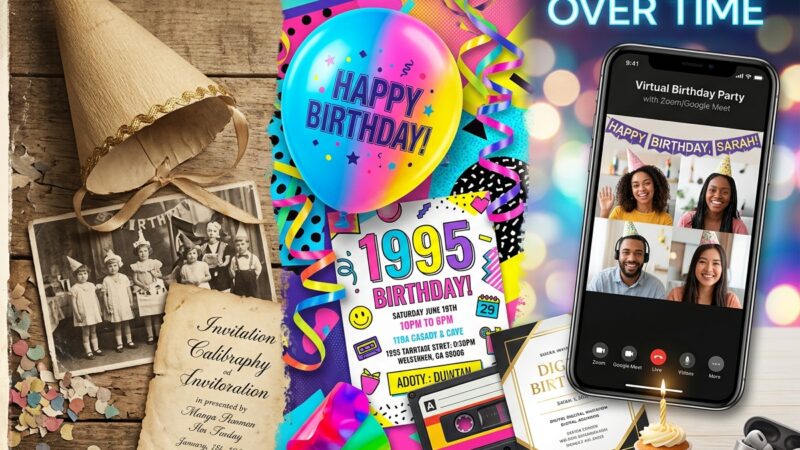
Here’s something wild — for most of human history, ordinary people didn’t celebrate their birthdays at all. No cake. No candles. No singing. No gifts wrapped in shiny paper. Birthday parties, the way you and I know them, are actually a pretty recent invention. For thousands of years, only gods, pharaohs, and kings had their birth dates marked on calendars.
So how did we go from “birthdays are only for royalty” to kids bouncing in inflatable castles and adults posting Instagram stories with balloon arches? The history of birthday parties is a fascinating ride through religion, superstition, commerce, and culture. And honestly, it tells you a lot about how societies changed over the centuries.
Let’s walk through this timeline together — era by era — and see exactly how birthday celebrations evolved into what they are today.
Ancient Times: Birthdays Were Only for the Powerful
The earliest recorded birthday celebrations go back to ancient Egypt, around 3,000 BCE. But here’s the catch — these weren’t celebrations of a person’s physical birth. Egyptians celebrated the “birth” of a pharaoh as a god. When a pharaoh was crowned, that was considered their true “birthday” — the day they became divine.
So regular people? They didn’t get birthday parties. Not even close.
The Greeks Added Candles (Yes, Really)
The ancient Greeks gave us one tradition that stuck — birthday candles. They baked moon-shaped cakes to honor Artemis, the goddess of the moon, and placed lit candles on top to make the cakes glow like the moon. Some historians believe this is the direct ancestor of our birthday cake and candle tradition.
If you’ve ever wondered about the meaning behind birthday candles, the roots go deeper than most people realize.
Romans: The First “Regular People” Birthdays
Ancient Rome was the first civilization where common citizens — well, common male citizens — actually celebrated birthdays. The Roman government even created public holidays to honor famous citizens’ birthdays. Friends and family gathered, ate food, and gave gifts.
But women’s birthdays? Those weren’t celebrated until around the 12th century. And even then, it was rare.
Quick Fact: Romans created the concept of a 50th birthday celebration called “natalis,” which included a special cake made with wheat flour, olive oil, cheese, and honey.
The Dark Ages: When Birthdays Were Considered Sinful
After the fall of Rome, birthday celebrations almost disappeared in Europe. Why? The early Christian Church had a lot to do with it.
Church leaders viewed birthday celebrations as a pagan tradition. They believed that marking one’s own birth was a form of vanity and self-worship. Some clergy even associated birthday parties with evil spirits. The idea was that evil forces were attracted to people on their birthdays — which led to all kinds of weird birthday superstitions people still believe today.
For hundreds of years across medieval Europe, the only “birthday” widely celebrated was the birth of Jesus — Christmas. Regular people simply didn’t track or celebrate their own birth dates.
Did You Know? The tradition of friends visiting you on your birthday originally started as a protective measure. People believed that gathering around the birthday person kept evil spirits away.
The 1700s–1800s: Germany Changed Everything
The modern birthday party as we know it? You can thank 18th-century Germany for that.
Kinderfeste — The First Children’s Birthday Parties
German families in the late 1700s started throwing “Kinderfeste” — birthday celebrations specifically for children. These parties included a cake with candles — one for each year of life, plus one extra candle representing the hope of living another year.
The candles burned all day long, and the child blew them out only after dinner when the family made a wish. Sound familiar?
This is the direct blueprint for the modern kids’ birthday party. The cake, the candles, the wish, the blowing out — all of it traces back to Germany.
The Industrial Revolution Made Parties Affordable
Before the 1800s, sugar, white flour, and butter were expensive. Only wealthy families could afford to bake cakes. But the Industrial Revolution changed that dramatically.
Mass production made baking ingredients affordable for middle-class families. Bakeries started popping up everywhere, and pre-made birthday cakes became something ordinary people could buy. By the mid-1800s, birthday cakes were common across Europe and America.
This is really the turning point in birthday party history — the moment celebrations stopped being exclusive to the wealthy and became something everyone could enjoy.
If you’re curious about how cake traditions developed further, check out the origin of birthday cakes and candles for the full story.
Early 1900s: The “Happy Birthday” Song Era
The early 20th century brought two things that permanently shaped birthday culture: the “Happy Birthday to You” song and the rise of greeting cards.
The Song That Everyone Knows
In 1893, two sisters — Patty and Mildred Hill — wrote a song called “Good Morning to All” for their kindergarten class in Kentucky. Sometime in the early 1900s, the lyrics got changed to “Happy Birthday to You,” and the rest is history.
By the 1930s, the song appeared in Broadway shows and movies. It became the most recognized song in the English language. For decades, Warner/Chappell Music claimed copyright over it and charged licensing fees — until a court ruled in 2016 that the copyright was invalid.
You can read more about the history of happy birthday songs and how this simple tune became a worldwide phenomenon.
Birthday Cards Became Big Business
Hallmark started mass-producing birthday cards in the early 1900s. Before that, people occasionally sent handwritten notes. But commercially printed cards made it easy — and expected — to send birthday greetings.
By the 1950s, sending a birthday card was a social obligation. You were considered rude if you forgot. The history of birthday cards shows just how much the greeting card industry shaped our birthday habits.
Pro Tip: The birthday card industry is still worth over $7 billion annually in the U.S. alone, even with digital messaging dominating communications.
The 1950s–1970s: The Golden Age of Kids’ Birthday Parties
If there’s one era that defined the classic birthday party, it’s the post-World War II period in America. The 1950s through the 1970s created the template that many of us grew up with.
What a Typical Party Looked Like
Picture this: a living room or backyard decorated with streamers and balloons. A homemade cake (often from a Betty Crocker box mix). Pin the Tail on the Donkey. Musical chairs. A stack of wrapped presents. Party hats. Goody bags with candy.
This was the standard. And it worked because the post-war economic boom gave middle-class families disposable income. Suburbs grew. Houses had backyards. Moms (who were often home full-time) planned and hosted these parties.
The Party Supply Industry Exploded
Companies like Party City (founded in 1986, but the trend started earlier) turned birthday supplies into a massive market. Themed paper plates, matching napkins, character-printed tablecloths — all of it became affordable and accessible.
The birthday party moved from a family event to a consumer event. And that shift? It never reversed.
This is also the era when kids started getting more excited for birthdays than adults — because parties became an entire experience designed specifically for them.
The 1980s–1990s: Parties Leave the House
Something big happened in the ’80s and ’90s. Birthday parties moved out of the home.
Chuck E. Cheese, McDonald’s, and Venue Parties
Chuck E. Cheese opened in 1977, but the real boom came in the ’80s. Suddenly, parents didn’t have to clean the house, bake a cake, or organize games. They just booked a venue, showed up, and let someone else handle everything.
McDonald’s birthday parties became hugely popular too. Skating rinks, bowling alleys, and movie theaters jumped on the trend. The birthday party became something you outsourced.
The Rise of Themed Parties
The ’80s and ’90s also brought us themed birthday parties on a new level. Ninja Turtles, Power Rangers, Barbie, Disney Princess — kids didn’t just want a party, they wanted a themed party. And the retail industry was more than happy to deliver character-specific plates, cups, banners, and invitations.
By the late ’90s, a plain birthday cake almost felt inadequate. Parents started ordering custom cakes shaped like cartoon characters. The pressure to “perform” a birthday party was building.
The 2000s–2010s: Pinterest Perfection and Party Pressure
If the ’80s and ’90s moved parties out of the house, the 2000s and 2010s made them into full-blown productions — even when they stayed at home.
The Pinterest Effect
Pinterest launched in 2010, and within a few years, it transformed birthday planning forever. Suddenly, every parent could see what other parents were doing. DIY dessert tables, custom banners, color-coordinated everything, elaborate photo booths, personalized favor boxes.
The bar got raised. A lot.
What used to be “cake and balloons” became “a curated aesthetic experience.” Some parents spent weeks planning and hundreds (or thousands) of dollars executing.
Social Media Changed the Game
Instagram and Facebook turned birthday parties into public content. People didn’t just throw parties for fun — they threw parties that looked amazing in photos. The visual aspect became as important as the experience itself.
This shift influenced everything from venue choices to cake designs. How social media changed birthday culture is a topic that deserves its own deep discussion — because its impact has been massive.
The Milestone Birthday Obsession
Sweet 16s became lavish affairs. MTV’s show “My Super Sweet 16” (2005–2017) showcased teenagers throwing parties that cost tens of thousands of dollars. Why 18th and 21st birthdays are considered special became even more culturally ingrained during this period.
Milestone birthdays — whether 1st, 16th, 21st, 30th, 40th, or 50th — each developed their own unwritten “rules” about how big the celebration should be.
2020s and Beyond: The Gen Z Birthday Revolution
We’re living through another massive shift right now. And Gen Z is leading it.
COVID Changed Birthday Parties Permanently
The 2020 pandemic forced people to rethink birthdays entirely. Zoom birthday parties, car parades, doorstep cake deliveries — these all became normal practically overnight.
Interestingly, some of these changes stuck. Virtual celebrations for long-distance friends and family are still common. People realized you don’t need a massive gathering to make someone feel celebrated.
TikTok Trends and Viral Birthday Moments
TikTok has created entirely new birthday traditions. Surprise reaction videos, “birthday dump” photo carousels, and viral party trends spread globally in hours. The most viral birthday trends on TikTok change constantly, but they all share one thing — they’re designed for sharing.
Experience Over Things
Here’s a major trend worth noting: Gen Z birthday trends lean heavily toward experiences over stuff. Concert tickets, travel trips, spa days, adventure activities — these are replacing traditional gift-giving parties.
A 2023 survey by Eventbrite found that 78% of millennials and Gen Z prefer spending on experiences rather than material goods for celebrations.
The “Anti-Party” Movement
Not everyone wants a big party. Some people don’t celebrate birthdays at all, and that’s becoming more socially acceptable. Birthday celebration ideas for introverts get tons of search traffic, which tells you something about changing attitudes.
The pressure to have a “perfect” birthday is being actively pushed back against, especially by younger adults who are more vocal about social anxiety and overstimulation.
How Birthday Traditions Differ Around the World
While we’ve mostly talked about Western birthday party history, it’s worth noting that birthday traditions around the world are incredibly diverse.
- Mexico: The quinceañera (15th birthday) for girls is a major celebration with religious and cultural significance
- South Korea: “Doljanchi” celebrates a child’s first birthday with a ceremony where the baby picks objects that predict their future
- India: Many families visit temples on birthdays, and the birthday person touches the feet of elders for blessings
- Jamaica: The birthday person gets doused with flour by friends and family — it’s called “antiquing”
- China: Long noodles are served on birthdays because they symbolize long life — you’re not supposed to cut them
Different religions also have varying views on birthdays. How different religions view birthdays covers everything from Jehovah’s Witnesses (who don’t celebrate) to Hindu naming ceremonies tied to birth dates.
Common Myths About Birthday Party History
Let’s clear up some misconceptions that keep floating around.
Myth 1: “Ancient Egyptians Celebrated Regular People’s Birthdays”
Not true. Only pharaohs’ coronation dates were celebrated — their “birth” as gods. Common Egyptians didn’t track or celebrate personal birthdays.
Myth 2: “Birthday Candles Come From Paganism and Witchcraft”
The candle tradition comes from Greek moon-worship rituals honoring Artemis. While it’s technically a pre-Christian practice, calling it “witchcraft” is a stretch. The modern tradition is mostly German in origin.
Myth 3: “People Have Always Sung ‘Happy Birthday'”
The song is barely 130 years old. For most of human history, no one sang anything at birthday celebrations. The universal singing tradition only became standard in the mid-20th century.
Myth 4: “Birthday Parties Have Always Been About Children”
Actually, the earliest birthday celebrations were exclusively for adult men — kings, pharaohs, and Roman citizens. Children’s birthday parties didn’t become a thing until 18th-century Germany, and they didn’t become widespread until the 20th century.
FAQ Section
Q: When did birthday parties start for common people?
A: Ancient Romans were the first to celebrate common citizens’ birthdays, but only for men. Modern birthday celebrations for everyone — including children — really started in 18th-century Germany with “Kinderfeste” (children’s festivals) and became widespread in America and Europe during the late 1800s and early 1900s.
Q: Why do we blow out candles on birthday cakes?
A: This tradition traces back to ancient Greece, where candles were placed on moon-shaped cakes to honor the goddess Artemis. The German “Kinderfeste” tradition in the 1700s added the custom of placing one candle for each year of life and making a wish while blowing them out. The belief was that the smoke carried your wish up to the gods.
Q: How have birthday parties changed in recent years?
A: The biggest recent changes include the rise of social media-driven celebrations (Instagram-worthy decor, TikTok trends), a shift toward experience-based parties over traditional gift-giving, more acceptance of low-key or solo celebrations, and the lasting impact of COVID-19 which normalized virtual birthday gatherings. Gen Z especially favors authentic, personalized celebrations over lavish productions.
Q: Did early Christians celebrate birthdays?
A: No. Early Christian leaders considered birthday celebrations a pagan practice and discouraged them. For centuries, the only birth-related celebration in Christianity was Christmas (the birth of Jesus). It wasn’t until the late Middle Ages that Christian communities slowly began accepting personal birthday celebrations, and even then, it took hundreds more years to become fully normal.
Q: What’s the most expensive birthday party ever thrown?
A: Some of the most expensive celebrity birthday parties have cost millions of dollars. The Sultan of Brunei reportedly spent $27.2 million on his 50th birthday celebration in 1996, which included a concert by Michael Jackson. Modern celebrity parties regularly run into the hundreds of thousands.
So, What’s Next for Birthday Parties?
Looking at the full arc of birthday party history — from Egyptian pharaohs to TikTok trends — one thing becomes clear. Birthday celebrations have always reflected the values, technology, and economics of their time.
Ancient people used birthdays to honor gods and power. Medieval Europeans avoided them out of religious fear. Industrial-era families embraced them because ingredients got cheap. The internet generation turned them into shareable content.
The next chapter is already being written. AI-personalized party planning, virtual reality celebrations, hyper-personalized gifts, and sustainability-focused parties (less waste, fewer disposable decorations) are all growing trends heading into 2025 and 2026.
But here’s what hasn’t changed in 5,000 years — the core human desire to feel seen, valued, and celebrated. That’s why people love their birthdays so much. The decorations and formats keep evolving, but the feeling of someone saying “I’m glad you were born”? That part is timeless.
Your birthday party might look nothing like what your grandparents had. And your kids’ parties will probably look nothing like yours. That’s not something to worry about — that’s the tradition working exactly as it always has. Adapting, evolving, and finding new ways to say the same simple thing: you matter, and today is your day.
Related Articles

Twins’ Birthday Wishes: Double the Fun & Greetings
Celebrating two people at once is a special kind of joy. Whether you’re writing in a...

Thank You Messages: 100+ Replies for Birthday Wishes
Someone took a moment out of their day to think of you, type out a message,...

Best Friend Birthday Wishes: Top Heartfelt Messages
A good friend’s birthday deserves more than a rushed text or a recycled message you’ve sent...