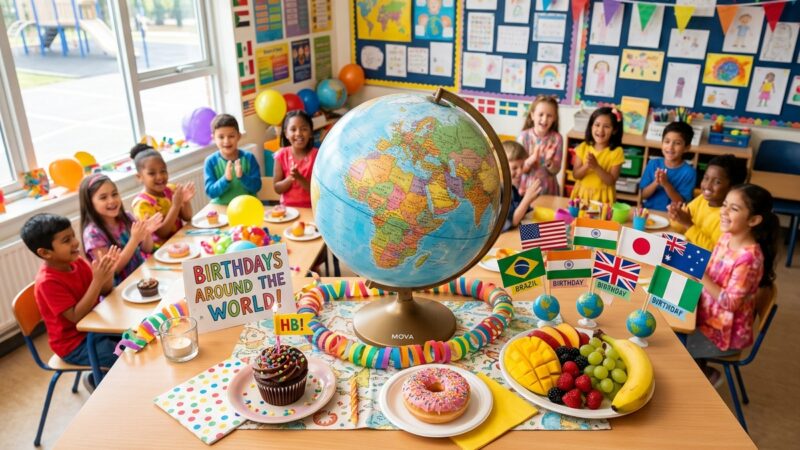
A seven-year-old in Germany walks into class wearing a crown made of paper flowers. A kid in Brazil gets his earlobes pulled — once for each year he’s been alive. And somewhere in the Netherlands, a child is sitting on a decorated chair while classmates sing a birthday song that sounds nothing like “Happy Birthday to You.”
Birthdays at school look wildly different depending on where you grow up. What feels completely normal to you might sound bizarre to a student on the other side of the world. And that’s what makes this topic so fascinating.
If you’re a parent, a teacher, or just someone curious about how schools celebrate birthdays worldwide, you’re going to love this. We’ll walk through school birthday traditions from over 15 countries — some sweet, some surprising, and a few that’ll make you wonder why your school didn’t do the same. Along the way, you’ll also pick up ideas you can actually bring into your own home or classroom.
For a broader look at how birthday celebrations vary across cultures, check out birthday traditions around the world.
Why Do Schools Celebrate Birthdays in the First Place?
Before jumping into the country-by-country breakdown, let’s talk about why schools even bother with birthday celebrations.
For young kids especially, school is their main social world outside of family. A birthday acknowledgment from a teacher or classmates can genuinely boost a child’s self-esteem. It tells them: “You matter here.”
There’s actual psychology behind this. Birthday happiness has roots in feeling seen and valued by your community, and for kids, school IS that community for 6-8 hours every day.
Schools also use birthdays as a teaching moment — about calendars, seasons, counting, cultural awareness, and even kindness.
Quick Fact: Research from child development studies consistently shows that small recognition rituals in classrooms improve a student’s sense of belonging. Birthday celebrations are one of the easiest ways to do this.
How Schools Celebrate Birthdays Worldwide: Country by Country
Now let’s get into the good stuff. Here’s a birthday in school different countries breakdown that covers traditions from every major continent.
North America: The Cupcake Culture and Beyond
United States
American school birthday culture is practically synonymous with cupcakes. Parents send in a batch for the whole class. The birthday kid might wear a special badge, a sticker, or a paper crown. The class sings “Happy Birthday,” and that’s about it.
But here’s what’s changed in recent years: many U.S. schools have started banning homemade treats because of allergy concerns. Nut-free, gluten-free, dairy-free — the restrictions vary by district. Some schools now encourage non-food celebrations instead — like letting the birthday child pick a class game or bring in a favorite book to read aloud.
Pro Tip for U.S. Parents: Check your school’s food policy BEFORE baking 30 cupcakes. Some schools only allow store-bought treats with ingredient labels.
Canada
Canadian schools follow a similar cupcake tradition, but there’s a stronger emphasis on inclusivity. In provinces like Ontario and British Columbia, teachers often celebrate all summer birthdays in June so nobody gets left out. Some classrooms have a “birthday board” where each child’s photo goes up during their birthday month.
Mexico
Mexican school celebrations are a little more vibrant. Think: “Las Mañanitas” — a traditional Mexican birthday song that’s different from the English “Happy Birthday.” Some schools organize small piñata sessions for younger kids. Parents often bring a tres leches cake instead of cupcakes. And yes, there’s the playful tradition of the birthday child getting their face pushed into the cake — called “mordida” (the bite).
Not every school does this, of course. But when it happens, everyone remembers it.
Europe: Crowns, Chairs, and Candy Traditions
European school birthday traditions are where things start getting really interesting.
Germany
German schools have one of the most well-known birthday traditions. The birthday child gets a “Geburtstagskrone” — a birthday crown, usually handmade from paper or felt. In Waldorf and Montessori-inspired German schools, there’s often a special “birthday circle” ceremony.
Here’s how it works: The teacher lights a candle on a seasonal nature table. The child walks around a sun symbol once for each year of their life while the class talks about milestones — first word, first day of school, learning to ride a bike. It’s incredibly personal.
Older kids in Gymnasium (secondary school) sometimes bring candy or small treats for classmates. Note: the birthday child gives treats to others, not the other way around. This is the opposite of what many American families expect.
Netherlands
Dutch birthday traditions in school are famous. The birthday child sits in a “verjaardagsstoel” — a decorated birthday chair. Classmates sing “Lang zal hij/zij leven” (Long shall he/she live). The child’s family sends in traktaties — small treat bags with a mix of candy, fruit, or tiny toys.
Here’s the interesting part: Dutch kids hand out treats to classmates AND the teacher AND the school staff. Yep, even the janitor might get one. It’s a culture of giving on your birthday, not just receiving.
Did You Know? In some Dutch schools, the birthday child’s parent is invited to the classroom to celebrate together. This open-door policy is less common in other countries.
United Kingdom
British schools keep it fairly simple. The class sings “Happy Birthday.” The child might get a sticker or badge. Some primary schools have a birthday assembly where all kids with birthdays that week stand up and get recognized.
What’s interesting about the UK is the rise of “party bag alternatives” in school. Instead of treats, some schools encourage families to donate a book to the class library on their child’s birthday. It’s a trend that’s been growing since around 2018.
Sweden
Swedish schools celebrate birthdays with a quiet but charming tradition. The birthday child often gets to choose the day’s activity — maybe a specific game during recess or a song during music class. In preschools (förskola), teachers might bake with the children as part of the celebration.
Swedish schools also tend to be strict about not creating inequality. Party invitations are NOT handed out at school unless every child in the class is invited. This rule exists in many Scandinavian countries and prevents the heartbreak of exclusion.
Italy
Italian school birthday traditions vary by region, but a common practice is bringing a torta (cake) to share. In some southern Italian schools, the birthday child’s mother or grandmother brings a homemade cake — and it’s a point of pride. The quality of that cake matters.
In Italian schools, birthdays are also used as an opportunity for the class to create a group card — often handmade with drawings and messages from each student.
Asia: Respect, Eggs, and Classroom Rituals
School birthday traditions across Asia reflect deeper cultural values — respect for elders, community, and sometimes even modesty about celebrations.
Japan
Japanese school birthday traditions are understated compared to Western ones. Most schools don’t do individual celebrations during class. Instead, many schools hold a monthly birthday gathering where all kids born in that month are celebrated together. This aligns with the Japanese cultural emphasis on group harmony over individual attention.
In preschools and kindergartens, it’s more festive. Children with birthdays sit at the front. The teacher tells the class how old they’re turning. Classmates sing a Japanese birthday song. Small medal-style badges are given.
Quick Fact: The Japanese birthday song “Tanjōbi Omedeto” literally translates to “Happy Birthday Congratulations.”
South Korea
Korean schools often celebrate birthdays with miyeok-guk — seaweed soup. It’s a traditional birthday food in Korean culture. While schools don’t always serve it, the cultural connection is strong. Kids know birthday = seaweed soup day at home.
In elementary schools, the class might sing, and the teacher gives a small gift or card. Korean schools also celebrate certain ages more than others — like the first birthday (돌, dol), which is a massive family event, though that one happens at home, not school.
For a deeper look at how birthday foods vary globally, read about birthday foods from different countries.
India
India’s diversity means school birthday traditions differ significantly by state, school type, and whether it’s a public or private school.
In many private schools, the birthday child wears “color dress” (casual clothes) instead of the uniform — which is a BIG deal when you wear a uniform every other day. Parents send chocolates or small candy packets for every student in the class. The birthday child distributes them personally, going desk to desk.
Some schools also have a tradition where the birthday child gives a short speech — usually thanking their parents and teachers. This is more common in southern and western India.
In schools following Montessori methods, there’s a “walking around the sun” ceremony similar to the German version. The child carries a globe and walks around a candle (representing the sun) while the teacher narrates their life story.
China
Chinese school birthday celebrations are becoming more common, especially in urban private schools. Traditionally, birthdays weren’t celebrated as elaborately in Chinese culture. But Western influence has changed this rapidly over the past two decades.
In modern Chinese urban schools, parents might send a cake and fruit to the classroom. The class sings “Zhù nǐ shēngrì kuàilè” — the Chinese version of “Happy Birthday.” In rural schools, birthday celebrations at school are still uncommon.
Did You Know? In Chinese culture, eating longevity noodles (长寿面) on your birthday symbolizes a long life. Some school cafeterias serve noodles to birthday kids.
South America: Ear Pulls, Songs, and Sweet Celebrations
Brazil
Brazilian school birthdays are energetic. The class sings “Parabéns a Você” — the Portuguese birthday song. There’s often a decorated table with a cake, candy, and brigadeiros (chocolate truffles that are basically Brazil’s national sweet).
And then there’s the ear-pulling tradition. Classmates gently tug the birthday child’s earlobes — one pull for each year. It’s playful and done with lots of laughing.
Some schools also let the birthday child choose a friend to sit next to for the day — a small gesture that kids take very seriously.
Argentina
Argentine schools are similar to Brazilian ones but with their own twist. The birthday song is followed by “¡Que los cumpla feliz!” — and classmates clap in rhythm. Parents typically send facturas (sweet pastries) or a cake.
An interesting Argentine tradition: the birthday child’s ears get pulled here too, but classmates also chant “¡Tirón de orejas!” while doing it.
Africa: Community, Songs, and Shared Meals
Birthday celebrations in African schools vary enormously across the continent’s 54 countries.
South Africa
In South African schools — particularly in urban and suburban areas — the Western tradition of bringing cake or cupcakes is common. But there’s a unique South African twist: in some schools, especially those serving Zulu or Xhosa communities, the class performs a special birthday song with clapping rhythms and sometimes dancing.
Nigeria
Nigerian school birthday celebrations depend heavily on the school type. In private and international schools in cities like Lagos and Abuja, parents go all out — sending jollof rice, small chops (appetizers), cake, and drinks for the entire class. It can feel like a mini party.
In public schools, celebrations are simpler. The class might sing, and the teacher acknowledges the birthday verbally.
Kenya
In many Kenyan schools, birthdays aren’t traditionally celebrated with fanfare. But a growing trend in Nairobi’s private schools is having a class recognition moment — singing and sometimes sharing mandazi (fried dough) that the birthday child’s family provides.
Australia and New Zealand: Fairy Bread and Laid-Back Vibes
Australia
Australians have a school birthday tradition that’s uniquely their own: fairy bread. It’s white bread with butter, covered in colorful sprinkles (called “hundreds and thousands”). It’s simple, cheap, and every Aussie kid knows it.
The birthday child brings fairy bread or cupcakes to share. The class sings “Happy Birthday.” Some Australian schools do a “birthday clap” — where classmates clap once for each year of the child’s age.
One thing that’s changed recently: many Australian schools now have “nude food” policies (meaning no packaged or processed food), which has complicated the cupcake tradition. Some schools encourage fruit platters or veggie sticks instead. Fairy bread, thankfully, usually gets a pass.
New Zealand
New Zealand school birthdays look similar to Australian ones, but with a Kiwi twist. In schools with strong Māori cultural ties, the birthday child might receive a special acknowledgment in te reo Māori (the Māori language). The class might sing “Rā Whānau” — the Māori birthday song.
Birthday Traditions at School That Are Changing
School birthday traditions aren’t frozen in time. They’ve evolved significantly over the decades, and several trends are reshaping how schools handle birthdays right now:
- Allergy awareness is pushing schools toward non-food celebrations
- Inclusivity policies mean schools try harder to include kids from families who can’t afford treats
- Religious considerations — some families (like Jehovah’s Witnesses) don’t celebrate birthdays, and schools are learning to respect that without singling kids out
- Social media influence — birthday trends from TikTok are showing up in classrooms, like decorated locker surprises or balloon-filled desks
- Mental health awareness — teachers are more conscious of kids who feel anxious about being the center of attention (yes, introverts experience birthdays differently)
Common Myths About School Birthday Celebrations
Let’s clear up a few misconceptions about birthday in school different countries:
Myth 1: “All countries celebrate birthdays at school.”
Not true. In many East Asian, Middle Eastern, and some African countries, school birthday celebrations are either minimal or non-existent. In Japan and China, group monthly celebrations are more common than individual ones.
Myth 2: “The birthday child always receives gifts at school.”
Actually, in countries like Germany and the Netherlands, the birthday child gives treats to classmates — the opposite of what you’d expect.
Myth 3: “Birthday celebrations are the same across all schools in a country.”
Nope. A private Montessori school in Mumbai and a government school in rural Rajasthan will have completely different approaches. School type, income level, and local culture all play a role.
Myth 4: “Cupcakes are a universal school birthday tradition.”
Cupcakes are mainly a North American and Australian thing. Most countries have their own traditional birthday food — or no food tradition at all.
For some truly surprising beliefs people hold about birthdays, read about weird birthday superstitions from around the world.
Practical Ideas: Bringing Global Birthday Traditions Into Your Classroom
If you’re a teacher or parent looking to make school birthdays more meaningful, here are ideas inspired by global traditions:
- Try the German “life walk” — Have the child walk around a candle once per year while you share a positive memory or milestone. It’s emotional and beautiful.
- Adopt the Dutch giving tradition — Instead of receiving, the birthday child gives something to classmates. It teaches generosity.
- Create a birthday book (UK style) — The child donates a book to the class library on their birthday. Put a nameplate inside: “Donated by Aisha on her 8th birthday.”
- Include a multicultural song — Learn birthday songs in 3-4 languages and rotate them throughout the year.
- Swedish-style choice — Let the birthday child pick one activity for the class that day. It gives them agency without focusing on material things.
- Make a class birthday card (Italian style) — Every student writes or draws something. The birthday child takes it home as a keepsake.
Pro Tip: If you have a student whose family doesn’t celebrate birthdays for religious or personal reasons, talk to the family privately. Offer alternatives like a “special day” that isn’t tied to the birthday. Some people genuinely don’t enjoy birthday celebrations, and that’s completely okay.
Why These Traditions Matter More Than You Think
School birthday traditions do something subtle but powerful — they create lasting birthday memories. Ask any adult about their childhood birthdays, and most will mention something that happened at school. The paper crown. The class singing. The embarrassment of standing up in front of everyone. The friend who shared their last candy.
These small moments shape how we feel about birthdays for the rest of our lives. There’s a reason kids get more excited for birthdays than adults — and school celebrations are a huge part of that magic.
FAQ: School Birthday Traditions Around the World
Q: Which country has the most unique school birthday tradition?
Germany’s “birthday walk around the sun” — especially in Waldorf schools — stands out as one of the most thoughtful traditions. The child walks around a candle (representing the sun) once for each year while the teacher narrates milestones from their life. It turns a birthday into a meaningful reflection, not just a party.
Q: Are there countries where schools don’t celebrate birthdays at all?
Yes. In some Middle Eastern countries, some East Asian rural schools, and communities like Jehovah’s Witnesses worldwide, school birthday celebrations are either minimal or don’t happen. Some cultures emphasize other milestones — like name days in Greece and Hungary — over birthdays.
Q: Can teachers celebrate birthdays without using food or candy?
Absolutely. Many schools worldwide are moving toward non-food celebrations. Options include: letting the birthday child wear casual clothes, choosing a class game, sitting in a special chair, receiving a handmade class card, or picking a book for storytime. Swedish and British schools are particularly creative with non-food alternatives.
Q: What’s the best way to handle birthdays in a diverse classroom?
Talk to families at the start of the year. Send a simple questionnaire asking about birthday preferences, dietary restrictions, and cultural or religious considerations. Create a flexible celebration format that can be adapted. The goal is making every child feel valued without forcing a one-size-fits-all approach.
Your Birthday, Your Classroom, Your World
Here’s what’s beautiful about school birthday traditions — they’re a tiny window into a culture’s values. Countries that emphasize community celebrate birthdays as a group. Cultures that value generosity have the birthday child giving, not receiving. Societies that prize individuality put a crown on the kid and make them the star.
No tradition is better or worse. They’re just different ways of saying the same thing: “We’re glad you were born.”
If you’re a teacher reading this, you don’t need a budget to make birthdays special. A handmade crown, a class song, or just a moment to say something kind about the birthday child — that’s enough. And if you’re a parent, maybe pick one tradition from another country and try it at home this year. Your kid might think it’s weird at first. But they’ll remember it forever.
What birthday tradition from this list would you bring into your own life? Think about it — and maybe start a new tradition of your own with ideas that work great for families.
Related Articles

Twins’ Birthday Wishes: Double the Fun & Greetings
Celebrating two people at once is a special kind of joy. Whether you’re writing in a...

Thank You Messages: 100+ Replies for Birthday Wishes
Someone took a moment out of their day to think of you, type out a message,...

Best Friend Birthday Wishes: Top Heartfelt Messages
A good friend’s birthday deserves more than a rushed text or a recycled message you’ve sent...