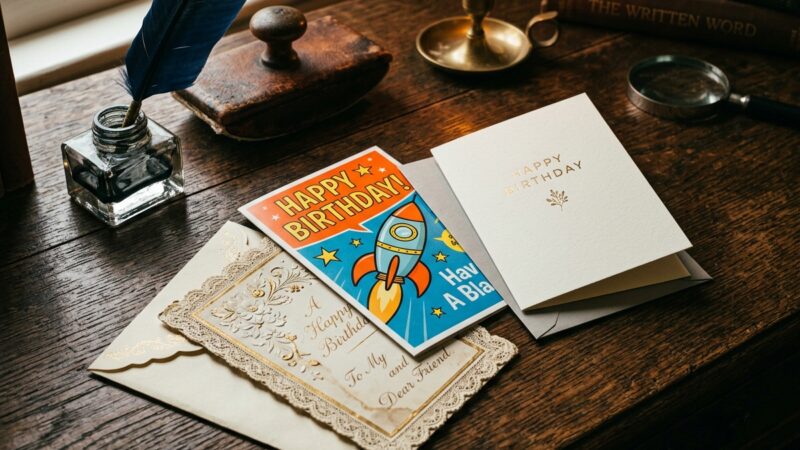
The oldest known birthday card still in existence sits behind glass in the British Museum. It dates back to the 15th century — a time when most people couldn’t even read or write. Someone, probably a wealthy noble, took the time to send a handwritten note wishing another person well on the anniversary of their birth. That single, fragile piece of paper kicked off a tradition that now fuels a multi-billion-dollar industry.
Think about it: you’ve probably given or received dozens of birthday cards in your life. Maybe you’ve picked one out at a store, laughed at a funny punchline inside, or even gotten a little teary reading a heartfelt message from your mom. But have you ever stopped and wondered — where did birthday cards come from? Who sent the first one? Why did we start doing this in the first place?
The history of birthday cards is way more interesting than you’d expect. It’s wrapped up in the invention of printing, the rise of the postal service, Victorian romance, and even the digital revolution. And by the end of this article, you’ll never look at a simple birthday card the same way again.
If you’re also curious about the broader story of how birthday parties changed over time, this piece connects beautifully with that journey.
Let’s get into it.
The Origin of Greeting Cards: Where It All Started
Before we talk about birthday cards specifically, we need to understand where the origin of greeting cards begins. Because birthday cards didn’t just pop up out of nowhere — they evolved from an older tradition of sending written greetings for various occasions.
Ancient Roots: China and Egypt
The earliest greeting cards weren’t really “cards” at all. Ancient Chinese communities exchanged messages of goodwill during the New Year, as far back as the 1st century. These were written on scrolls or pieces of papyrus and bamboo.
Around the same time, Egyptians used papyrus scrolls to send greetings. These weren’t birthday-specific, but they set the tone for what was coming — the idea that you could write a message and deliver it to someone to mark an occasion.
Quick Fact: The ancient Egyptians are also credited with some of the earliest birthday celebrations for pharaohs, though these marked the date of their “birth as a god” (coronation day), not their actual biological birthday.
The Valentines Came First
Here’s something most people don’t know: the greeting card industry owes its beginnings to Valentine’s Day, not birthdays. Handmade Valentine cards were circulating in Europe by the 1400s. The oldest known Valentine still in existence was written in 1415 by Charles, Duke of Orleans, while he was imprisoned in the Tower of London. He sent a love poem to his wife.
Birthday greetings came a bit later, but they borrowed heavily from the Valentine tradition — handmade paper, decorative edges, poetic messages.
The First Birthday Cards: 15th to 18th Century
So, where did birthday cards come from as their own separate tradition? The answer takes us to Europe, roughly around the 1400s.
Germany Leads the Way
Germans played a huge role in birthday culture. They were already celebrating Kinderfeste (children’s birthday parties) and had traditions around birthday cakes and candles by this period. It makes sense that they’d also be among the first to exchange written birthday greetings.
By the early 1700s, handmade birthday cards were fairly common among the European upper class. These weren’t mass-produced — each one was individually crafted, often decorated with intricate hand-drawn illustrations, ribbons, and lace. They were expensive to make and expensive to send.
Why Only the Rich?
Two big reasons:
- Literacy: Most ordinary people couldn’t read or write until the 18th and 19th centuries. Sending a written birthday greeting was a luxury.
- Postage costs: Before standardized postal systems, sending a letter or card cost a fortune. The recipient often had to pay for delivery — not the sender. Imagine getting charged for your own birthday card!
Pro Tip: If you’re a history nerd, the British Museum and the Victoria & Albert Museum in London both have early examples of handmade birthday and greeting cards in their collections. Worth a visit or a virtual browse.
The Printing Press Changes Everything
The single biggest turning point in the history of birthday cards wasn’t a card at all. It was a machine.
Gutenberg’s Impact
When Johannes Gutenberg invented the movable-type printing press around 1440, he didn’t just change books — he eventually changed greeting cards too. It took a few centuries for the technology to trickle down to card-making, but once it did, the game shifted completely.
By the late 1700s, printers in England and Germany were producing simple printed greeting cards. These weren’t personalized masterpieces anymore. They were affordable, reproducible, and accessible to a growing middle class.
The Penny Post of 1840
This is a date every greeting card enthusiast should know: 1840. That’s when Sir Rowland Hill introduced the Uniform Penny Post in Great Britain.
Before this, sending mail was chaotic and costly. Hill’s reform standardized postage at one penny for letters under a certain weight, regardless of distance within the country. Suddenly, sending a birthday card wasn’t just for the wealthy. Anyone could afford a penny stamp.
Did You Know? Card sales in Britain exploded almost immediately after the Penny Post launched. By the 1850s, commercially printed cards were a mainstream product.
The parallel here is interesting — just as the postal system democratized birthday cards, social media has done something similar in our era. Curious about that shift? Check out how social media changed birthday culture.
The Victorian Era: The Golden Age of Birthday Cards
If any period deserves the title of “golden age” for birthday cards, it’s the Victorian era (roughly 1837–1901). Queen Victoria’s England was obsessed with etiquette, sentiment, and social rituals. Birthday cards fit perfectly into that world.
Elaborate Designs and Sentimental Verses
Victorian birthday cards were something else. We’re talking about:
- Embossed paper with raised floral designs
- Silk fringes and ribbon trim
- Die-cut shapes — cards shaped like flowers, fans, or even shoes
- Chromolithography — a color printing technique that made vivid, multi-colored images affordable for the first time
- Hidden panels and fold-outs — some cards were mini engineering projects
The messages inside were usually sentimental poems — full of “dearest wishes” and “fondest hopes.” Victorian culture valued emotional expression through writing, and birthday cards became a socially acceptable way to say things you might not say out loud.
Cards Become a Social Obligation
Here’s where things get really interesting. During the Victorian period, sending birthday cards went from “nice to do” to “you really should do this.” Etiquette guides of the time explicitly listed birthday card-sending as a social duty among the middle and upper classes.
Not sending a card when expected could actually damage a relationship. Sound familiar? That same social pressure still exists today — just think about how guilty you feel when you forget someone’s birthday on Facebook.
Speaking of birthday emotions, there’s a whole psychological layer to why we care so much about these gestures. You might enjoy reading about the psychology behind birthday happiness.
The Rise of Hallmark and the Modern Card Industry
Now we jump across the Atlantic to the United States, where the birthday card went from a charming European custom to a full-blown commercial empire.
Louis Prang: The Father of the American Greeting Card
A German immigrant named Louis Prang set up a lithography shop in Boston in the 1850s. By the 1870s, he was producing high-quality printed Christmas cards, and soon after, birthday cards followed. Prang’s cards were famous for their beautiful color reproduction — he earned the nickname “the father of the American Christmas card,” but his influence on birthday cards was just as significant.
Prang ran annual design contests that attracted top artists, raising the artistic quality of greeting cards across the industry.
Hallmark Enters the Scene
In 1910, a teenager named Joyce Clyde Hall arrived in Kansas City, Missouri, with two shoeboxes full of postcards. He started selling them from a YMCA room. By 1915, he and his brother Rollie had founded Hall Brothers — the company that would eventually become Hallmark Cards.
Hallmark didn’t invent birthday cards. But they perfected the business model:
- Standardized sizes for easy display in stores
- Envelopes included (sounds obvious now, but it was a smart move)
- Emotional messaging crafted by professional writers
- Retail partnerships — Hallmark created the “card aisle” concept we all know today
By the mid-20th century, Hallmark and its competitors like American Greetings (founded in 1906) had turned birthday cards into a billion-dollar industry.
Quick Fact: Hallmark currently produces cards in over 30 languages and sells them in more than 100 countries. Birthday cards are their #1 selling category, followed by Christmas cards.
The “Shoebox” Revolution
In the 1980s, Hallmark launched its Shoebox Greetings line — funny, irreverent, slightly edgy cards that broke away from the sentimental tradition. Suddenly, birthday cards could be hilarious, sarcastic, or even mildly inappropriate.
This shift reflected a broader cultural change. People wanted cards that sounded like them, not like a Victorian poem. The humor card became a massive seller and remains one today.
Birthday Cards Go Digital: The 21st Century Shift
Okay, let’s fast forward to where things stand now. The internet didn’t kill birthday cards — but it definitely transformed them.
E-Cards Take Off (Then Fade)
Remember Blue Mountain Arts? In the late 1990s and early 2000s, their free e-cards were everywhere. You’d get an email with a link, click it, and a little animated card would play with music. It felt magical at the time.
E-card sites exploded in popularity. Companies like Jacquie Lawson, 123Greetings, and American Greetings’ online platform all jumped in. For a while, it looked like digital might replace paper entirely.
But here’s what happened: the novelty wore off. E-cards started feeling impersonal. Getting an animated email just didn’t carry the same emotional weight as holding a physical card in your hands.
Social Media Birthday Wishes
Facebook changed the birthday game in a huge way. Starting around 2008-2009, the platform began reminding users about friends’ birthdays. Suddenly, your wall would fill up with “Happy Birthday!” messages from people you hadn’t talked to in years.
Is a Facebook “HBD” the same as a birthday card? Not really. But it replaced the function for many casual relationships. You can explore more about why people share birthday posts on social media and what drives that behavior.
The Surprise Comeback of Physical Cards
Here’s a twist nobody predicted: physical birthday cards are making a comeback.
In 2023, the global greeting card market was valued at approximately $7.5 billion, and birthday cards still accounted for the largest share. Millennials and even Gen Z consumers — the most “digital” generations ever — are buying physical cards in growing numbers.
Why? Because in a world flooded with digital noise, a tangible card stands out. It says, “I went to a store, picked this out, wrote something by hand, put a stamp on it, and mailed it to you.” That effort communicates something no text message can.
Pro Tip: If you really want to make someone’s day, pair a physical card with a personalized birthday gift. That combo hits different.
Common Myths About Birthday Cards — Debunked
Let’s clear up some misconceptions that float around about the history of birthday cards.
Myth 1: “Hallmark Invented Birthday Cards”
Nope. Hallmark commercialized and popularized them in the U.S., but birthday cards existed for centuries before Joyce Hall sold his first postcard. The tradition traces back to 15th-century Europe.
Myth 2: “Birthday Cards Are a Western-Only Tradition”
Not accurate. While the modern printed birthday card is largely a Western invention, the concept of sending written birthday greetings exists in many cultures. Japanese nengajō (New Year cards) share a similar spirit, and many Asian and Middle Eastern cultures have adopted birthday cards as part of modern celebrations. Birthday customs vary wildly across the globe — different cultures celebrate birthdays in ways that might surprise you.
Myth 3: “Nobody Buys Physical Cards Anymore”
The numbers say otherwise. The Greeting Card Association reports that approximately 6.5 billion greeting cards are purchased in the U.S. each year, and birthday cards are the single largest category. Physical cards aren’t going anywhere.
Myth 4: “E-Cards Will Replace Paper Cards”
This was a popular prediction around 2005-2010. It didn’t happen. E-cards found their niche (mostly for last-minute or long-distance greetings), but they never replaced the emotional impact of a physical card with a handwritten message.
How Birthday Card Trends Have Evolved Over the Decades
Let’s do a quick decade-by-decade look at how birthday cards shifted in style and purpose:
| Decade | Key Trend |
|---|---|
| 1850s-1900s | Elaborate Victorian designs, sentimental poetry, lace and silk |
| 1900s-1920s | Postcards dominate, simpler designs, mass production begins |
| 1930s-1950s | Hallmark era begins, standardized cards, cute illustrations |
| 1960s-1970s | Pop art influence, bolder colors, counterculture humor creeps in |
| 1980s-1990s | Humor cards explode, Shoebox-style comedy, pop-up cards |
| 2000s | E-cards boom, digital transition begins |
| 2010s | Social media wishes surge, handmade/Etsy cards gain popularity |
| 2020s | Physical card revival, sustainable materials, personalized prints |
Each shift mirrors what was happening in broader culture. The cards we send reflect who we are as a society at any given moment.
If you’re curious about how birthday celebrations themselves tracked a similar evolution, the article on how birthday parties changed over time is a great companion read.
What Makes a Birthday Card Actually Meaningful?
After looking at hundreds of years of birthday card history, one question keeps coming up: what makes a birthday card special?
It’s not the paper quality. It’s not the printing technique. It’s not even the pre-written message inside (sorry, Hallmark).
It’s the handwritten part.
Research on emotional psychology suggests that handwritten messages trigger stronger emotional responses than printed or digital text. When someone writes “I love you” or “I’m so glad you exist” in their own handwriting — with all its imperfections — that carries a weight that no font can replicate.
This connects to something deeper about why birthdays matter to us emotionally. If you’ve ever felt unexpectedly moved by a birthday card, you’re not alone. That reaction is rooted in psychology — why people feel emotional on their birthday is a whole topic worth exploring.
Three Things That Make a Card Stand Out
- A specific memory or inside joke — not just “Happy Birthday,” but “Remember when we got lost in Shimla and ended up eating momos at 2 AM? Here’s to more adventures.”
- Honest emotion — skip the generic. Write what you actually feel, even if it’s just two sentences.
- Effort — a hand-delivered card beats a mailed one. A mailed one beats a text. A text beats nothing. The effort gradient matters.
The Future of Birthday Cards
Where are birthday cards headed? Based on current trends, here’s what’s likely:
FAQ Section
Who sent the first birthday card in history?
The exact identity is unknown, but the earliest birthday cards trace back to 15th-century Europe. Germans and English nobility were among the first to exchange handwritten birthday greetings. The oldest surviving examples are housed in museums like the British Museum in London. Mass-produced birthday cards didn’t appear until the late 1700s and early 1800s, after advances in printing technology made them affordable.
Why are birthday cards still popular in the digital age?
Physical birthday cards carry emotional weight that digital messages can’t match. A handwritten card requires effort — choosing it, writing in it, mailing or delivering it — and that effort communicates care. Studies on emotional psychology show that tangible, handwritten communication triggers stronger feelings of connection. The greeting card industry still generates billions in annual revenue, with birthday cards leading all categories.
When did Hallmark start making birthday cards?
Hallmark’s origins go back to 1910, when founder Joyce Clyde Hall began selling postcards in Kansas City. The company officially incorporated as Hall Brothers in 1915 and later rebranded as Hallmark Cards. By the 1930s and 1940s, Hallmark had established itself as the dominant greeting card brand in the United States, with birthday cards as its best-selling product line.
Are e-cards replacing traditional birthday cards?
Not really. E-cards gained massive popularity in the early 2000s but have since settled into a niche role — useful for last-minute greetings or long-distance friends, but not a full replacement for physical cards. The global greeting card market continues to grow, suggesting that people still value the tangible experience of receiving a paper card. Many people now use a combination of both: a social media wish and a physical card for close relationships.
Your Turn to Be Part of the Story
From handmade 15th-century notes passed between European nobles to the billions of cards exchanged every year around the world — the history of birthday cards is really a history of how humans say “I care about you.”
The materials changed. The delivery methods changed. The humor got better (and sometimes worse). But the core idea hasn’t budged in 600 years: someone thought of you on your special day, and they wanted you to know it.
Next time you stand in a card aisle, flipping through options and trying to find the one that feels right — you’re participating in a tradition that’s older than the printing press. That’s pretty cool.
And if you want to make this year’s card really count? Put down the phone, pick up a pen, and write something real. Even three honest sentences will mean more than the most beautifully printed card ever could.
Want to go deeper into birthday traditions? Explore the history of birthday wishes and discover how the words we use on birthdays have their own fascinating backstory.
Related Articles

Twins’ Birthday Wishes: Double the Fun & Greetings
Celebrating two people at once is a special kind of joy. Whether you’re writing in a...

Thank You Messages: 100+ Replies for Birthday Wishes
Someone took a moment out of their day to think of you, type out a message,...
Best Friend Birthday Wishes: Top Heartfelt Messages
A good friend’s birthday deserves more than a rushed text or a recycled message you’ve sent...