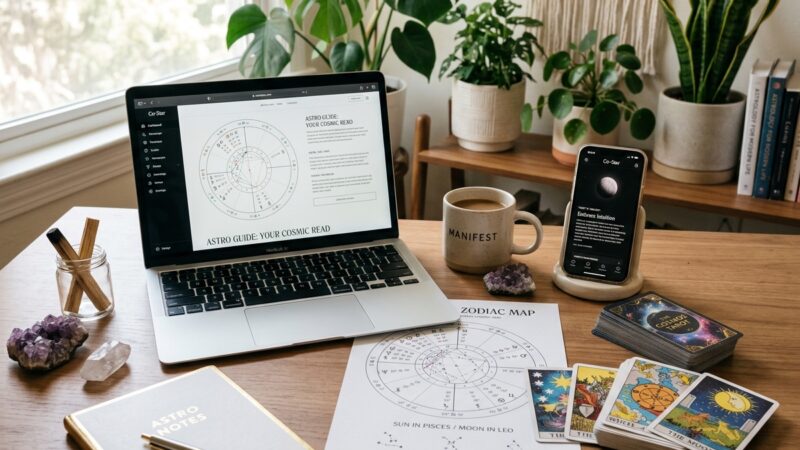
A Pew Research survey in 2022 found that nearly 30% of Americans believe in astrology. That number jumps even higher among millennials and Gen Z. Scroll through Instagram for five minutes, and you’ll spot at least one meme about Mercury retrograde or a reel explaining why Scorpios are “toxic.”
Here’s the thing — astrology isn’t new. It’s literally thousands of years old. But somehow, in the age of AI, space exploration, and evidence-based everything, reading your horoscope feels cooler than ever. So, how did astrology become mainstream again?
That’s exactly what we’re going to break down. Not from a “believe it or don’t” angle, but from a cultural, psychological, and digital perspective. Why are millions of people — educated, skeptical, modern people — suddenly obsessed with their birth charts? What changed?
Let’s figure this out together.
H2: Astrology’s Deep Roots — It Never Really Disappeared
Before we talk about why astrology is trending now, let’s get something straight. Astrology didn’t just “come back.” It was always around. Your nani probably checked kundlis before weddings. Newspapers ran horoscope columns for decades. People whispered about being a “typical Gemini” at dinner parties long before TikTok existed.
H3: A Quick Historical Reality Check
Astrology dates back over 4,000 years to ancient Babylon. The Greeks refined it. Medieval scholars studied it alongside astronomy. Even Carl Jung, one of the most influential psychologists of the 20th century, used astrological archetypes in his work.
What happened in the modern era was that science and astrology got officially “divorced.” By the 18th and 19th centuries, the Enlightenment pushed astrology into the “superstition” box. It became something you did quietly — reading your horoscope in the back of a magazine, not something you’d discuss at work.
But underground? People never stopped caring. The history of birthday superstitions shows us that humans have always attached meaning to when you’re born. Astrology was simply waiting for the right cultural moment to step back into the spotlight.
And that moment came.
H2: The 2020s Perfect Storm — Why Astrology Popularity Exploded
The astrology popularity in the 2020s didn’t happen because of one thing. It was a collision of multiple forces — technology, anxiety, identity culture, and good old-fashioned human curiosity.
H3: The Pandemic Changed Everything
Let’s start with the obvious. COVID-19 turned the world upside down in 2020. People were locked inside, anxious, scared, and looking for meaning. When your daily routine collapses and the future feels uncertain, you start searching for any framework that helps you make sense of things.
Astrology offered that framework. It didn’t promise certainty, but it gave people language to process chaos. “Oh, that makes sense — Saturn is in Aquarius.” Even if you didn’t fully believe it, there was comfort in having some kind of narrative.
Google Trends data shows that searches for “birth chart” and “astrology compatibility” spiked dramatically between March 2020 and mid-2021. The Co-Star astrology app saw its downloads surge past 20 million during this period.
People weren’t just bored. They were looking for meaning. And astrology stepped right in.
H3: Social Media Made Astrology Shareable
Here’s where the real magic happened. Astrology content is perfectly designed for social media. Think about it:
- It’s personal — “This is YOUR sign’s reading”
- It’s visual — zodiac symbols, constellation art, aesthetic charts
- It’s shareable — You tag your friends (“This is SO you, Taurus”)
- It’s debatable — “Virgos are NOT boring!” sparks comments instantly
- It creates community — People bond over shared signs
Instagram, TikTok, and Twitter became astrology’s biggest marketing channels — and nobody had to pay for ads. Meme accounts like @notallgeminis and astrology creators on TikTok built audiences of millions, practically overnight.
The way social media changed birthday culture is the same way it changed astrology. It took something personal and made it public, visual, and interactive.
Did you know? The hashtag #astrology has over 40 billion views on TikTok as of 2025. That’s not a niche interest anymore — that’s mainstream culture.
H3: Apps Turned Astrology Into a Daily Habit
Before apps, checking your horoscope meant buying a newspaper or visiting a specific website. Now? Your phone buzzes with a personalized astrology notification before you even get out of bed.
Apps like Co-Star, The Pattern, Sanctuary, and TimePassages turned astrology into a daily ritual. Co-Star, in particular, became famous for its weirdly specific (and sometimes savage) daily push notifications. “You’re not growing — you’re just getting older” hits different at 7 AM.
These apps didn’t just give you a sun sign reading. They pulled up your full natal chart — moon sign, rising sign, Venus placement, all of it. Suddenly, astrology wasn’t just “I’m a Leo.” It was a complex personality map that felt tailored specifically to you.
That personalization? It’s addictive. And it turned casual horoscope readers into people who genuinely study astrology.
H2: The Psychology Behind Astrology’s Comeback
Okay, let’s get real for a second. Why does astrology work on us psychologically? Even people who say “I don’t really believe in it” still know their sign. Still check their horoscope “just for fun.” Still feel a tiny thrill when a reading feels accurate.
There’s actual psychology behind this.
H3: The Barnum Effect — Why Horoscopes Feel True
The Barnum Effect (named after P.T. Barnum) describes our tendency to accept vague, general personality descriptions as uniquely applicable to ourselves. Read a horoscope that says, “You sometimes doubt your decisions but present a confident face to the world,” and most people will think, “Wow, that’s SO me.”
It’s not manipulation — it’s human nature. We’re pattern-seeking creatures. We want things to fit. And astrology gives us patterns that feel meaningful.
The psychology behind birthday happiness works on a similar principle. We assign special meaning to dates, signs, and cycles because our brains crave narrative structure.
H3: Identity and Self-Discovery
Here’s something nobody talks about enough. The 2020s are the “identity decade.” People are deeply invested in understanding who they are — their personality type, their attachment style, their love language, their Enneagram number.
Astrology fits perfectly into this trend. Your birth chart becomes another lens for self-exploration. “I’m a Capricorn sun, Pisces moon, Scorpio rising” is really saying, “Here’s a shortcut to understanding my complexity.”
For many young people, astrology language has replaced other frameworks. Instead of saying “I’m introverted,” they say “I’m a Cancer moon.” Same concept, different vocabulary. And it feels more poetic, more personal, more yours.
This is especially true for Gen Z. If you look at how birthday trends changed in Gen Z, you see the same pattern — a generation that personalizes everything and turns self-expression into a cultural practice.
H3: Coping With Uncertainty
Psychologists have long noted that interest in astrology, tarot, and mysticism tends to rise during periods of social upheaval. The 1970s saw a major astrology boom during economic recession and cultural upheaval. The same thing happened after 9/11.
The 2020s gave us a pandemic, economic anxiety, climate change dread, political polarization, and social media overload — all at once. That’s a LOT of uncertainty.
Astrology doesn’t claim to fix these problems. But it offers something powerful: a sense that there’s a bigger pattern at work. That the chaos isn’t random. That your struggles have cosmic timing.
Pro Tip: You don’t have to “believe” in astrology to benefit from it psychologically. Many therapists and psychologists acknowledge that astrology can serve as a useful reflection tool — a way to prompt self-awareness and meaningful conversation.
H2: The Business of Astrology — Follow the Money
If you still think astrology is a “fringe” interest, look at the economics. The mystical services market — which includes astrology, tarot, and psychic readings — was valued at over $2.2 billion in the US alone by 2023. Industry analysts project it will keep growing through 2026 and beyond.
H3: Astrology Apps Are Serious Tech
Co-Star raised $15 million in venture capital funding. Sanctuary, another popular astrology app, got backing from serious Silicon Valley investors. These aren’t hobby projects — they’re tech startups with millions of users, sophisticated AI algorithms, and real revenue models.
The Pattern reportedly had over 25 million downloads and even went viral when celebrities like Channing Tatum publicly talked about using it.
H3: Brand Marketing Jumped On Board
Major brands noticed the trend too. Spotify created “Cosmic Playlists” based on zodiac signs. Clothing companies sell zodiac-themed merchandise. Even dating apps like Bumble added zodiac filters, because apparently people want to know if they’re swiping right on a compatible sign.
This commercial adoption is a huge signal. When corporations invest marketing dollars into something, it’s no longer underground. It’s mainstream.
H3: Astrology-Inspired Gifting Culture
You’ve probably seen zodiac jewelry, sign-based candles, and constellation mugs everywhere. The most popular birthday gifts by age increasingly include astrology-themed items. People buy birthstone necklaces, natal chart prints, and custom astrology readings as gifts.
It’s not just consumption. It’s identity expression wrapped in a product.
H2: Why Zodiac Signs Became a Cultural Language
Here’s where things get really interesting. Astrology didn’t just become popular — it became a communication shorthand. People use zodiac signs the way they used to use Myers-Briggs types or college majors — as quick personality labels.
H3: The Rise of “Zodiac Talk” in Daily Life
“That’s such a Virgo thing to do.”
“Of course he ghosted you — he’s an Aquarius.”
“Don’t mess with her — she’s a double Scorpio.”
These aren’t just jokes anymore. For millions of people, this is a genuine conversational framework. Why zodiac signs became so popular has a lot to do with this — they gave people a fun, low-stakes way to categorize behavior and connect with others.
H3: Relationships and Compatibility
One of the biggest drivers of astrology popularity in the 2020s is romantic compatibility. Search volumes for terms like “Aries and Libra compatibility” or “best zodiac matches” are consistently massive.
People check zodiac compatibility before first dates. They analyze their partner’s chart when the relationship hits a rough patch. Some even time major life decisions around planetary transits.
The fascination with zodiac compatibility isn’t just about prediction — it’s about trying to understand relationship dynamics through a different lens. Whether you think it’s accurate or not, it gets people talking about their needs, boundaries, and communication styles. And that’s actually helpful.
H3: Meme Culture as a Delivery System
Let’s give credit where it’s due — memes made astrology accessible. You don’t need to understand planetary transits to laugh at a meme that says, “Sagittarius leaving a party the second they get bored.” It’s relatable, it’s funny, and it makes you curious about what YOUR sign says.
Astrology memes became one of the most-shared content formats on Instagram and TikTok between 2019 and 2025. They lowered the barrier to entry. You didn’t need to study anything — you just needed to know your birthday.
And speaking of birthdays — the most viral birthday trends on TikTok often overlap with astrology content. Birthday reveals with zodiac themes, “guess my sign” challenges, and birth chart readings are consistently trending.
H2: The Critics — Is Astrology Just Pseudoscience?
Fair question. And we’d be dishonest if we didn’t address it.
H3: What Science Actually Says
No, there’s no scientific evidence that planetary positions at the time of your birth determine your personality or predict your future. Multiple large-scale studies — including a famous one by Shawn Carlson published in Nature (1985) — have tested astrological claims and found no statistical support.
Astronomers frequently point out that the zodiac doesn’t even align with actual constellations anymore because of a phenomenon called axial precession. The dates shifted over centuries, meaning your “sign” might technically be different from what you’ve always been told.
H3: But Does That Matter to People?
Here’s what’s fascinating. Most modern astrology enthusiasts already know this. They’re not arguing that astrology is science. They’re saying it’s a meaning-making tool — closer to philosophy or even poetry than to physics.
A 2021 YouGov survey found that among young adults who engage with astrology, the majority describe it as “fun” or “useful for self-reflection” rather than literally predictive. They treat it like a personality framework, not a crystal ball.
Think about it — nobody “scientifically proves” that journaling works better than not journaling, but millions of people find it helpful for mental clarity. Astrology functions similarly for many people.
Quick Fact: The word “zodiac” comes from the Greek word zōidiakos, meaning “circle of animals.” Nothing mystical about the etymology — just ancient categorization.
H3: The Real Debate
The honest criticism isn’t “astrology is silly.” It’s more nuanced than that:
- Confirmation bias can make people overvalue readings that match their experience
- Financial exploitation exists — some “astrologers” charge huge fees for vague advice
- Fatalism risk — some people use astrology to avoid personal responsibility (“Mercury retrograde made me do it”)
These are valid concerns. But they apply to the misuse of astrology, not to the concept itself. A hammer can build a house or break a window — depends on who’s holding it.
H2: Astrology and Birthdays — The Connection You Can’t Ignore
You can’t separate astrology from birthdays. Your entire chart — sun sign, moon sign, rising sign, planetary placements — is calculated from your exact date, time, and place of birth. Your birthday is literally the foundation of your astrological identity.
That’s why people love their birthdays so much. It’s not just about cake and presents. There’s a deeper psychological pull — a feeling that your birth date means something. Astrology gives that feeling a structure and a story.
Even the tradition of birthday candles traces back to ancient beliefs about cosmic forces and the significance of birth moments.
And consider this — why people reflect on life during birthdays connects directly to what astrology offers. Both your birthday and your birth chart serve as annual checkpoints. Astrologers call your birthday your “Solar Return” — the moment the sun returns to the exact position it held when you were born. It’s treated as a cosmic reset, a new personal year.
So when someone reads their “birthday horoscope” or gets a Solar Return chart reading, they’re combining two powerful psychological forces — birthday reflection and astrological meaning-making.
H2: What’s Next — Will Astrology Stay Mainstream?
This is the million-dollar question. Is astrology popularity in the 2020s a fad that’ll fade, or is it here to stay?
H3: Signs It’s Not Going Anywhere
- Academic interest is growing. Universities now offer courses in the history and sociology of astrology
- Therapy integration. Some therapists use birth charts as conversation starters in sessions
- AI and astrology. ChatGPT-powered astrology tools are getting more personalized and detailed every month
- Cultural embedding. Zodiac language is now embedded in dating, fashion, wellness, and social media — that’s hard to undo
H3: Possible Cooling Off
Could the hype reduce? Sure. Every cultural trend goes through peaks and valleys. We might see fewer “Mercury retrograde” memes by 2027. But the underlying interest — self-discovery, meaning-making, personality exploration — isn’t going away.
Astrology will likely evolve. It’ll get more personalized through AI, more integrated into wellness apps, and more normalized in everyday conversation. The “fringe” label is gone for good.
FAQ Section
Q1: Why did astrology become popular again?
Astrology’s comeback was driven by a combination of social media, smartphone apps, pandemic-era anxiety, and a cultural shift toward self-discovery and identity exploration. Platforms like TikTok and Instagram made astrology content viral, while apps like Co-Star turned horoscope reading into a daily personalized habit. People were drawn to astrology as a coping tool during uncertain times, and its meme-friendly format made it accessible to millions who’d never studied it before.
Q2: Is astrology scientifically proven?
No. There is no peer-reviewed scientific evidence supporting the claim that celestial positions influence human personality or predict future events. Studies, including a notable 1985 study published in the journal Nature, have failed to find statistical support for astrological predictions. That said, many modern astrology users treat it as a self-reflection and meaning-making tool rather than a hard science.
Q3: Why do millennials and Gen Z love astrology so much?
These generations grew up with the internet and are deeply engaged with identity frameworks — personality tests, love languages, attachment styles, and now astrology. Astrology fits perfectly into social media culture because it’s personal, visual, and shareable. It also provides a low-cost, accessible way to explore mental health themes and relationship dynamics, which these generations prioritize highly.
Q4: What’s the difference between sun sign astrology and birth chart astrology?
Sun sign astrology is the simplified version you see in newspaper horoscopes — based only on your birth date. Birth chart (or natal chart) astrology is far more detailed. It maps the position of every planet, the sun, and the moon at your exact birth time and location. This gives you a sun sign, moon sign, rising sign, and dozens of other placements, creating a much more personalized and complex profile.
Q5: Will astrology remain popular after the 2020s?
Most cultural analysts believe astrology’s mainstream presence will continue, though the intensity of the trend may fluctuate. The infrastructure is now deeply embedded — apps have millions of users, brands incorporate zodiac themes, and astrology language is part of everyday communication. As AI tools make astrology even more personalized, engagement is likely to grow rather than shrink.
Final Thoughts
Astrology didn’t come back because people suddenly got less scientific or more superstitious. It came back because the world got more chaotic, more digital, and more hungry for personal meaning — all at the same time.
Social media gave astrology a stage. The pandemic gave it an audience. Apps gave it convenience. And our deep, very human need to understand ourselves gave it staying power.
You don’t have to believe your birth chart is destiny to appreciate why millions of people find comfort, community, and even fun in checking their horoscope every morning. At its best, astrology is a mirror — it reflects back the questions you’re already asking yourself about who you are and where you’re going.
So the next time someone asks you, “What’s your sign?” — maybe don’t roll your eyes. Maybe just answer. You might be surprised where the conversation goes.
Related Articles

Twins’ Birthday Wishes: Double the Fun & Greetings
Celebrating two people at once is a special kind of joy. Whether you’re writing in a...

Thank You Messages: 100+ Replies for Birthday Wishes
Someone took a moment out of their day to think of you, type out a message,...

Best Friend Birthday Wishes: Top Heartfelt Messages
A good friend’s birthday deserves more than a rushed text or a recycled message you’ve sent...