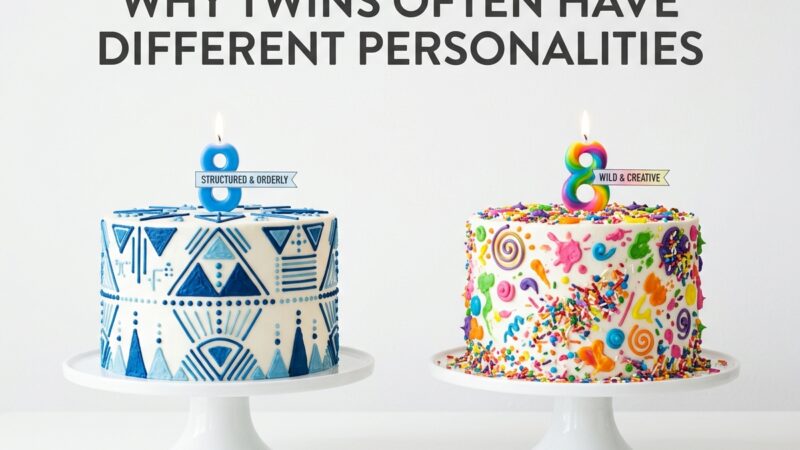
Here’s something that catches most people off-guard: identical twins share 99.99% of their DNA. Yet ask any twin, and they’ll tell you — they’re nothing alike. One’s the quiet bookworm, the other’s the life of every party. One loves risk, the other plays it safe. Same womb, same birthday, same genes… but two completely different human beings.
So why do twins have different personalities if they literally started as the same cell?
This question has fascinated psychologists, geneticists, and parents of twins for decades. And the answer isn’t one simple thing — it’s a fascinating mix of biology, environment, personal experiences, and choices that slowly shape each twin into their own unique person. The psychology behind how we become who we are is far more complex than most people realize.
Let’s break it all down — no jargon, no textbook language. Just a clear, honest look at what science and real life tell us.
DNA Isn’t the Whole Story — Not Even Close
Most people assume genes = personality. You inherit your mom’s eyes, your dad’s temper, and that’s it. But personality doesn’t work like eye color. It’s not a single gene switch that turns “shy” on or “confident” off.
Personality is polygenic. That means hundreds, possibly thousands, of genes interact together to influence traits like extraversion, anxiety, openness, and conscientiousness. And here’s the kicker — even identical twins don’t have a perfectly identical genetic code.
Epigenetic Differences Start Early
A groundbreaking 2005 study from Spain (led by Dr. Manel Esteller at the Spanish National Cancer Research Centre) found that identical twins are born with nearly the same epigenetic patterns. But as they age, those patterns diverge significantly.
Epigenetics is basically a system of chemical tags on your DNA that tell your genes when to turn on and off. Think of it like this: your DNA is the piano, but epigenetics decides which keys get played.
Quick Fact: By age 50, identical twins can have vastly different epigenetic profiles — even though their underlying DNA sequence remains almost the same. Environmental factors like diet, stress, sleep, and even friendships cause these changes.
So the same gene might be “active” in one twin and “silent” in the other. That alone can create noticeable personality differences.
Somatic Mutations — Tiny Genetic Drifts
Here’s something many people don’t know. After the fertilized egg splits into two embryos, each twin continues to develop independently. During that process, random mutations happen — tiny copying errors in DNA.
A 2021 study published in Nature Genetics (from deCODE genetics in Iceland) found that identical twins differ by an average of 5.2 somatic mutations that occur very early in development. Some pairs had over 100 differences.
These mutations are small, but they can affect brain chemistry, hormone production, and — yes — personality.
The Womb Isn’t Equal: Prenatal Environment Matters
People rarely think about this, but twins don’t have the exact same experience inside the womb. And those nine months matter a lot for brain development.
Unequal Nutrient Distribution
In most twin pregnancies, one twin gets a slightly better position in the uterus. They might receive more blood flow, more nutrients, and more oxygen. This is especially true in monochorionic twins (identical twins sharing one placenta).
This imbalance can affect:
- Brain development — which directly influences temperament
- Birth weight — the lighter twin often shows different stress responses
- Hormone exposure — subtle differences in cortisol and testosterone levels in the womb
Pro Tip for Parents: If your twins were born at noticeably different weights, don’t be surprised if their temperaments differ from day one. It’s biology, not favoritism.
Twin-to-Twin Transfusion Syndrome (TTTS)
In severe cases, one twin can actually divert blood supply from the other. This condition, called TTTS, affects about 10-15% of identical twin pregnancies sharing a placenta. Even in mild cases that don’t get diagnosed, the unequal blood flow can create different developmental conditions for each twin.
So before they even take their first breath, twins have already had different biological experiences. That sets the stage for different personalities right from birth.
Birth Order Effect — Yes, Even for Twins
“But they’re born minutes apart — how can birth order matter?”
You’d be surprised. Research from the journal Personality and Individual Differences suggests that even among twins, the one born first often takes on slightly more “firstborn” characteristics. They might be more assertive, more responsible, or more dominant in social situations.
Why? Part of it is biological — the first twin out often has a slightly easier delivery. But a bigger factor is how parents and family members treat them.
The Labeling Trap
From the moment twins arrive, people start assigning labels. “She’s the calm one.” “He’s the troublemaker.” “This one’s the shy twin.”
These labels, even when said casually, become self-fulfilling prophecies. A child who’s constantly called “the quiet one” starts identifying with that label. They lean into it. Their twin, labeled as “the outgoing one,” does the same.
Did You Know? Psychologist Dr. Joan Friedman, herself an identical twin and author of Emotionally Healthy Twins, has spoken extensively about how parents unconsciously push twins into opposite roles to tell them apart. This “identity differentiation” becomes a major driver of twin personality differences.
It’s similar to how introverts and extroverts experience the same events differently — the label you’re given (or you give yourself) shapes how you move through life.
Different Friends, Different Worlds
Imagine two kids growing up in the same house, going to the same school. Sounds like the same environment, right? Not really.
The Non-Shared Environment Theory
Behavioral geneticist Robert Plomin (King’s College London) has spent decades studying twins. His research consistently shows that the non-shared environment — experiences unique to each twin — plays a much bigger role in personality development than the shared family environment.
What counts as non-shared environment?
- Different friend groups — One twin befriends athletes, the other hangs out with artists
- Different teachers — A supportive vs. a harsh teacher in the same school year
- Different romantic partners later in life
- Different illness or injury experiences
- Different bullying experiences — one twin might get targeted while the other doesn’t
Each of these micro-experiences adds up over years. By the time twins are teenagers, they’ve essentially lived in two different social worlds — even if they share a bedroom.
The Butterfly Effect of Small Moments
Think about a single moment that shaped who you are. Maybe a teacher praised your writing in 4th grade, and you became a lifelong reader. Maybe you got lost at a mall as a kid, and it made you more cautious.
Twins have different “small moments.” One twin might get picked for the school play. The other doesn’t. That one event changes their confidence levels, their friend circle, and their self-image. Multiply that by thousands of moments across childhood, and you’ve got two very different people.
That’s exactly why some memories stick with us while others fade — the emotional weight of an experience determines how much it shapes us.
Twins Actively Try to Be Different
Here’s a factor most articles overlook: twins don’t want to be the same person. There’s an active, conscious effort — especially during adolescence — to carve out a separate identity.
De-identification: The Twin Identity Split
Psychologists call this process de-identification. It means twins deliberately choose different interests, styles, and personality traits to establish their own unique identity.
One twin picks up guitar; the other chooses painting. One becomes the “sporty” twin; the other becomes the “smart” one. These aren’t random choices. They’re strategic moves — often unconscious — to avoid being “just a twin.”
This is especially strong in identical twins who look alike. The pressure to prove “I’m my own person” can drive significant personality divergence. It’s a deeply human need. We all want to feel unique, and twins feel this need even more intensely because their individuality is constantly being questioned.
The way people reflect on their own lives and identities during milestone moments shows how powerful this need for individual identity really is.
Competition Between Twins
Let’s be honest — siblings compete. Twins compete even more, because the comparison is constant and direct.
If one twin excels at math, the other might unconsciously abandon math and pursue something completely different. Not because they can’t do math, but because they don’t want to be “the worse version” of their twin in the same field.
This competitive divergence creates genuinely different skill sets, interests, and — over time — personalities.
The Role of Random Brain Development
Your brain isn’t built from a blueprint the way a house is. It’s more like a garden — genes provide the seeds, but which ones grow depends on countless random factors.
Neural Wiring Is Partially Random
During fetal development, neurons form connections through a process that’s partly genetic and partly random. Two brains with the same DNA will wire up differently — just like two gardens with the same seeds will grow differently depending on where rain falls.
By the time twins are born, their brains already have different neural architectures. These differences affect:
- Emotional reactivity — how strongly you respond to stress, joy, or fear
- Risk tolerance — how comfortable you are with uncertainty
- Social behavior — whether you seek out people or prefer solitude
- Attention patterns — what catches your eye and holds your focus
Quick Fact: Brain imaging studies (using fMRI) have shown that identical twins’ brains can look surprisingly different in structure and activity patterns, especially in areas related to personality and emotion.
Hormonal Differences After Birth
Even after birth, twins experience slightly different hormonal environments. Stress hormones, growth hormones, and neurotransmitters like serotonin and dopamine fluctuate independently in each twin based on their individual experiences.
One twin gets sick at age 2 and spends a week in the hospital. That experience floods their system with stress hormones during a critical developmental period. The other twin stays home, feeling secure. Years later, one might be more anxious, the other more relaxed — and neither knows exactly why.
Nature vs. Nurture: The Real Answer
So is personality about genes or environment? The honest answer: it’s both, and they constantly interact with each other.
The classic “nature vs. nurture” debate has been largely replaced by what scientists call gene-environment interaction (GxE). Your genes influence what environments you seek out, and your environments influence which genes get expressed.
The Minnesota Twin Study — A Landmark Finding
The Minnesota Study of Twins Reared Apart (started in 1979 by Dr. Thomas Bouchard) is one of the most famous twin studies ever. Researchers studied identical twins who were separated at birth and raised by different families.
Some findings were eerie — separated twins sometimes had the same hobbies, married people with similar names, or chose the same career. But their personalities were never identical. They showed similarities in broad temperament, but significant differences in specific traits, values, and emotional patterns.
The study estimated that genetics account for roughly 40-60% of personality variation. That means 40-60% comes from environment, experiences, and random biological factors.
So genes set the range. Everything else determines where you land within that range.
Common Myths About Twin Personality Differences
Let’s clear up some misconceptions that keep floating around.
Myth 1: “Identical Twins Are Basically the Same Person”
No. Just no. They share DNA, but as we’ve seen, DNA isn’t destiny. Epigenetics, prenatal environment, unique life experiences, and conscious identity-building all push them apart. Calling identical twins “the same” is like calling two cities with the same climate “the same place.”
Myth 2: “Fraternal Twins Are Always More Different Than Identical Twins”
Usually true in terms of physical appearance, but not always for personality. Some fraternal twins raised in very similar environments develop more similar personalities than identical twins raised apart. Environment can sometimes outweigh genetic similarity.
Myth 3: “Twin Personality Differences Mean Something Went Wrong”
Absolutely not. Personality divergence is normal and healthy. It shows that each twin is developing as their own complete individual. Parents who notice their twins becoming more different over time should see it as a positive sign of healthy psychological development.
Myth 4: “Twins Have Telepathy or a Special Psychic Bond”
This one falls into weird superstitions people believe. While twins often share strong emotional bonds and can sometimes predict each other’s reactions (because they know each other so well), there’s no scientific evidence for twin telepathy. Their connection is built on shared experience, not supernatural ability.
What This Means for Parents of Twins
If you’re raising twins, understanding why twins have different personalities isn’t just interesting — it’s practically useful.
Do’s:
- Celebrate differences openly. Let each twin know their unique traits are valued
- Avoid comparing. “Why can’t you be more like your sister?” is one of the most damaging things you can say to a twin
- Give individual time. Even 15 minutes of one-on-one attention daily makes a difference
- Let them choose their own interests. Don’t force both into the same activities
- Use their names, not “the twins.” Language shapes identity
Don’ts:
- Don’t dress them identically past the age they can express preference (unless they want it)
- Don’t assume they want the same gifts, friends, or experiences
- Don’t panic if one twin develops faster than the other — different timelines are normal
- Don’t label them as “the smart one” and “the athletic one”
The way families build birthday traditions offers a small but meaningful example — giving each twin their own celebration moment, even if they share a birthday, reinforces that they’re individuals.
What Twins Themselves Say
Talk to adult twins, and you’ll hear a common theme: the journey to feeling like a separate person is one of the most important parts of growing up.
Many twins describe a period — usually in their teens or early twenties — where they deliberately pulled away from their twin. Different colleges, different cities, different friend groups. Not because they didn’t love their twin, but because they needed space to figure out who they were without the constant mirror.
And here’s what’s beautiful: most twins report that once they’ve established their separate identities, their relationship with their twin actually gets stronger. They can appreciate each other as individuals, not just as “half of a set.”
This mirrors something we see in all human relationships — you can only truly connect with someone else when you know who you are first.
FAQ Section
Do identical twins have the same personality?
No. While identical twins share nearly all their DNA, their personalities are shaped by a combination of epigenetics, prenatal conditions, individual life experiences, friend groups, and conscious identity choices. Research consistently shows that identical twins have more similar personalities than strangers, but they’re never personality clones of each other.
What causes twin personality differences the most?
The non-shared environment — meaning the experiences unique to each twin — is considered the single biggest driver of twin personality differences. This includes different friendships, different teacher interactions, different health events, and even different positions in the womb. Epigenetic changes also play a major role, especially as twins age.
Can twins develop opposite personalities?
Yes, and it’s actually quite common. Psychologists call this de-identification — a process where twins (especially identical ones) deliberately develop contrasting traits to establish separate identities. One becomes outgoing while the other becomes reserved. One takes risks while the other plays it safe. This isn’t a coincidence; it’s a natural psychological response to being constantly compared.
Are fraternal twins more different in personality than identical twins?
On average, identical twins show more personality similarity than fraternal twins, since they share more genetic material. But the gap isn’t as large as you’d expect. Environment plays such a significant role that some fraternal twins end up with more similar personalities than some identical twin pairs, depending on their life experiences.
Do twin personality differences increase with age?
Yes. The 2005 Esteller study showed that identical twins’ epigenetic profiles become more different over time. As twins accumulate different life experiences — different careers, relationships, health challenges, and personal choices — their personalities tend to diverge further. Twins in their 50s are typically more different from each other than they were as children.
Your Takeaway
Twin personality differences aren’t a mystery or a mistake. They’re proof that being human is about so much more than your DNA. Every friendship you make, every challenge you face, every quiet moment of self-discovery — all of it sculpts who you become.
Twins start from the same biological starting line, but life gives each of them a different path. And that’s not a flaw in the system. That’s the whole point.
If you’re a twin, a parent of twins, or just someone curious about what makes people who they are — remember this: your personality isn’t something that was handed to you. It’s something you’re building, every single day. And no two people, not even twins, will ever build the same one.
For more on how our identities and emotions shape our experiences, check out why people feel emotional on their birthday — it ties beautifully into this idea that who we are is always evolving.
Related Articles
Twins’ Birthday Wishes: Double the Fun & Greetings
Celebrating two people at once is a special kind of joy. Whether you’re writing in a...

Thank You Messages: 100+ Replies for Birthday Wishes
Someone took a moment out of their day to think of you, type out a message,...
Best Friend Birthday Wishes: Top Heartfelt Messages
A good friend’s birthday deserves more than a rushed text or a recycled message you’ve sent...