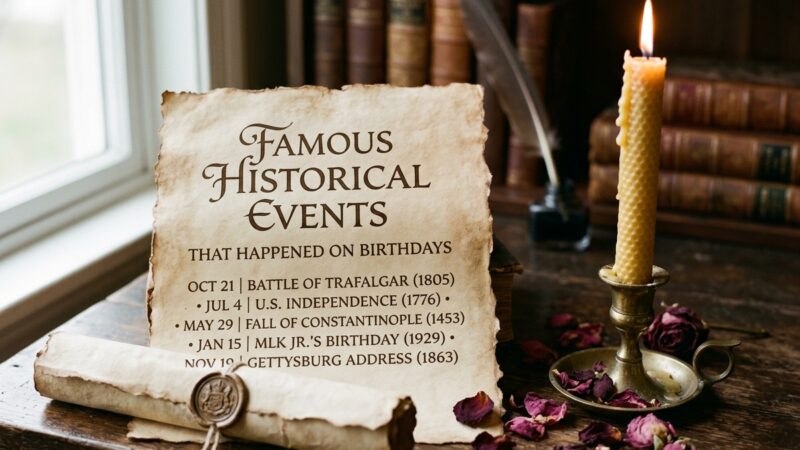
On April 15, 1912, the Titanic sank — the same date Abraham Lincoln was born decades earlier. Strange, right? Your birthday isn’t just about cake, candles, and awkward phone calls from relatives. It’s a date that holds layers of history you probably never thought about.
Every single day on the calendar has witnessed something extraordinary. Wars started, treaties were signed, inventions changed the world, and leaders were born or lost — all on dates that millions of people celebrate as their birthdays. These historical events on birthdays create a fascinating connection between your personal celebration and moments that shaped humanity.
And here’s the thing — people genuinely love discovering what happened on their birthday. It makes that date feel bigger than just “the day I was born.” It becomes a window into history, a conversation starter, and sometimes, a deeply meaningful coincidence.
So let’s walk through some of the most jaw-dropping famous events on birthday dates and explore how history collided with celebration days across the calendar. Along the way, you might just discover something extraordinary about your own birthday.
If you’ve ever wondered why people love their birthdays so much, this connection to history might be one of the deeper reasons.
Why Do People Care About Historical Events on Their Birthday?
Before we get into the actual events, let’s talk about why this topic hooks people so hard.
There’s a psychological phenomenon called the “Birthday-Number Effect.” Studies from the Journal of Experimental Social Psychology show that people naturally feel a stronger connection to numbers, dates, and events that are linked to their personal identity — especially their birthday.
You see your birthday as YOUR date. So when you find out that, say, the Berlin Wall fell on your birthday, it creates an instant emotional bond with that event. It’s no longer just a history textbook entry. It becomes personal.
This explains why “what happened on my birthday” is one of the most searched birthday-related queries on Google. People aren’t just curious — they’re looking for meaning. They want their date to matter beyond the personal.
That desire for significance is deeply connected to the psychology behind birthday happiness — the idea that your birthday carries weight in the world.
Quick Fact: Google Trends data shows searches for “what happened on my birthday in history” spike every year around New Year’s, when people get reflective, and again during summer birthday season.
Month-by-Month: Famous Historical Events on Birthday Dates
Let’s break this down month by month. No matter when your birthday falls, something significant happened on that date. Here are some of the most notable birthday historical coincidences across the year.
January — New Beginnings and Historic Firsts
January birthdays carry some seriously heavy historical weight.
Did You Know? Martin Luther King Jr. was born on January 15, 1929. His birthday became a federal holiday in 1986 — meaning the Challenger disaster happened just days after the first official MLK Day observance.
February — Love, Revolution, and Discovery
February isn’t just about Valentine’s Day. Some of history’s most pivotal moments happened during this short month.
March — Wars, Discoveries, and Turning Points
March historically kicks off major global shifts.
Pro Tip: Want to find out exactly what happened on YOUR specific date? Websites like the Library of Congress’s “Today in History” archive and the New York Times “On This Day” feature let you search by exact date.
April — Tragedies and Triumphs Side by Side
April has an uncanny pattern of holding both devastating losses and extraordinary achievements on the same dates.
May — Milestones That Changed Daily Life
May birthdays connect to events that shaped the modern world you live in.
June — Rights, Conflict, and Culture
These events remind us that birthday traditions around the world don’t exist in a vacuum — they’re layered on top of complex, often painful, history.
July — Independence and Exploration
August — Endings and New Eras
September — Dates That Shook the World
October — Revolutions and Discoveries
November — Elections, Walls, and Speeches
December — Endings, Beginnings, and Celebrations
The Strangest Birthday Historical Coincidences
Some birthday historical coincidences are so eerie, they feel scripted. Here are a few that genuinely make you pause:
Lincoln and Kennedy — The Parallel That Won’t Quit
You’ve probably heard some version of this, but it’s worth revisiting:
- Lincoln was elected to Congress in 1846. Kennedy in 1946.
- Lincoln was elected president in 1860. Kennedy in 1960.
- Both were shot on a Friday, in the head, seated next to their wives.
- Lincoln’s assassin, John Wilkes Booth, was born in 1838. Kennedy’s assassin, Lee Harvey Oswald, was born in 1939.
Not all these “parallels” hold up under scrutiny (some are cherry-picked), but the genuine overlaps are still striking. Some people also tie these to weird birthday superstitions people believe — the idea that certain dates carry hidden patterns.
Shakespeare — Born and Died on the Same Date
William Shakespeare was born on April 23, 1564, and died on April 23, 1616. Same date, 52 years apart. The greatest writer in the English language bookended his life on a single calendar square.
Three Presidents Died on July 4th
We already mentioned Adams and Jefferson dying on the same July 4th. But James Monroe, the fifth president, also died on July 4th — in 1831. Three out of the first five U.S. presidents died on Independence Day. Coincidence? Statistically improbable, at the very least.
Mark Twain and Halley’s Comet
Mark Twain was born on November 30, 1835, two weeks after Halley’s Comet appeared. He famously said, “I came in with Halley’s Comet in 1835. It is coming again next year, and I expect to go out with it.” He died on April 21, 1910 — one day after the comet returned. He called his own death based on a celestial birthday connection.
How to Find Out What Happened on YOUR Birthday
Alright, so you’re probably itching to know — what major historical event shares your birthday? Here’s how to find out:
- Library of Congress — “Today in History” — A free, curated resource from the U.S. government’s official library. Reliable and well-sourced.
- BBC “On This Day” — The BBC’s archive covers global events with a British perspective. Great for non-U.S. events.
- The New York Times “On This Day” — Searchable front pages going back to the 1800s. You can literally see the newspaper from your birthday.
- Wikipedia’s “Selected Anniversaries” pages — Each date has its own page listing births, deaths, and events.
- History.com’s “This Day in History” — User-friendly, with short summaries and related videos.
Pro Tip: Don’t just look up ONE year. Search your birthday date across multiple centuries. You’ll find layers of events — some joyful, some tragic, some world-changing — all stacked on the same 24-hour window.
This kind of deep dive into your birthday also connects to why people reflect on life during birthdays. Discovering historical events on your date adds another layer of reflection.
Common Myths About Birthday-History Connections
Let’s clear up a few misconceptions people often have about famous events on birthday dates.
Myth 1: “My Birthday Date Is Boring — Nothing Happened”
False. Every single date on the calendar has documented historical events. You might not find a “headline” event on every date, but dig deeper — scientific discoveries, cultural firsts, political shifts — something significant happened. Always.
Myth 2: “Sharing a Birthday With a Famous Person Means Something Mystical”
Many people believe sharing a birthday with a celebrity or historical figure creates a spiritual or astrological connection. While zodiac signs became popular for a reason — humans love patterns — there’s no scientific evidence that sharing a birth date gives you shared traits with a historical figure.
That said, it’s still fun. And “fun” doesn’t need scientific proof.
Myth 3: “More Bad Things Happen on Certain Dates”
Some people think dates like September 11 or April 15 are “cursed.” In reality, traumatic events are spread across all 365 days. We just remember certain dates more because of recency bias and media coverage. Your birthday isn’t cursed because something bad once happened on it.
Myth 4: “Historical Events on My Birthday Predict My Personality”
This is a blend of astrology and confirmation bias. People read about an event on their birthday and think, “That explains why I’m so determined!” It doesn’t — but it does make for a great party conversation.
Why This Matters More Than You’d Think
Here’s something most articles on this topic skip: why does connecting birthdays to history actually benefit you?
1. It makes you curious about history.
Most people zone out during history class. But tell someone that the Wright Brothers flew on their birthday? Suddenly they want to know everything about early aviation. Personal connection is the strongest learning motivator.
2. It’s a powerful conversation starter.
Imagine telling someone at a party, “Oh, my birthday is June 6 — same date as D-Day.” That’s an instant connection point. It’s also a reason why people share birthday posts on social media — they want engagement, and historical trivia delivers it.
3. It creates perspective.
Feeling down about getting older? Remembering that your birthday shares a date with a moment that changed millions of lives can shift your mindset. It puts your personal timeline in the context of the human timeline.
4. It bonds families.
Parents who teach their kids about historical events on their birthday create a tradition of curiosity. This fits perfectly alongside other best birthday traditions for families that go beyond cake and presents.
FAQ Section
What is the most historically significant birthday date?
It’s hard to pick just one, but July 4 is a strong contender. Beyond the U.S. Declaration of Independence in 1776, three of the first five American presidents died on this date. September 11 also carries enormous modern significance. And June 28 — the assassination of Archduke Franz Ferdinand in 1914 — triggered a chain of events that shaped the entire 20th century.
How can I find what historical event happened on my birthday?
You can use free resources like the Library of Congress “Today in History,” BBC “On This Day,” the New York Times historical archive, or Wikipedia’s date-specific pages. Just search your birth month and day, and you’ll find events spanning centuries.
Do historical events on my birthday affect my personality?
There’s no scientific evidence that events occurring on your birthday influence your personality or destiny. This belief often overlaps with astrology and numerology. While these systems have cultural significance, they don’t have empirical support. It’s fun to explore, but don’t use it to make life decisions.
Are there any birthdays with no historical events?
No. Every day of the year has documented historical events. Some dates have more “headline” events than others, but even quieter dates hold scientific discoveries, cultural milestones, political changes, or notable births and deaths. You just need to dig a little deeper.
Why do some dates seem to have more tragic events?
This is largely due to perception bias. Dates like December 7 (Pearl Harbor) or September 11 carry heavy media coverage and cultural memory, making them feel “heavier.” Statistically, tragic events are distributed across all dates. Your memory just flags certain ones more than others.
Your Birthday Is Bigger Than You
Every year, you blow out candles on a date that someone else used to sign a peace treaty, launch a rocket, or start a revolution. That’s not a small thing.
Your birthday sits in a long line of human history — a thread connecting your personal story to the collective one. You don’t need to feel the weight of every event that shares your date. But knowing about them? That adds a richness to your celebration that no gift card can match.
So next time someone asks, “When’s your birthday?” — don’t just give them the date. Tell them what happened on that date. You might surprise yourself with how much your little corner of the calendar has witnessed.
And if you want to go even deeper into what makes birthdays such a powerful human experience, explore why birthdays matter in psychology. Your date is more than a number — it’s a story.
Related Articles

Twins’ Birthday Wishes: Double the Fun & Greetings
Celebrating two people at once is a special kind of joy. Whether you’re writing in a...

Thank You Messages: 100+ Replies for Birthday Wishes
Someone took a moment out of their day to think of you, type out a message,...

Best Friend Birthday Wishes: Top Heartfelt Messages
A good friend’s birthday deserves more than a rushed text or a recycled message you’ve sent...